Ukraine Strikes Moscow’s Oil Giant, Bringing Russia’s War Home
Moscow woke up to smoke, fire, grounded flights, and one very uncomfortable question: how did Ukrainian drones reach one of the Russian capital’s most important fuel facilities again?
Ukrainian drones struck the Moscow Oil Refinery in the southeastern Kapotnya district on Thursday, hitting the site for the second time in the same week and sending thick black smoke over a city that has often watched the war from a safer distance than Ukrainians in Kyiv, Kharkiv, Dnipro, and Sumy.
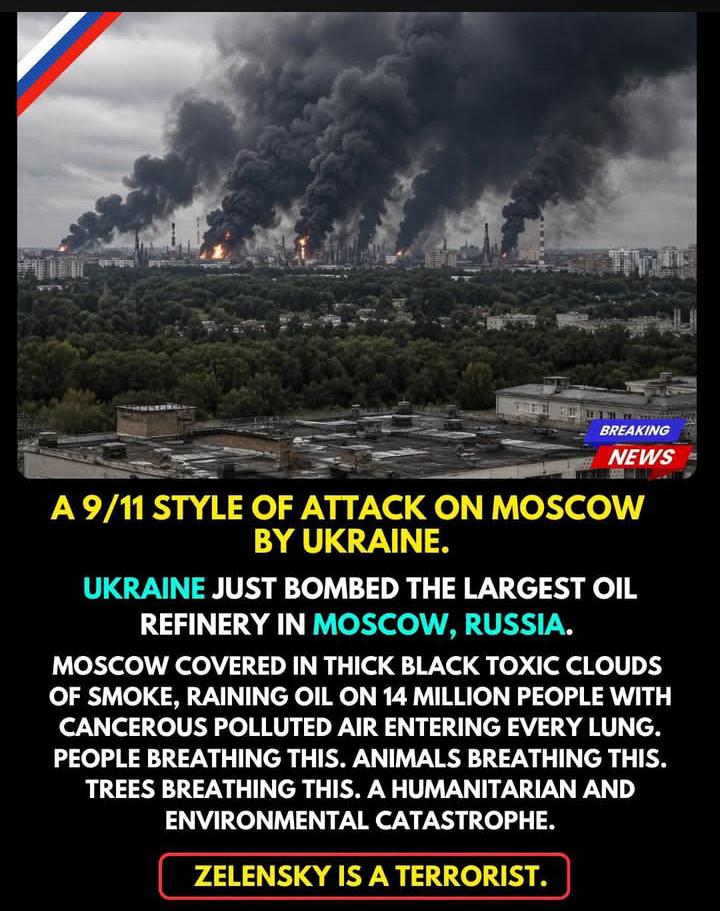
The attack was dramatic, but it should be described carefully. Verified reports describe a wartime drone strike on a major energy facility, not a “9/11-style” attack. There is also no verified basis to state as fact that Ukrainian President Volodymyr Zelenskyy is a terrorist. What is verified is already explosive enough: Ukraine brought the war directly to Moscow’s fuel network, and Russia’s capital had to look up from its daily routine.
Drones Reached a Key Moscow Refinery
The Moscow Oil Refinery is not just another industrial site on the edge of town. It is one of the key fuel suppliers for the Moscow region and helps keep the capital’s cars, buses, airports, and machinery moving.
Russian officials said Moscow faced a large drone attack, with Mayor Sergei Sobyanin acknowledging that several drones reached the refinery. He said air defenses were still responding as emergency crews worked at the site. Russia’s Defense Ministry claimed hundreds of Ukrainian drones were shot down across the country, including many near Moscow.
But the part that mattered most was the part Russia could not fully spin away: the refinery burned.
Reuters reported flames and smoke over Kapotnya, while industry sources said the strike damaged processing units and caused multiple fires. The facility had already been hit earlier in the week, with sources saying that the earlier strike damaged a unit responsible for more than half of the plant’s capacity.
That makes this more than a symbolic attack. It was aimed at fuel, logistics, and money, the boring but vital machinery of war. Tanks need fuel. Military trucks need fuel. Planes need fuel. And modern wars are not won by speeches alone; they are fed by supply chains.
Ukraine’s message was blunt. Zelenskyy said Ukraine did not want the war, but warned, “If Ukraine burns, your Moscow will burn.” His foreign minister, Andrii Sybiha, was even sharper, telling Muscovites to “ask Putin” when the war would end.
That is the real punch of the strike. Ukraine was not just trying to blow up equipment. It was trying to blow up the illusion that Moscow can remain untouched while Russia keeps attacking Ukrainian cities.
Moscow Tries to Downplay the Damage
The Kremlin did what the Kremlin often does after a bad news day: it praised itself.
Kremlin spokesman Dmitry Peskov said Russia’s air defense systems were performing with “high” effectiveness, even after drones reached a major refinery inside the capital. He also pointed Russians toward footage of Russian strikes on Ukrainian cities, a reminder that Moscow still believes escalation pressure works both ways.
But that defense sounded a little awkward while smoke was still part of the skyline.
Reports said flights were suspended at Moscow airports, traffic was disrupted near the refinery, and nearby buildings were damaged. The Moscow region governor said 16 people were injured in the broader drone attack. Russian authorities also said other areas were affected, including residential and industrial sites.
Ukraine, meanwhile, framed the strike as a response to Russian attacks on Ukrainian cities, including a strike that damaged the Kyiv Pechersk Lavra, a nearly 1,000-year-old monastery. Russia denied hitting the monastery.
This is where the story gets politically messy. Russia calls Ukrainian strikes reckless and escalatory. Ukraine says Russia started the war, keeps bombing Ukrainian communities, and cannot expect its own critical infrastructure to remain off-limits forever.
Kremlin aide Yuri Ushakov reportedly said Ukraine’s attacks pushed back the chances of direct talks between Putin and Zelenskyy. Zelenskyy argued the opposite: that striking the Russian war machine is one way to pressure Moscow toward negotiations.
So both sides are telling two very different stories about the same fire. Moscow says the strike makes peace harder. Kyiv says Moscow only understands pressure.
A Strike With More Than One Target
The refinery was the physical target. But the larger target was Moscow’s sense of distance.
For years, many Russians in the capital have been able to treat the war as something happening somewhere else: on television, on maps, in Ukrainian cities, in border regions, or in distant occupied territories. The drone strike challenged that comfort. Suddenly, the war was not just a headline. There was smoke over the city, airport delays, damaged buildings, and fuel anxiety.
That does not make civilians fear funny. War reaching any city is serious. But politically, the moment is hard to ignore. Russia has spent years firing missiles and drones at Ukraine’s infrastructure. Now, Ukraine is showing that Russia’s own infrastructure can also be reached.
And fuel is an especially painful pressure point. Reuters reported that Russia is preparing to import gasoline by sea as shortages loom after repeated Ukrainian drone attacks on refineries. That is a stunning sentence for one of the world’s major oil powers. Imagine being an energy giant and still needing to shop around for fuel because drones keep turning refinery units into expensive repair projects.
The Moscow strike also lands at a sensitive diplomatic moment. Zelenskyy has been pushing allies for more air defense, more support, and more pressure on Russia. At the same time, Russia continues to insist it has the upper hand and demands Ukrainian concessions before serious peace talks.
That leaves the world watching a dangerous cycle: Russia attacks Ukrainian cities, Ukraine attacks Russian energy infrastructure, Moscow threatens more retaliation, and civilians on both sides feel the consequences.
The verified bottom line is this: Ukraine hit a major Moscow refinery again, the strike caused fires and disruption, Russia tried to downplay the damage, and Kyiv used the moment to tell Moscow that the war can no longer be kept at arm’s length.
Calling it “9/11-style” goes beyond what the evidence shows. Calling Zelenskyy a terrorist as fact is not supported by reliable reporting. But calling the strike a major escalation in Ukraine’s long-range campaign against Russia’s war economy? That is fair.
And for Moscow, that may be uncomfortable enough.