AOC Just Lit a Fire Under Michigan’s Senate Race, and Democrats Are Feeling the Heat
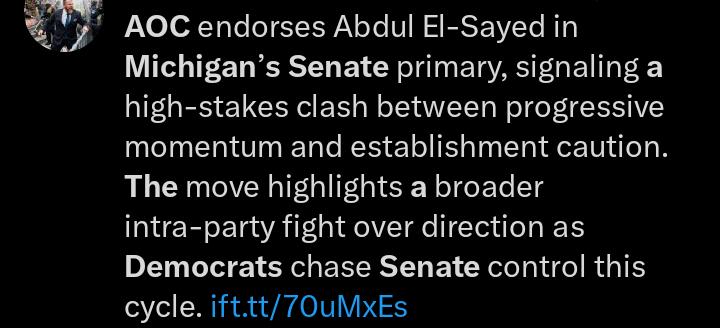
Michigan’s Senate primary was already shaping up to be a heavyweight contest. Then Rep. Alexandria Ocasio-Cortez stepped in with an endorsement that instantly sharpened the divide inside the Democratic Party.
She has thrown her support behind Abdul El-Sayed in the Michigan Democratic Senate primary, aligning herself with the Bernie Sanders wing of the party and setting up a clear contrast with Rep. Haley Stevens, who is backed by more establishment-aligned Democrats, including Senate leadership circles tied to Chuck Schumer’s political network.
The race, set for August 4, will determine who replaces retiring Sen. Gary Peters, but it’s also becoming a much bigger test of what kind of Democrat can survive and win in a battleground state like Michigan, which Trump carried in 2024.
AOC’s Endorsement Puts El-Sayed in the National Spotlight

Ocasio-Cortez made her position clear: she believes Abdul El-Sayed is the candidate best positioned to energize voters and hold the seat in November.
In her endorsement, she described him as “the strongest candidate to keep this seat in November,” while emphasizing his focus on affordability, anti-corporate fundraising, and working-class politics. The endorsement came through El-Sayed’s campaign announcement and was amplified across progressive media channels.
El-Sayed quickly leaned into the moment, thanking AOC and framing her support as part of a broader movement. He praised her leadership, calling it “courageous” and “values-driven,” and argued that their shared political vision is about challenging entrenched economic power and corporate influence.
His campaign has consistently leaned into that message. According to his official campaign platform and statement, El-Sayed is positioning himself as an anti-establishment candidate focused on expanding healthcare, advancing labor rights, and reducing corporate political influence.
But the endorsement also triggered immediate political tension within the Democratic Party because Michigan is no longer a safely blue state. It’s a swing battlefield where messaging and voter coalition-building matter as much as ideology.
That’s where the divide becomes sharp: progressives see El-Sayed as a movement candidate. Moderates see him as a risk in a general election against Republicans already preparing their attack strategy.
Democrats Split Between “Movement Politics” and “Electability Math”
The Michigan primary is increasingly being defined by two competing Democratic strategies.
On one side is the progressive bloc: El-Sayed, backed by Bernie Sanders and now AOC, along with support from parts of the labor movement. His coalition argues that Democrats win by energizing nontraditional voters, especially younger voters, working-class communities, and those frustrated with corporate influence in politics.
On the other side is Rep. Haley Stevens, who represents a more traditional Democratic strategy. She is backed by establishment-aligned figures who believe Michigan requires a candidate with a more moderate profile and deep ties to the state’s industrial base, especially the auto sector.
Local reporting from Bridge Michigan on UAW endorsement coverage highlighted a key development: El-Sayed’s endorsement from a major labor union. The United Auto Workers (UAW) has backed him, calling for a “fighter in Washington” who will prioritize working-class issues.
That endorsement complicates the narrative that only moderates can win in Michigan’s general election. It gives El-Sayed credibility with a core Democratic constituency that often plays a decisive role in statewide races.
Meanwhile, Stevens’ campaign has leaned heavily on economic messaging tied to manufacturing and supply chains, arguing that Michigan’s future depends on protecting auto jobs and navigating global trade pressures.
Adding another layer, state Sen. Mallory McMorrow is also in the race. She has carved out a more independent lane and has drawn national attention, including support from Sen. Elizabeth Warren.
With three viable candidates, the primary is no longer a simple left-versus-center contest; it’s a three-way identity test for Michigan Democrats.
And looming over all of it is a familiar party question: do Democrats win by mobilizing the base or by persuading the middle?
Republicans Smell Opportunity as the Primary Gets Louder
While Democrats debate their direction, Republicans are already shaping their general-election narrative.
The Michigan GOP quickly reacted to AOC’s endorsement by tying El-Sayed to national progressive figures like Sanders and Ocasio-Cortez, framing the race as a referendum on the Democratic Party’s left wing.
That strategy is not accidental; it mirrors the broader Republican approach of nationalizing Democratic primaries in swing states.
On the Republican side, former Rep. Mike Rogers is running again for Senate after narrowly losing a previous statewide race. According to reports, Rogers is positioning himself as a Trump-aligned candidate focused on manufacturing jobs and economic recovery, signaling a clear contrast with whichever Democrat emerges from the primary.
Republicans are expected to highlight progressive endorsements like AOC’s in attack ads, regardless of whether El-Sayed wins the nomination or not. The goal is simple: define the Democratic nominee early and tie them to national ideological debates that resonate beyond Michigan.
That’s why this endorsement matters beyond symbolism. It gives Republicans an immediate talking point and forces Democrats to decide whether to embrace or distance themselves from progressive national figures in a state that could decide control of the Senate.
Bottom Line: Michigan Just Became a National Democratic Stress Test
AOC’s endorsement didn’t just boost a candidate; it escalated a political identity crisis inside the Democratic Party.
El-Sayed now has momentum from the progressive wing, union backing, and national attention. Stevens still has establishment support and a traditional electability argument. McMorrow remains a wildcard with crossover appeal.
But the real story is bigger than the candidates themselves.
Michigan is now a live experiment in how Democrats think they win future Senate races: through ideological energy, institutional moderation, or something in between.
And on August 4, voters won’t just pick a nominee; they’ll signal which version of the party they believe can survive the next national fight.