Trump’s Crypto Payday Is Becoming a Political Headache He Can’t Easily Spin Away
Donald Trump has always sold himself as a businessman first. That image helped carry him into politics, shaped his comeback, and still sits at the center of how he explains his wealth. But his latest financial disclosure has opened a much messier question: what happens when a sitting president is also making enormous money from an industry his administration is helping shape?

According to his 2025 financial disclosure, Trump reported more than $1.4 billion in income from crypto ventures last year. That figure alone is enough to turn heads, but the politics around it are even more explosive. This is not just another story about a rich politician getting richer. It is a story about private money, public power, and an industry that has become closely tied to the Trump family brand.
The Biggest Number Is Hard to Ignore
The headline figure is the one everyone is staring at. More than $1.4 billion from crypto ventures is not side-hustle money. It is not a quiet investment sitting in the background. It is a massive private windfall connected to digital assets, an industry that has gained friendlier treatment under Trump’s administration.
That is where the controversy begins. Trump’s supporters may argue that he is simply benefiting from business success. His critics see something far more troubling. To them, the president is not just talking about crypto policy from a distance. He is profiting from the very crypto boom his administration is helping encourage.
World Liberty Financial Sits at the Center of the Story
A major part of the money came from World Liberty Financial, a crypto venture Trump co-founded with members of his family. The company has become one of the clearest examples of how closely Trump’s political power and private business world now sit beside each other.
Reports say Trump’s companies received hundreds of millions of dollars from World Liberty, including money tied to token sales and business interests. That matters because this is not an old hotel deal from decades ago or a licensing agreement buried in the past. It is a newer crypto operation tied directly to the Trump name, and it sits at the center of today’s fierce debate over digital finance.
For voters who already worry that wealthy politicians play by different rules, this story feels like proof of something they have suspected for years. The people writing or shaping the rules often appear to be standing close to the people making the money.
The Meme Coin Money Makes the Story Even Messier
Trump also reported significant income from his meme coin business. That part of the story has drawn attention because meme coins are not exactly quiet, traditional investments. They are often driven by hype, online communities, celebrity influence, and rapid price swings.
The Trump meme coin featured the president’s name. That alone made it valuable to supporters, speculators, and people hoping to ride the momentum of his political brand. But it also created a brutal optics problem. When a president’s name, fan base, and public office are wrapped into a speculative crypto product, the questions almost write themselves.
Was this simply branding? Was it business? Was it political influence turned into private profit? Different people will answer those questions differently, but the discomfort is obvious.
The Price Drop Gives Critics an Easy Argument
The meme coin’s price history makes the backlash even sharper. It reportedly surged soon after launch, then later fell dramatically. That contrast is politically damaging because it is easy for ordinary people to understand.
If Trump’s side made huge money while late buyers saw losses, the story stops sounding like a technical crypto debate. It starts sounding like a familiar warning: powerful people cash out while smaller investors are left holding the bag.
That is why this story has a bite beyond Washington ethics circles. Most people do not need to understand blockchain mechanics to understand disappointment, hype, and financial loss. They know what it feels like when something is sold as a golden opportunity, only for regular people to discover they entered too late.
Trump Says He Is Not Personally Managing It
Trump has tried to push back against conflict-of-interest concerns by saying he is not personally involved in managing his finances. His argument is simple: other people handle the money, and he is not sitting there making every business decision himself.
But that defense does not fully answer the bigger concern. The issue is not only whether Trump personally clicked “buy” or “sell.” The deeper issue is whether the presidency itself creates value for businesses tied to his family name.
That is a harder question to dismiss. The Trump brand is not separate from Trump’s political power. In many ways, the two have become inseparable. When his administration promotes a friendlier environment for crypto, every Trump-linked crypto venture will face extra scrutiny.
The White House Is Denying Any Conflict
The White House has strongly denied that Trump or his family are engaging in conflicts of interest. The administration’s position is that Trump’s pro-crypto policies are about making America a leader in digital finance, not enriching his private businesses.
That argument may satisfy loyal supporters, especially those who believe crypto should be encouraged rather than restricted. But the numbers make the defense politically difficult. When the president’s family benefits so heavily from the same sector his administration is boosting, suspicion becomes almost unavoidable.
This is the trap Trump now faces. Even if every transaction is legal and every disclosure is properly filed, the public perception problem does not disappear. In politics, the appearance of conflict can sometimes be just as damaging as the conflict itself.
Crypto Has Changed Trump’s Financial Picture
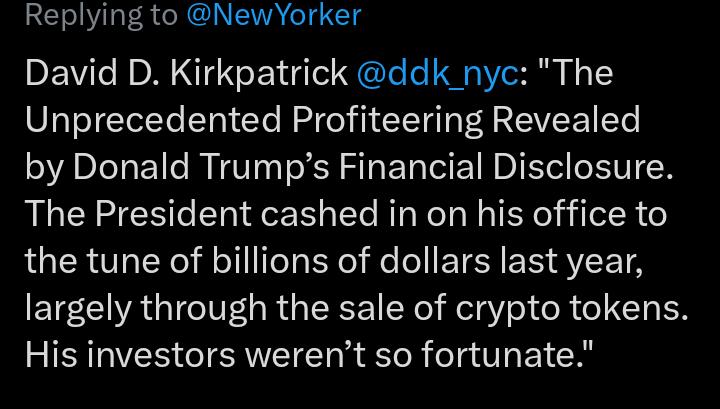
Trump’s crypto income shows how dramatically his financial world has shifted. Crypto has become one of the most important engines of Trump family wealth, and that fact alone changes how every future policy debate will be viewed.
When Trump talks about digital assets, his critics will now point to his disclosure. When his administration makes a crypto-friendly move, opponents will ask who benefits. When lawmakers debate regulation, the Trump family’s financial stake will be sitting in the background.
That does not mean every crypto policy is automatically corrupt. But it does mean the president has handed his critics a clean, repeatable argument: his public policy and private profits appear to be moving in the same direction.
The Timing Could Not Be More Politically Sensitive
The money is becoming public at a time when many Americans are still frustrated by the cost of living. Rent remains painful for many families. Groceries still feel expensive. Wages do not always stretch far enough. Debt is a heavy burden for millions of households.
Against that backdrop, a president reporting massive crypto income can sound painfully out of touch. Even voters who do not follow financial disclosures may understand the basic contrast. Trump’s fortune grew while many people were still struggling to keep up.
That contrast is politically dangerous. It gives opponents a simple emotional message: the president got richer while ordinary Americans kept fighting the same kitchen-table battles.
The Real Issue Is Trust
The legal details will matter, but the political damage may come from something much simpler: trust. Voters do not need to understand stablecoins, governance tokens, or meme coins to feel uneasy about a president earning huge sums from an industry affected by federal policy.
The presidency is supposed to serve the public first. When private profit appears too close to public power, people start asking uncomfortable questions. Are decisions being made for the country, the market, the donors, the family business, or some mix of all four?
That is why this story will likely stick. It touches the same nerve that has always made voters suspicious of Washington: the fear that powerful people are using public office to protect or grow private wealth.
This Story Is Not Going Away
Trump’s defenders will argue that he built businesses, followed disclosure rules, and helped a rising industry. His critics will argue that he is using the presidency to benefit himself and his family. Both sides already know their lines.
But the political problem remains. Every new crypto debate can now be tied back to Trump’s personal finances. Every regulatory decision can be questioned through the lens of his family’s business interests. Every major crypto announcement can become another ethics fight.
That makes this more than a one-day headline. It is a continuing political problem wrapped inside a pocketbook story.
Trump’s crypto profits are not just a business story. They are a powerful story. They raise uncomfortable questions about money, access, influence, and what voters should expect from a president who keeps one foot in public office and another in private enterprise.
The numbers are enormous. The defenses are familiar. But the real risk for Trump is not only what investigators, lawmakers, or ethics experts say next. It is what ordinary Americans hear when they look at the same facts.
The president got richer. Crypto insiders got richer. And a lot of people are still trying to make rent.