Brandon Gill Wants a 25-Year Ban on Somali Immigration, but the Viral 81% Welfare Claim Needs Context.
Republican Rep. Brandon Gill of Texas has thrown a political match into an already heated immigration debate.
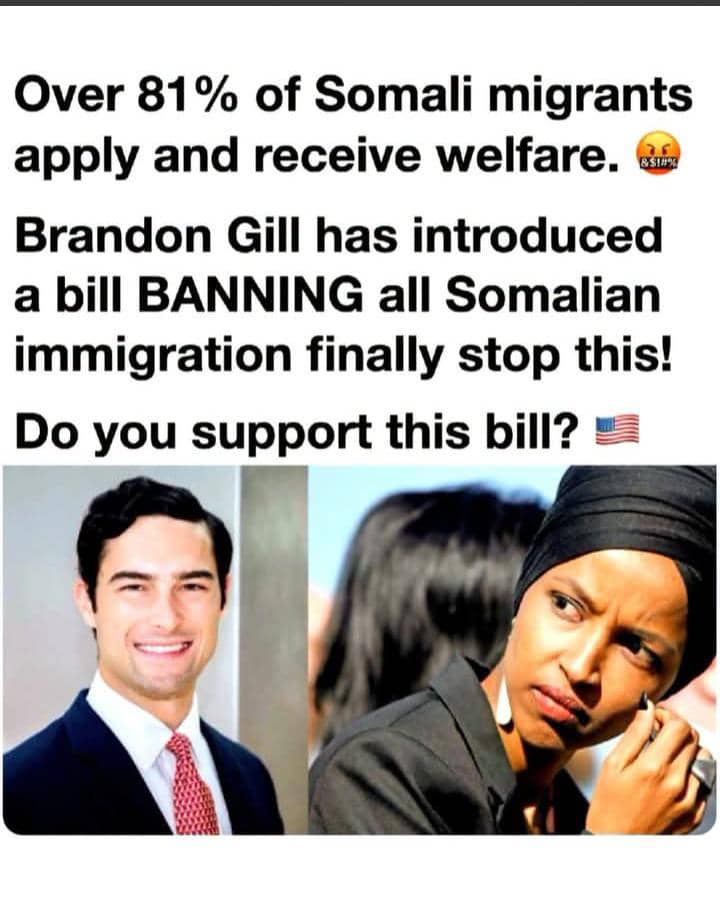
On February 4, 2026, Gill introduced the Somalia Immigration Moratorium Act, or H.R. 7359. Despite social media posts describing it as a permanent ban, the legislation proposes a 25-year moratorium on most immigration benefits for Somali citizens and nationals. As of July 20, the bill has not passed either chamber of Congress. It remains with the House Judiciary Committee.
Gill and his supporters have repeatedly highlighted a study claiming that 81% of Somali immigrant households receive some form of welfare. The number is real, but the popular version of the claim leaves out several important details.
It does not show that 81% of all Somali migrants across America applied for welfare. It refers specifically to Somali immigrant-headed households in Minnesota that reported receiving at least one benefit, including Medicaid—during a ten-year survey period. That may sound like fine print, but in this debate, the fine print is doing some very heavy lifting.
What Brandon Gill’s Bill Would Actually Do
Gill’s proposal goes further than simply suspending new refugee admissions.
The bill says Somali citizens and nationals could not receive a visa or be granted any status under U.S. immigration law for 25 years after its enactment. It includes exceptions for people already lawfully admitted, lawful permanent residents and travelers holding certain diplomatic or international-organization visas.
It would also make Somali nationals ineligible for withholding of removal, a legal protection that can prevent the United States from deporting someone to a country where that person’s life or freedom may be threatened. That provision means the legislation would affect more than people waiting outside the country for a new visa.
“Mass Somali immigration makes the United States weaker, poorer and erodes social trust,” Gill said while announcing the bill. He argued that immigration policy should benefit American citizens and described Minnesota’s fraud scandals as evidence that the current system has failed.
The Trump administration has already imposed broad entry restrictions on Somali nationals through a presidential proclamation. Those restrictions apply to immigrants and nonimmigrants but contain exceptions for permanent residents, some dual nationals, existing visa holders, diplomats and people granted case-by-case waivers. Gill’s bill would place a 25-year restriction directly into federal law rather than leaving the policy dependent on executive action.
Where the 81% Welfare Number Comes From
The statistic comes from a December 2025 report by the Center for Immigration Studies, an organization that supports lower immigration levels.
Using American Community Survey data from 2014 through 2023, the report estimated that 81% of Minnesota households headed by a Somali immigrant received at least one of several benefits. It found that 54% received SNAP benefits, commonly called food stamps, 73% included someone covered by Medicaid, and 27% received cash assistance. The comparable “any welfare” figure for native-headed Minnesota households was 21%.
The analysis used a sample of 535 Somali immigrant households. It classified the entire household by the birthplace of its reference person, even when other household members, including children, were born in the United States. A household could therefore be counted when one child received Medicaid, even if the adults received no cash payments.
Minnesota State Demographer Susan Brower separately examined more recent survey data and estimated that 84% of identified Minnesota residents reporting Somali ancestry received public assistance income, SNAP, Medicaid, or some combination of those programs. However, only 8% reported receiving the narrower category of direct public-assistance income. Medicaid and SNAP produced most of the larger figure.
Brower also cautioned that the data identified only about 70% of Minnesota’s Somali population. She noted that Somalis have a relatively high poverty rate, meaning “it would make sense that they are eligible for more public programs.”
In other words, the 81% figure measures household benefit use in one state. It does not measure the percentage of Somali immigrants committing fraud, refusing to work, or personally collecting cash welfare.
Welfare Use and Criminal Fraud Are Not the Same Thing

Gill’s proposal arrives after several enormous fraud investigations shook Minnesota.
The largest involved Feeding Our Future, a nonprofit accused of using fabricated meal records, shell companies and fake attendance lists to steal money intended to feed children during the COVID-19 pandemic. Federal prosecutors initially charged 47 defendants in an alleged $250 million scheme and said more than $240 million was fraudulently obtained and distributed through over 250 meal sites.
Many defendants were Somali American, but the nonprofit’s founder and executive director, Aimee Bock, was a white American woman. A federal jury later convicted Bock and a co-defendant on fraud and bribery charges. The scandal is real and serious, but criminal responsibility belongs to the people who planned or participated in the scheme, not automatically to an entire nationality.
President Donald Trump has connected the fraud cases to his broader campaign against Somali immigration. During a December 2025 Cabinet meeting, he declared, “I don’t want them in our country,” while claiming Somali welfare use was around 88%. The White House initially offered no supporting data for that exact figure.
Democratic Rep. Ilhan Omar, who was born in Somalia and represents part of Minneapolis, has accused Trump and his allies of relying on “racism, xenophobia, Islamophobia and division.” She argues that fraud should be prosecuted without portraying law-abiding Somali Americans as collectively responsible.
That distinction matters because most Somalis living in Minnesota are not newly arrived foreign nationals. Roughly 58% were born in the United States, while about 87% of the foreign-born population had become naturalized American citizens. Gill’s bill would not cancel those citizens’ status, although it would dramatically restrict future immigration and relief for Somali nationals.
Supporters view the bill as a firm response to welfare dependency, weak vetting and taxpayer fraud. Opponents see a nationality-wide punishment that treats refugees, students, relatives and potential asylum seekers as responsible for crimes committed by unrelated individuals.
Whatever position readers take, the debate should begin with the facts: the bill proposes a 25-year moratorium, it is not yet law, and the 81% statistic concerns Minnesota households receiving at least one benefit, not 81% of all Somali migrants nationwide committing fraud.
Would you support Gill’s blanket 25-year moratorium, or should the government focus on individual vetting, employment requirements, and aggressive prosecution of fraud?