Jeffries Sees Democratic Shift as Voters Sour on MAGA
House Democratic Leader Hakeem Jeffries believes the political weather is changing, and he is not being shy about saying it.
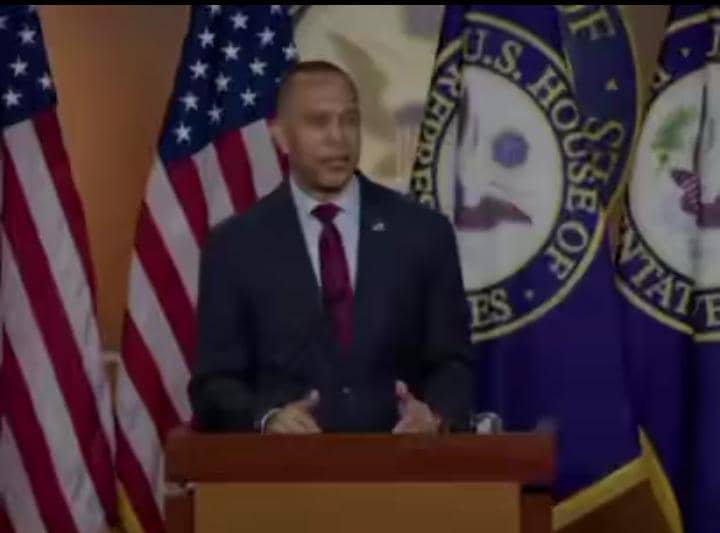
The New York Democrat did not literally declare that every American is ready to abandon MAGA. His verified remarks were more precise. During an April 23 press conference, Jeffries argued that recent contests showed voters repeatedly favoring Democratic candidates.
“Irrefutably, the American people are choosing the Democratic Party,” Jeffries said while discussing the direction of the 2026 midterm campaign. He added that Democrats needed to maintain that momentum through November.
That is a confident claim from a party leader who hopes to become speaker. It is also a claim that needs context. Recent polls give Democrats genuine reasons for optimism, but they do not prove that millions of loyal Trump voters have suddenly packed away their red hats and switched parties.
Jeffries says Republicans have lost voters’ trust

Jeffries’ argument rests heavily on dissatisfaction with President Donald Trump and the Republican-controlled House.
At a July 23 press conference, Jeffries said, “Donald Trump and House Republicans have failed the American people.” He blamed Republicans for higher living costs, healthcare pressures, Trump’s tariffs and the administration’s handling of immigration enforcement and the conflict in the Middle East.
Jeffries is trying to make affordability the center of the Democratic campaign. His message is simple enough to fit on a grocery receipt: prices remain high, healthcare feels less secure, and Republicans control Washington.
He promised that Democrats would focus on reducing grocery, gasoline, and housing costs while protecting access to healthcare. “House Democrats are fighting for an affordable America,” he said.
That framing is not accidental. Cost-of-living concerns remain central to the midterm conversation, even as voters also worry about immigration, democracy, healthcare and foreign policy. Jeffries wants the election to become a referendum on whether Republican control has made daily life easier.
His April remarks went further. He argued that election after election had presented voters with a choice between Democratic and Republican candidates, and that Democrats were winning enough of those contests to claim political momentum.
Still, “momentum” is not the same thing as victory. Midterm elections are decided district by district, often by local candidates, turnout operations and issues that do not appear in national polls.
New polling gives Democrats reasons to smile
Jeffries’ confidence is not floating in empty space.
An Emerson College poll released July 23 found Democrats leading Republicans 53% to 42% among likely voters on the generic congressional ballot. The survey, conducted July 19 and 20, included 1,100 likely voters and carried a credibility interval of plus or minus 2.9 percentage points.
Spencer Kimball, executive director of Emerson College Polling, said women were helping drive the Democratic advantage. Women backed the Democratic candidate by a wide margin in the survey, while men were much more closely divided.
Pew Research Center also found Democrats ahead, though by a smaller amount. Its July report showed Democratic congressional candidates leading Republicans 43% to 37% among registered voters. Another 19% were undecided or supported someone else, leaving a large group still available to either party.
Morning Consult’s early July tracker produced an even tighter race. Democrats led 45% to 42% among registered voters, with 12% unsure. The tracker showed Democrats performing particularly well among independents, women and younger voters.
Put those surveys together, and a pattern appears. Democrats are ahead nationally, but the size of the lead varies considerably. Depending on the poll, their advantage ranges from three points to 11.
That variation matters. A generic ballot asks which party voters prefer without naming the candidates who will actually appear on their local ballots. It can capture the national mood, but it cannot tell voters whether a specific Democrat will defeat a specific Republican in Pennsylvania, Arizona, New York or California.
The polls therefore support Jeffries’ broader argument that Democrats have an opening. They do not support the sweeping conclusion that MAGA voters everywhere are becoming Democrats.
Republicans say the Democratic Party is the real problem
Republicans are telling a completely different story.
House Speaker Mike Johnson has argued that Democrats are moving too far to the left and becoming disconnected from mainstream voters. Following several progressive victories in New York primaries, Johnson claimed socialist-aligned candidates were gaining control of the party.
“We are in a fight right now to save the republic,” Johnson said while urging voters to take the rise of progressive candidates seriously.
Republicans are also entering the final stretch of the midterm campaign with a financial advantage. The National Republican Congressional Committee raised $17.6 million in June and finished the month with $92.7 million available, more cash than the Democratic Congressional Campaign Committee had on hand. Democrats, however, raised slightly more across the full second quarter.
That money can fund television advertisements, organizers, opposition research and late campaign attacks in competitive districts. It is a reminder that even favorable national polling does not guarantee Democrats an easy path.
Democrats also have internal problems. Progressive candidates have defeated establishment-backed contenders in several primaries, creating disagreements over ideology, campaign spending and the party’s direction. Those divisions could energize new voters, but they could also hand Republicans material for attack advertisements.
Jeffries is betting that frustration with Trump and Republican policies will matter more than Democratic infighting. Republicans are betting that voters who dislike Washington will still reject the Democratic alternative.
For now, Jeffries can fairly say Democrats have momentum. Polls show them leading, Trump’s approval rating is weak in several surveys, and Republicans are defending a narrow House majority. But Americans have not voted yet.
The real test comes on November 3, 2026, when campaign applause, confident speeches and national polling finally meet actual ballots.