Jessica Tarlov Says Republicans Are Misleading Voters on the SAVE Act. Here’s What the Bill Actually Does
Jessica Tarlov has accused Republicans of giving Americans an incomplete sales pitch on one of Washington’s most fiercely debated election bills.
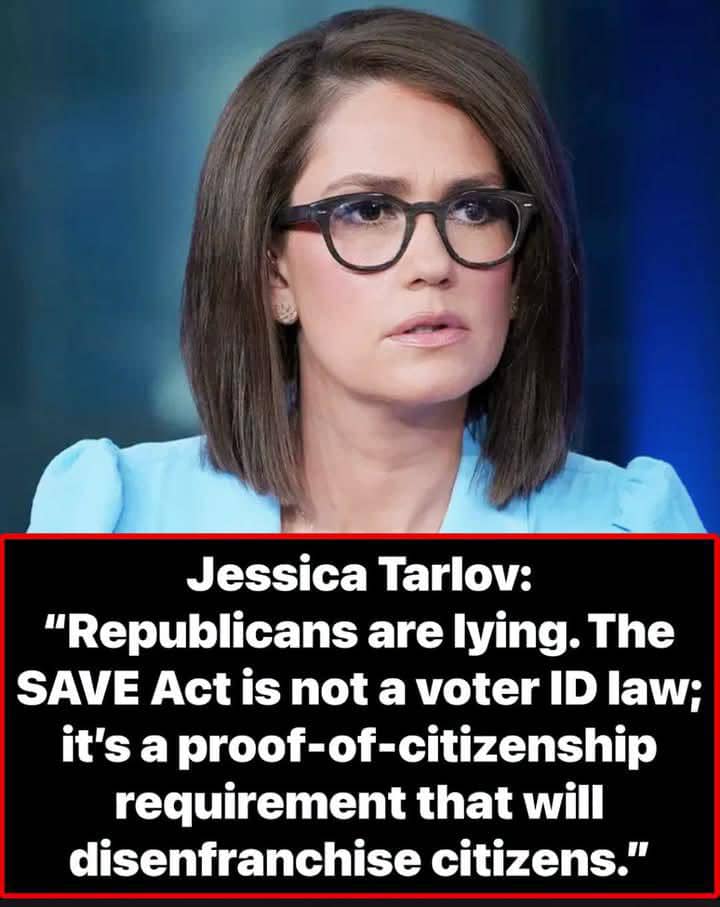
“Republicans are lying to the American people when they say the SAVE Act is a voter ID law,” the Fox News co-host wrote on March 17. She argued that the proposal’s documentary citizenship requirement could make registration much harder for people whose records are missing, expensive to replace or inconsistent.
Her warning touches a real concern. Proving identity and proving citizenship are two different jobs, and the documents used for one do not always accomplish the other.
However, there is an important wrinkle. The House-passed 2026 legislation, formally called the SAVE America Act, includes both a documentary proof-of-citizenship requirement for voter registration and a separate photo-ID requirement for casting a federal ballot.
That means the most accurate description is not simply “voter ID law” or “proof-of-citizenship law.” It is both, wrapped into one sweeping federal election proposal.
Tarlov’s Argument Highlights a Real Difference, but Leaves Out Part of the Bill
A traditional voter ID rule generally asks someone to prove who they are when they arrive to vote. A driver’s license, state identification card, or other approved photo ID may satisfy that requirement.
Documentary proof of citizenship goes further. It asks a person registering to vote to prove that they are legally a United States citizen, typically through records such as a passport, birth certificate, naturalization certificate or other qualifying government document.
That difference matters because an ordinary driver’s license does not necessarily prove citizenship. Legal immigrants and other noncitizens may receive state-issued licenses, while even many REAL ID cards do not state whether the holder is an American citizen.
The official House-passed text lists several acceptable pathways. These include a valid U.S. passport, certain identification showing citizenship or a government-issued photo ID combined with a certified birth certificate, adoption decree, naturalization certificate or another approved citizenship record.
Still, Tarlov’s declaration that the legislation is “not a voter ID law” does not fully describe the 2026 version.
Republican sponsors openly say they expanded the original SAVE Act by adding a voter ID requirement. Sen. Mike Lee of Utah and Rep. Chip Roy of Texas described the proposal as requiring both “Voter ID and proof-of-citizenship” to ensure federal elections are decided by American citizens.
In other words, the political argument has become tangled partly because lawmakers and commentators sometimes use “SAVE Act” and “SAVE America Act” interchangeably. The earlier proposal focused mainly on proving citizenship during registration, while the expanded 2026 bill added photo identification at the ballot box.
The Fine Print Goes Far Beyond Showing a License at the Polls
Under the legislation, states could not complete a person’s federal voter registration unless the applicant presented documentary proof of citizenship.
People using mail registration forms would generally have to present their citizenship documents to an election official before the registration deadline. In states offering same-day registration, applicants could present the documents at a polling place.
That provision could significantly change online and mail registration. A person might fill out the form from home, but the process would remain incomplete until the required citizenship evidence reached an election official.
The bill also addresses a major concern raised about married voters and others who have changed their names. When a citizenship document contains a previous name, states would have to accept additional documentation or an affidavit connecting that previous name to the applicant’s current identity.
Voters without the listed documents would not automatically be rejected. The bill directs states to create an alternative process in which applicants could attest under penalty of perjury that they are citizens, submit other evidence, and allow an election official to determine whether citizenship has been sufficiently established.
That safeguard is central to the Republican response to disenfranchisement claims. Supporters argue that the legislation provides multiple routes for legitimate citizens while creating stronger checks against ineligible registrations.
House Speaker Mike Johnson called it “common sense legislation” intended to ensure that American citizens decide American elections. Rep. Roy similarly argued that showing ID and verifying citizenship are “simple, reasonable, and common sense.”
The bill would also require physical photo identification before a person receives a federal ballot. A voter without acceptable identification could cast a provisional ballot, subject to additional verification requirements afterward.
The Disenfranchisement Debate Comes Down to Access and Paperwork
Federal law already prohibits noncitizens from voting in federal elections. Research reviewed by the Bipartisan Policy Center found that noncitizen registration and voting occur rarely and have not been shown to affect the outcome of a federal election.
Critics therefore question whether the proposed cure could create a larger problem than the one it is meant to solve.
The Bipartisan Policy Center estimates that approximately 12% of registered voters lack the specific forms of documentary evidence required under the legislation. Some may be citizens whose documents were lost, damaged, never obtained, or filed under a previous name.
Kansas offers a cautionary example. According to the center’s analysis, the state’s earlier documentary citizenship law prevented roughly 31,000 eligible citizens from completing registration, while suspected noncitizen registration had been extremely rare.
Supporters counter that public backing for photo identification is broad. A Pew survey cited during the House debate found 83% support for requiring voters to show photo ID. Yet support for showing a familiar card at a polling place does not necessarily equal support for producing birth certificates, passports and name-change records during registration.
The House approved the SAVE America Act 218 to 213 on February 11, with one Democrat joining Republicans. The legislation has not cleared the Senate, while congressional Republicans have also explored a scaled-back approach offering federal funding to states that adopt similar citizenship and identification rules.
So, is Tarlov right?
She is correct that the citizenship-document requirement is more demanding than an ordinary voter ID check and could create serious obstacles for eligible citizens. Her claim that the current proposal is not a voter ID law, however, is incomplete because the 2026 bill explicitly contains a nationwide photo-ID provision.
The honest description is less catchy than either party’s talking point: the SAVE America Act combines voter identification, proof of citizenship, voter-roll reviews and new federal registration procedures. The real argument is whether those rules would secure elections without trapping lawful voters in a maze of paperwork.