Jasmine Crockett Tells Supreme Court ‘F— You’ Over Texas Map, but Did the Ruling Really End Her Career?
Rep. Jasmine Crockett did not hide her anger after the Supreme Court allowed Texas to use a Republican-backed congressional map for the 2026 elections.
The Texas Democrat accused President Donald Trump and Republican officials of using state governments to “rig the system,” then delivered a message rarely heard from a sitting member of Congress: “F— you to the Supreme Court for what they did.”
The decision certainly disrupted her plans. It did not legally force her out of Congress, fire her from office or permanently prevent her from running again.
Crockett’s Outburst Came With a Larger Warning

Crockett made the remarks in a January 2026 video discussing the nationwide battle over congressional redistricting.
“Obviously, Trump is still doing his bidding with these state Houses and state Senates and governors’ mansions to try to rig the system,” she said. Crockett praised Indiana lawmakers for resisting a proposed Republican redistricting effort and applauded California for responding to Texas with its own Democratic-friendly map.
Her sharpest words were reserved for the Supreme Court.
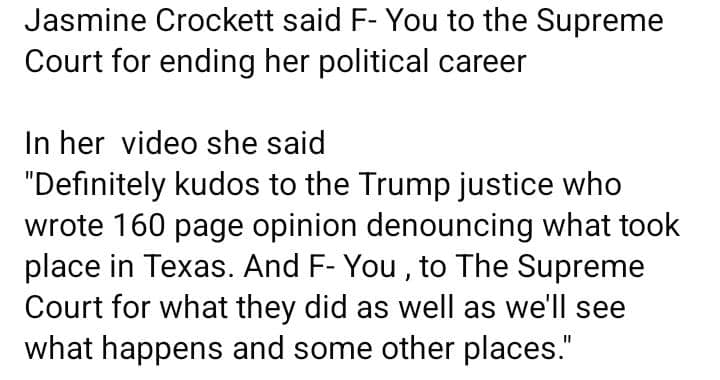
“Definitely kudos to the Trump justice who wrote the 160-page opinion denouncing what took place in Texas and f— you to the Supreme Court for what they did,” Crockett said.
There was one technical mix-up in that statement. The person she praised was not a Supreme Court justice. It was U.S. District Judge Jeffrey V. Brown, a Trump appointee who wrote the lower court opinion blocking the new map.
Brown was part of a three-judge federal panel that concluded there was substantial evidence Texas had used race, rather than politics alone, when constructing several districts. The court blocked the map in November 2025, finding that the challengers were likely to succeed with their racial-gerrymandering claims.
Crockett initially responded to the Supreme Court’s intervention in more restrained language. In an official statement, she stressed that the justices had not declared the maps fair or constitutional. Instead, she said, the Court had temporarily allowed Texas to use them while litigation continued.
The profanity came later, when Crockett framed the ruling as part of a wider struggle over voting rights, representation and political control.
What the Supreme Court Actually Decided
Texas lawmakers approved the mid-decade map in August 2025 after Trump and his allies pushed for boundaries that could potentially help Republicans gain as many as five additional House seats.
The state defended the map as a lawful partisan redistricting plan. Its opponents argued that Republican officials accomplished their political goals by intentionally sorting voters according to race.
On December 4, the Supreme Court granted Texas a stay, allowing the new districts to be used while the case proceeded. The majority said the lower court had failed to properly presume that lawmakers acted in good faith and had not placed enough weight on the challengers’ failure to produce an alternative map meeting Texas’s partisan objectives.
Justice Samuel Alito, joined by Justices Clarence Thomas and Neil Gorsuch, wrote that the motivation behind the Texas map was “partisan advantage pure and simple.” His position was that the evidence did not sufficiently prove race, rather than party affiliation, controlled the drawing of the lines.
Justice Elena Kagan strongly disagreed.
Joined by Justices Sonia Sotomayor and Ketanji Brown Jackson, Kagan argued that the three-judge panel had conducted a nine-day hearing, reviewed thousands of exhibits and reasonably concluded that race had predominated. She warned that the majority’s approach left the challengers hoping for “better luck in 2028.”
The Supreme Court formally reinstated the Republican-favored map in April 2026, again dividing 6-3. That meant the contested boundaries would govern the November elections.
The Map Hurt Crockett, but It Did Not Fire Her
The new boundaries moved Crockett’s residence outside the district she had represented since 2023. That was politically awkward, but it did not automatically make her ineligible to run for the House.
The Constitution requires House members to live in the state they represent, not necessarily inside the congressional district where they are running. Crockett therefore still had potential House options, although the new map created difficult contests involving several Democratic incumbents.
Crockett instead entered the Democratic primary for the U.S. Senate. She gave up a straightforward path to seeking another House term and competed against Texas state Rep. James Talarico for the right to challenge Republicans in November.
That gamble did not work. Talarico defeated Crockett in the March 3 Democratic primary after a close and expensive campaign. Following his victory, Talarico told supporters, “We’re about to take back Texas.”
Still, Crockett was not immediately removed from public office. As of August 2026, the House Clerk continued to list her as the representative for Texas’s 30th Congressional District, with her current term running until January 3, 2027.
So the accurate version is less dramatic than the viral one. The Supreme Court approved a map that complicated Crockett’s future in the House. She then chose to run for Senate and lost the Democratic nomination.
Whether that marks the end of her political career is something no court ruling can definitively decide. Crockett remains a member of Congress for the rest of her term, and nothing in the decision prevents her from seeking another office in the future.