8 Supermarket Brands From the ’70s That Are Hard to Find Today
Remember when a trip to the supermarket meant spotting colorful cereal boxes, unusual candy bars, and snacks that looked like something straight out of a science-fiction movie?
The 1970s certainly had their share of memorable grocery products. Some came with cartoon mascots, others had unusual flavors, and a few were so creatively packaged that you almost wanted to keep the wrapper.
Fast-forward to today, and many of those familiar names have disappeared from supermarket shelves. Some were discontinued decades ago, while others survived through ownership changes, specialty retailers, and unexpected comebacks.
According to the Food Industry Association (FMI), supermarkets carried an average of 33,248 items in 2025. Yet having thousands of products to choose from doesn’t guarantee you’ll find the childhood favorites you remember.
Here are eight supermarket-era brands from the 1970s that might have you wishing grocery shopping came with a time machine.
Pillsbury Space Food Sticks
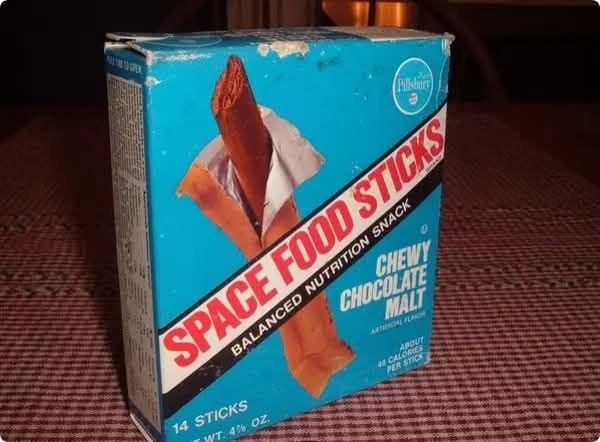
Imagine walking into a supermarket and buying something inspired by astronaut food. That was part of the appeal of Pillsbury Space Food Sticks.
Introduced to grocery shoppers in 1969, these individually wrapped, rod-shaped snacks had a futuristic identity that fit perfectly with America’s fascination with space exploration.
Chocolate, peanut butter, and caramel were among the flavors.
In 1971, Pillsbury began removing the word “Space” from its advertising and eventually sold the snacks simply as Food Sticks.
The product even had a genuine connection to space travel. According to General Mills, a modified commercial version accompanied the third Skylab mission in 1973.
Unfortunately, the excitement didn’t last forever. Pillsbury discontinued the original product during the 1980s as consumer interest faded.
Although an independent company later tried to revive it, the original supermarket favorite is long gone.
Related: 6 Classic Foods from the 1970s That Have Vanished from Modern Kitchens
Team Flakes
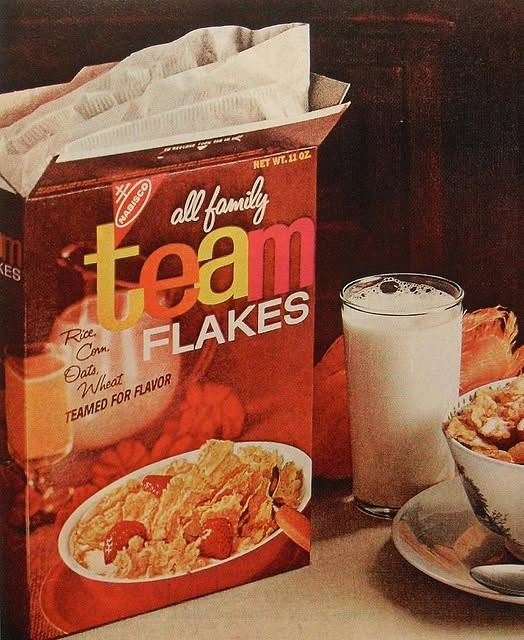
Some cereals became memorable because of cartoon characters. Others earned loyal fans simply by being different.
Nabisco’s Team Flakes belonged to the second category.
Introduced in 1963, the cereal combined four grains: rice, wheat, corn, and oats. TODAY has described it as the first four-grain flake cereal.
During the 1970s, shoppers might have noticed something interesting about the packaging. The word “Flakes” disappeared from the prominent package title early in the decade, making it simply Team, before returning later.
That explains why some people remember Team while others remember Team Flakes.
Despite its long run, the cereal eventually disappeared. TODAY reports that Nabisco discontinued it in 1993.
If you remember pouring a bowl of Team before school, today’s cereal aisle won’t offer an exact replacement.
Related: 11 Grocery Store Items From the 1960s That Vanished From the Shelves. Can You Remember Even 5?
Freakies
What happens when cereal marketing gets wonderfully weird? You get Freakies.
Made by Ralston-Purina, Freakies was a colorful cereal brand remembered for its seven unusual creature mascots.
The characters were appeared prominently in advertising, including a memorable cereal-tree concept that set the brand apart.
The advertising campaign even featured the catchy declaration, “We are the Freakies!”
By February 1976, the company was marketing both Freakies and Fruity Freakies, according to contemporary reporting in The New York Times.
Cocoa Freakies also appeared in the brand’s expanded lineup.
The original cereal disappeared in the 1970s, though accounts differ on its exact final year.
A later revival introduced a substantially different space-themed concept, but that version also disappeared.
Today, Freakies is more likely to turn up in vintage advertising collections than in the breakfast aisle.
Marathon Candy Bar
Some candy bars are remembered for their flavor. Marathon had another unforgettable selling point: its length.
Mars introduced the American Marathon bar in 1973, featuring eight inches of braided caramel covered in chocolate.
Its bright-red wrapper displayed inch markings that emphasized just how long the candy was.
Of course, being longer didn’t necessarily mean getting more candy by weight. Still, it was a clever way to make an ordinary candy purchase feel special.
According to The Christian Science Monitor, Mars discontinued Marathon in 1981 after sales fell short of expectations.
One detail often causes confusion: Britain’s Marathon was an entirely different chocolate bar that eventually became known as Snickers.
The American braided Marathon never underwent that transformation.
While similar candy bars exist, the original Mars Marathon is discontinued.
Junket
Not every disappearing supermarket name actually disappears.
Junket proves that sometimes a product simply becomes harder to spot.
The brand’s history stretches back well before the 1970s, with household rennet tablets introduced in the 1880s.
By the 1970s, Kellogg’s had acquired Junket through its 1969 purchase of Salada.
Its product family included dessert powders, ice cream mixes, rennet tablets, and Danish Dessert.
For households familiar with making desserts from packaged mixes, Junket was a recognizable name.
Unlike several brands on this list, Junket is still in business.
However, finding its products in an ordinary supermarket hasn’t always been easy. A 2014 newspaper report noted that not every grocery chain carried the brand, so direct ordering was an option.
Today, its manufacturer still offers the products, even if the name isn’t prominent in every dessert aisle.
Bonomo’s Turkish Taffy
Few candy brands encouraged customers to do something as unusual as hitting their purchase against a hard surface.
That was part of the fun with Bonomo’s Turkish Taffy.
The foil-wrapped candy bars became known for their distinctive break-apart experience, captured in the memorable instruction “CRACK IT UP!”
The product’s history began decades before the 1970s, but the decade brought an important change.
In 1972, Tootsie Roll Industries acquired the brand rights.
According to the brand’s official history, subsequent changes affected the formula, packaging, shape, and eventually the name.
But here’s the good news for nostalgic candy lovers: Turkish Taffy is back.
The brand relaunched in 2010, and specialty retailers such as The Vermont Country Store have offered vanilla and assorted bars.
You might not see it on your regular grocery run, but this childhood favorite isn’t completely gone.
Clark Bar
If you grew up enjoying chocolate-covered peanut butter candy, the Clark Bar might bring back a few memories.
David L. Clark created the brand in Pittsburgh, and it dates back to 1917.
Its signature combination was a crunchy peanut-butter center surrounded by chocolate.
The candy survived for generations, but its future became uncertain when NECCO’s bankruptcy disrupted production in 2018.
Fortunately, that wasn’t the end.
Boyer Candy Company acquired the brand’s rights, recipes, and equipment in September 2018.
Production eventually returned to western Pennsylvania.
And there’s a recent reason for fans to celebrate: September 2026 reporting confirmed that Boyer still manufactures traditional Clark bars.
That doesn’t mean they’ll appear in every supermarket, though. Their precise national grocery distribution remains unclear.
Still, unlike many discontinued candies, this one has a genuine comeback story.
Sky Bar
Why settle for one filling when you can have four?
That was the clever idea behind Sky Bar, a chocolate bar NECCO introduced in 1938.
Instead of a single uniform center, Sky Bar offered four separate filled chocolate sections.
The brand remained in production throughout the 1970s and continued for decades afterward.
Its original run ended after NECCO collapsed in 2018.
Thankfully, the story didn’t stop there.
Louise Mawhinney acquired the brand, and the revived Sky Bar business began wholesale sales in January 2020.
Today, Sky Bar Confectionary Company produces the candy in Sudbury, Massachusetts.
The current bar features caramel, peanut, vanilla, and fudge fillings, although the exact assortment has changed over the product’s long history.
Manufacturer-direct ordering is available, making Sky Bar another example of a nostalgic candy surviving outside the traditional supermarket spotlight.
Why These Old Supermarket Favorites Still Matter
The grocery aisle has changed enormously since the 1970s.
In fact, a major retail milestone happened on June 26, 1974, when a Marsh supermarket in Troy, Ohio, installed the first supermarket scanner. According to the Smithsonian, a package of Wrigley’s gum became the first scanned purchase.
Today, shoppers navigate stores filled with thousands of products, yet some of the most memorable names from earlier decades are missing.
These eight brands also reveal an important distinction: disappearing from supermarket shelves doesn’t always mean disappearing forever.
Some products were discontinued, some found new owners, and others discovered second lives through specialty shops.
And perhaps that’s what makes vintage supermarket brands so interesting. Sometimes it’s not just the snack or candy people remember. It’s the colorful packaging, unusual commercials, and excitement of discovering something different during an ordinary grocery trip.
The next time you’re shopping, take a closer look at the shelves. Today’s everyday favorites might become tomorrow’s nostalgic treasures.