7 Old-School Kitchen Tasks We Rarely Do Anymore
Take a look around your kitchen. The flour is ready to use, butter comes neatly packaged, and frozen vegetables are just a few steps away. It’s easy to forget how much work once happened before anyone could even start cooking dinner.
Many kitchen chores that were familiar to earlier generations have quietly slipped out of everyday routines. Some required patience, others demanded serious arm strength, and a few turned ordinary food preparation into a family activity.
Modern appliances and commercially prepared foods have changed all that. Yet these old-fashioned tasks haven’t completely disappeared. Some remain popular with home cooks who enjoy doing things by hand.
Here are seven kitchen chores that remind us just how much American kitchens have changed.
Sifting Flour Before Almost Every Baking Project
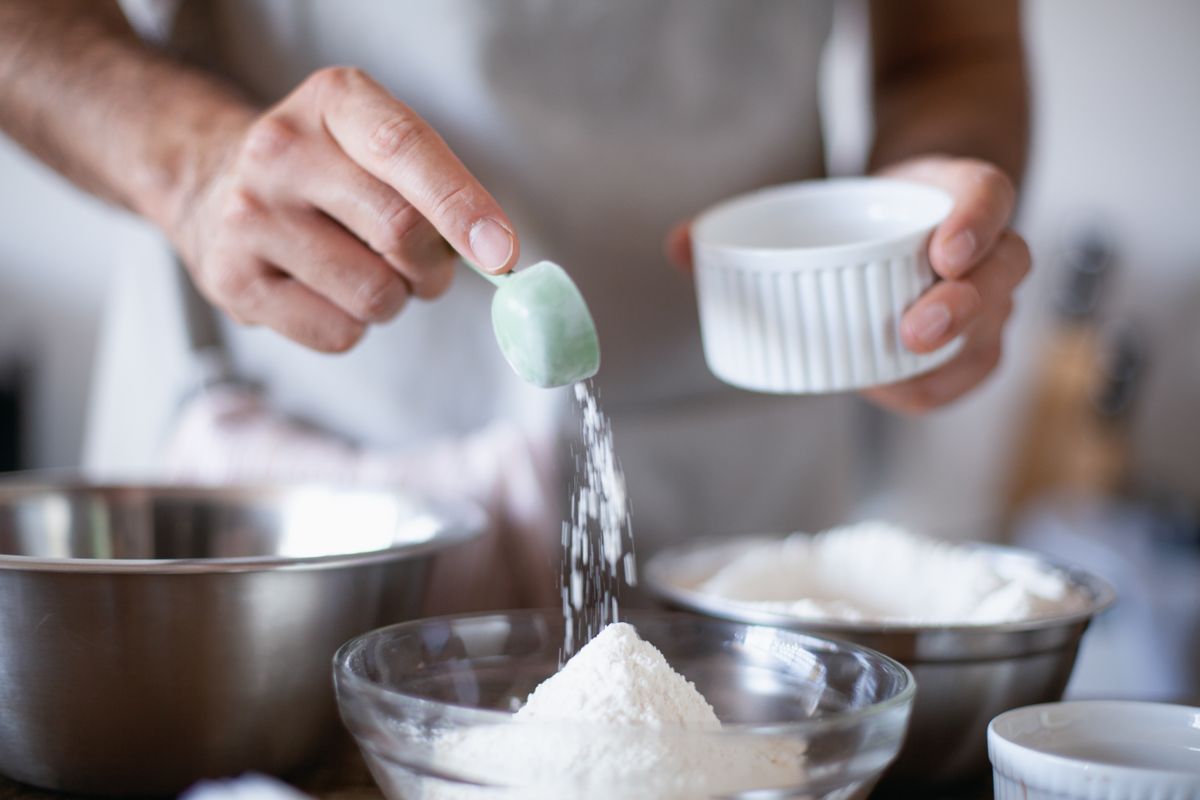
Before mixing cake batter or preparing dough, many home bakers once had another job to finish: pushing flour through a hand-operated sifter.
It wasn’t simply about making the flour lighter. Older flour could contain unwanted bits, including chaff, seeds, or other material left behind during milling. According to King Arthur Baking, flour produced by smaller mills once varied considerably in texture and quality.
That made sifting a useful preparation step rather than an optional baking technique. Modern commercially milled flour is much more consistent. It’s finely ground, refined, and inspected before reaching grocery store shelves, reducing the need to sift it for everyday recipes.
Of course, the flour sifter hasn’t retired completely. Delicate cakes such as angel food cake and genoise can still benefit from sifting. It’s also useful when dry ingredients develop stubborn lumps.
The difference is simple: what was once a familiar starting step has become something many bakers do only when a particular recipe calls for it.
Churning Cream Into Butter by Hand
Imagine wanting butter for your morning toast and realizing you still have to make it. For some farm and dairy-keeping households, producing butter meant working cream inside a churn until it transformed into butter.
Depending on the equipment, someone might repeatedly move a wooden dasher up and down or turn the crank on a barrel-style churn. It wasn’t a quick little kitchen project, either.
Smithsonian folklife materials describe butter churning as a process that could take anywhere from about half an hour to two hours. For households that kept dairy animals, making butter was part of managing the food supply. Some also produced butter for nearby markets.
Commercial creameries eventually changed that arrangement. Mechanical cream separators, larger-scale production, and railroad distribution helped move butter-making away from individual households.
Now, most shoppers simply pick up a package of butter at the grocery store. Hand-churned butter still has its place, but the sustained physical effort once involved in producing it is no longer a regular household necessity.
Shelling a Big Pile of Garden Peas
Picture a bowl filled with freshly picked garden peas, another container waiting to catch the peas, and a growing pile of empty pods. Before dinner could begin, someone had to open each pod and push out the peas.
Then came another pod. And another. For gardening and farming families, shelling peas could become a substantial preparation job, especially when dealing with a large harvest.
It could also bring people together. One oral history preserved by the National Park Service recalls a group shelling six bushels of peas. That’s a reminder that ordinary food preparation sometimes doubled as shared family or community time.
Today, frozen peas have made this particular chore easy to skip. The development of commercially frozen foods, including work associated with Clarence Birdseye, helped create an alternative to preparing fresh peas directly from their pods.
Instead of sitting with a large bowl and working through the harvest, a cook can open a bag and get straight to preparing dinner. Gardeners and fans of seasonal produce still shell fresh peas. But for many everyday meals, those empty pods are no longer part of the kitchen scene.
Canning Enough Produce to Fill the Pantry
A large harvest could mean a long stretch of work in the kitchen. Fruits and vegetables needed preparing, jars needed filling, and the contents had to undergo heat processing before being put away for storage.
For households that depended heavily on home-preserved foods, canning was much more than an occasional weekend activity. It was a way to make seasonal produce available beyond the harvest.
Home canning became especially important during the world wars. According to the USDA’s historical timeline, the practice reached a U.S. peak in 1943, when households processed more than four billion cans and jars.
That’s an enormous amount of household food preservation. After World War II, increased access to home refrigeration helped reduce the need for such extensive home canning.
Interest in the practice returned during the 1970s, and many home cooks continue to preserve produce today. However, there’s a meaningful difference between canning because the household depends on stored garden produce and choosing to preserve a few favorite seasonal foods.
For many people, filling an entire pantry with home-canned food has shifted from a regular necessity to an optional project.
Defrosting the Refrigerator’s Freezer Compartment
Few kitchen chores were quite as inconvenient as dealing with a freezer compartment packed with frost. The process began by removing the frozen food and switching off the refrigerator. Then came the waiting as the accumulated ice slowly melted.
And, naturally, there was water to clean up. General Electric’s manual-defrost guidance describes this process and recommends defrosting when frost buildup reaches approximately one-quarter to one-half inch.
It was the sort of maintenance job that interrupted the normal kitchen routine. Food had to be moved, the appliance needed attention, and someone eventually had to wipe up the mess.
Automatic-defrost refrigerators have largely removed that particular responsibility. Instead of requiring the owner to shut down the refrigerator and manually remove accumulated frost, automatic systems handle the process internally.
GE notes that almost all refrigerators manufactured today have automatic defrost, although smaller and compact models can be exceptions. Manual-defrost compact refrigerators and standalone freezers still exist, so the chore hasn’t disappeared entirely.
But in many modern kitchens, managing freezer frost is something the appliance handles without anyone having to reach for a towel.
Turning a Hand-Cranked Eggbeater
Before electric mixers became familiar kitchen helpers, beating ingredients could require a little mechanical effort. A hand-cranked rotary eggbeater had gears, beaters, and a handle that someone had to keep turning.
Want to beat eggs or whip cream? You supplied the motion yourself. The Smithsonian’s National Museum of American History has documented a rotary food mixer advertised in a 1910 catalog and listed in the 1918 Sears catalog.
Its promoted uses included beating eggs, whipping cream, and preparing cakes and custards. The tool offered a mechanical way to mix ingredients, but it still depended on the cook’s hands.
Electric mixers changed that experience by allowing a motor to handle the sustained rotation. A stand mixer, for example, can continue mixing larger quantities without someone repeatedly turning a crank.
That doesn’t mean cooks have abandoned hand mixing. Plenty of recipes still involve a whisk, and rotary beaters remain recognizable kitchen tools.
But there’s something amusing about realizing that a task now handled by flipping a switch once meant standing over a bowl and keeping that little handle moving.
Hand-Cranking an Ice-Cream Freezer
Making homemade ice cream could once involve much more than combining ingredients and waiting for dessert. First came preparing the ice, which sometimes meant chipping pieces from a larger block.
Then the ice was packed around an inner container holding the ice-cream mixture. Finally came the memorable part: turning the crank. And turning it some more. The Smithsonian traces this style of homemade ice cream to the 19th century. Nancy Johnson’s 1843 hand-cranked design used an inner churning chamber surrounded by an outer ice container.
It improved on earlier methods, but making ice cream still required considerable hands-on effort. For families who enjoyed the activity on special occasions, the work could become part of the experience.
Electric refrigeration eventually offered ways to prepare frozen desserts without chipping ice or continuously turning a handle. Homemade ice cream is still very much a possibility, and some people continue to enjoy traditional hand-cranked equipment.
What’s changed is that making a frozen dessert no longer has to begin with an ice-filled bucket and a workout for your arms.
The Kitchen Has Changed, but the Memories Remain
These seven tasks show just how much kitchen work can change without anyone making a big announcement about it.
A package of butter replaces a lengthy churning session. A bag of frozen peas eliminates a pile of empty pods. An electric mixer takes over a job once powered entirely by hand.
Some of these chores are still enjoyable traditions, and others remain useful for particular recipes or households. But modern conveniences have made many of them less necessary for everyday cooking.
Perhaps that’s what makes these old kitchen tasks so interesting. They remind us that even the simplest meal once involved work we barely notice anymore.