Australia’s Largest Cocaine Bust Exposes A Hidden Underground Network Beneath Sydney’s Edge
Australian police have uncovered what authorities describe as the country’s largest ever cocaine seizure after officers found 2.7 tonnes of the drug hidden beneath shipping containers on a semi-rural property in Londonderry, on Sydney’s western edge.
The scale of the discovery has immediately pushed the case beyond a routine drug raid. Police estimate the cocaine had a street value of about A$816 million and could have been broken down into roughly three million street-level deals if it had reached the community.
We are looking at a seizure that tells a bigger story than the number alone. The drugs were not found in a warehouse, a vehicle, or a visible storage shed. They were allegedly buried inside plastic tubs in underground bunkers concealed beneath false floors in three shipping containers, a method that points to planning, patience, money, and confidence.
The Australian Federal Police said the discovery was made on Friday, June 19, during a search of the Londonderry property. Two Sydney men, aged 21 and 25, were arrested at the scene after police alleged they attempted to flee on foot. Both have been charged with possessing a commercial quantity of an unlawfully imported border-controlled drug, an offense that carries a maximum penalty of life imprisonment if convicted.
The men remain before the courts. At this stage, the charges are allegations, and the broader investigation is still active.
How Police Say the Cocaine Was Hidden Beneath Shipping Containers
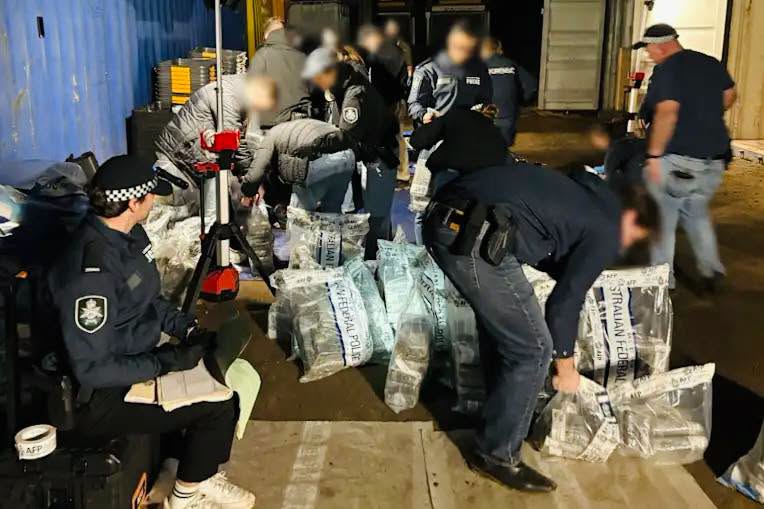
The hiding place is one of the most striking details in the case. Police say the cocaine was located in plastic tubs buried in underground bunkers beneath shipping containers at the rear of the Londonderry property.
The containers allegedly had false floors, giving access to hidden compartments below. That detail matters because it suggests the property was not simply being used as a temporary drop-off point. According to police, the concealment was elaborate enough to keep a huge quantity of cocaine out of sight until investigators found signs that disturbed earth near the containers may have pointed to something below.
We can understand why investigators are describing the hide as complex. A shipment of this size requires more than a few bags and a locked door. It requires storage, movement, trusted handlers, surveillance awareness, transport planning, and the ability to keep a major criminal asset concealed long enough to move it into distribution channels.
The Londonderry discovery also gives the story a local edge. This was not a seizure made only at sea or at a border checkpoint. It was found on the outskirts of Australia’s most populous city, in a semi-rural area close enough to Sydney to serve as a possible staging point, yet quiet enough to appear ordinary from the outside.
The Investigation That Started With Cocaine in the Water
The Londonderry raid forms part of Operation Minjiang, a Queensland Joint Organized Crime Taskforce investigation into an alleged drug importation and distribution network operating along Australia’s east coast.
Police say the operation began in May after Queensland Police responded to reports of a burnt-out flatbed truck near a boat ramp at Midge Point in North Queensland. Officers then discovered 40 kilograms of cocaine in the water nearby.
That discovery appears to have been the first loose thread. What may have looked at first like an isolated incident grew into a wider investigation involving police across Queensland and New South Wales, as well as federal agencies.
Before the Londonderry seizure, authorities had already recovered 178 kilograms of cocaine and 142 kilograms of methamphetamine linked to the same investigation. With the latest seizure included, police say Operation Minjiang has now removed more than three tonnes of border-controlled drugs from the criminal market.
That is why the case is being treated as more than a record bust. It is being viewed as a major disruption of an alleged importation network, one that police believe involved sea transfer, road transport, safe houses, and interstate coordination.
The Alleged Route( From North Queensland to Western Sydney)
Police allege the cocaine found in Londonderry was imported into Australia near Midge Point in North Queensland before being transported south to Sydney.
That journey is significant. Midge Point sits in a sparsely populated coastal region, while Sydney is roughly 1,800 kilometers away by road. Moving a shipment of this size across that distance would require planning, vehicles, drivers, storage points, and people willing to take enormous legal risks.
Investigators allege the cocaine was moved at the direction of a Sydney organized crime group. Police have not publicly identified the group, and investigations into the wider network are continuing.
The alleged route also highlights a growing concern for Australian law enforcement. Queensland’s coastline is vast, complex, and difficult to monitor in every location at every moment. Organized crime groups are accused of trying to exploit that geography by landing drugs in quieter coastal areas before moving them into larger cities.
In this case, police believe the drugs came ashore in North Queensland and were later transported to Sydney, where the Londonderry property allegedly became a storage point.
MV Wealth and the International Link Under Investigation
Authorities are also examining the suspected role of a vessel called MV Wealth, a Belize-flagged cargo ship detained in the Solomon Islands.
Police allege the MV Wealth may have served as a mother vessel connected to the importation. A mother vessel is typically a larger ship positioned offshore, from which smaller boats can collect cargo and move it closer to land.
The Solomon Islands connection adds an international layer to the case. The islands lie northeast of Queensland, and Australian authorities are now working with domestic and international partners as they continue to investigate the origin of the drugs and the people behind the alleged importation.
At this point, police have not publicly confirmed the final origin of the cocaine. They have said the investigation remains active, and further arrests have not been ruled out.
Why Australia Is a High-Value Target for Cocaine Traffickers
Australia has long been viewed by international drug trafficking groups as a lucrative market because cocaine can command extremely high prices compared with many other countries.
That financial incentive is one reason police say organized crime groups are willing to take extreme risks. A shipment worth hundreds of millions of dollars creates pressure on criminal networks to protect their supply chain, conceal their storage locations, and move product quickly once it reaches land.
The Londonderry seizure shows how far those networks are allegedly prepared to go. A hidden bunker system beneath shipping containers is not a casual hiding place. It suggests the alleged group behind the shipment expected to hold or stage the drugs before distribution.
For communities, the concern is not only the cocaine itself. Police often connect large drug importations to violence, intimidation, money laundering, weapons, debt collection, and corruption attempts. When a shipment is valued at hundreds of millions of dollars, the criminal stakes become enormous.
Previous Cocaine Record Broken by the Londonderry Seizure
The 2.7-tonne Londonderry seizure surpasses Australia’s previous record cocaine haul, which involved 2.34 tonnes seized in 2024 from a fishing boat near K’gari, formerly known as Fraser Island, off the Queensland coast.
That earlier seizure was already considered extraordinary. The latest case pushes the scale even higher and shows how quickly trafficking attempts can grow.
The trend is clear. Australian authorities are not only dealing with small importation attempts or isolated couriers. They are confronting large-scale international supply chains that allegedly use commercial-style logistics, remote coastlines, interstate transport, and hidden storage facilities.
The Londonderry case may now become a reference point for future drug enforcement discussions in Australia, especially around maritime surveillance, organized crime intelligence, and cross-border c