Bill Maher Demands Attention for Christians Killed in Nigeria, but His 100,000 Claim Needs Context
Bill Maher has spent much of his career poking organized religion with a very sharp stick. That made his defense of Nigerian Christians especially striking.
During the September 26, 2025, episode of HBO’s Real Time with Bill Maher, the comedian turned a panel discussion about religious violence into a blunt challenge to the media, American activists and anyone whose view of global suffering depends on what happens to be trending online. The episode featured Republican Rep. Nancy Mace of South Carolina and broadcaster Michael Smerconish.
“I’m not a Christian,” Maher said, before arguing that extremists were “systematically killing the Christians in Nigeria.” After citing a death toll of more than 100,000, he asked the line that sent the clip racing across social media: “Where are the kids protesting this?”
Maher identified a real and horrifying crisis. Christians have been murdered, kidnapped and driven from their communities by Boko Haram, Islamic State West Africa Province, armed bandits and other violent groups. But the sweeping figure he used, and his description of the violence as an attempt to eliminate Christianity from the entire country, are disputed by conflict researchers and Nigerian officials.
Maher’s challenge landed because it came from an unlikely messenger

Maher is hardly the person most viewers would expect to deliver an emotional defense of persecuted Christians. His television career has featured relentless jokes about faith, scripture and religious institutions. That history gave his remarks an unusual punch.
“The fact that this issue has not gotten on people’s radar, it’s pretty amazing,” Maher said. He also accused people who were unaware of the crisis of living inside a media bubble.
Mace thanked him for raising the subject. During the exchange, she suggested the lack of sustained attention was partly because the violence was happening in Africa, a continent whose conflicts often struggle to hold the American news cycle for long.
Maher’s broader point was difficult to dismiss. Nigeria’s violence rarely produces the months of campus demonstrations, celebrity statements and nonstop television panels inspired by wars elsewhere. Yet the human consequences are enormous.
In October 2025, the International Organization for Migration counted more than 2.3 million internally displaced people across six northeastern states affected by conflict. Another IOM assessment identified more than 1.25 million displaced people in parts of north-central and northwestern Nigeria.
The violence has not disappeared since Maher made his comments. In July 2026, gunmen attacked a community in Benue State, killing at least eight people according to police, while residents and local officials reported a higher toll. Women and young people later blocked roads in protest, demanding greater protection.
Christians face genuine persecution, but Nigeria’s bloodshed has several causes
There is no serious dispute that Christians have suffered targeted atrocities in Nigeria.
The U.S. Commission on International Religious Freedom reported that conditions remained poor in 2024. It said Boko Haram, ISWAP, some Fulani militants and criminal groups attacked religious communities, while security forces were often slow to respond. The commission documented killings, abductions and church attacks affecting Christians, while also recording attacks on Muslims and followers of traditional religions.
Some jihadist violence carries an unmistakably religious purpose. Boko Haram and ISWAP have executed Christians, attacked churches, kidnapped clergy and attempted to impose their interpretation of Islam. The U.S. State Department has also documented checkpoints where militants reportedly searched for Christians and captives who faced pressure to abandon their faith.
But Nigeria is not experiencing one single conflict with one single motive.
In the northeast, jihadist organizations fight the state and attack civilians. In the northwest, heavily armed criminal gangs raid villages and kidnap residents for ransom. Across the Middle Belt, predominantly Christian farming communities and predominantly Muslim Fulani herders clash over land, grazing routes, water and political power. Religion, ethnicity, organized crime, weak policing and competition for resources frequently overlap.
That complexity does not make the victims less dead. It does, however, make it dangerous to label every Nigerian killing as part of one centrally directed religious extermination campaign.
Amnesty International said attacks in Benue had displaced more than 500,000 people by the end of 2024. After visiting affected communities, the organization accused authorities of repeatedly failing to protect residents and warned that impunity was encouraging more violence.
“The authorities’ persistent failure to hold suspected perpetrators to account is fueling a cycle of impunity,” Amnesty International Nigeria director Isa Sanusi said.
The 100,000 figure is the part that cannot be presented as settled fact
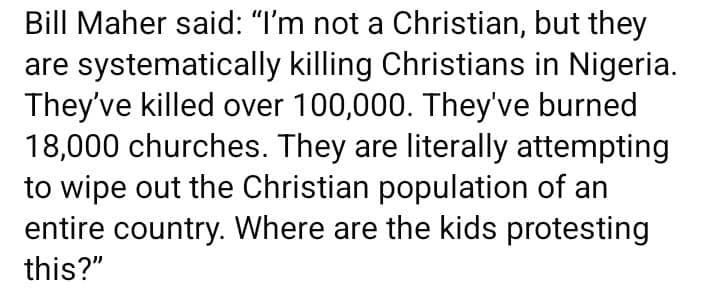
Maher said more than 100,000 Christians had been killed since 2009. Available independent datasets do not clearly support that precise claim.
United Nations Development Program research estimated that the Boko Haram conflict had directly caused about 35,000 deaths through insurgent violence by the end of 2020. When indirect deaths caused by hunger, disease, and destroyed services were included, the estimated human cost rose to nearly 350,000. Those figures covered people of different religions and did not identify 100,000 confirmed Christian victims.
ACLED data cited in later analyses recorded 20,409 deaths in attacks on civilians between January 2020 and September 2025. Within incidents where a victim’s religious identity was reported as a factor, ACLED recorded 317 Christian deaths and 417 Muslim deaths. The organization has stressed that incomplete reporting and Nigeria’s regional differences make broad religious classifications difficult.
Nigeria’s government has strongly rejected the genocide label. Information Minister Mohammed Idris said portraying the country’s insecurity as a campaign against one religion was a “gross misrepresentation,” arguing that the description oversimplified a crisis affecting Christians and Muslims alike.
Still, Abuja’s objections cannot erase its responsibility. Whatever terminology politicians, researchers or television hosts prefer, communities continue to bury families, abandon farms and worship behind guarded doors. The government’s inability to stop repeated attacks has become the common thread connecting nearly every account of the crisis.
Maher was right to ask why Nigeria’s victims receive so little global attention. His numbers, however, should be treated as claims rather than established totals.
The most honest version of the story sits between denial and exaggeration. Christians in Nigeria face serious, sometimes explicitly religious persecution. Muslims are also massacred by many of the same groups. Criminality, land conflict and state failure intensify the carnage.
The question is not whether Nigeria’s suffering perfectly fits a social-media slogan. It is why so much suffering was required before much of the world began looking at all.