DOGE, Tariffs, Epstein, ICE, Iran, and Inflation: Why Trump’s Second Term Is Facing a Growing Backlash
There are presidencies that feel steady, and then there are presidencies that feel like they are constantly arguing with the scoreboard.
Donald Trump’s second term, according to critics and several political observers, is increasingly being described as the second category.
The promises were big and familiar: clean up government waste through DOGE, fix the economy with tariffs, restore order at the border through ICE, bring transparency with the Epstein files, reshape foreign policy with Iran, and ease the cost-of-living crisis driving inflation concerns.
But as the months have unfolded, critics argue that the results have been far more complicated than the slogans.
That gap between promise and outcome is now driving a broader political debate about whether Trump’s leadership is delivering stability, or amplifying division.
DOGE Was Meant to be efficient. Critics Say It Became a Disruption Instead
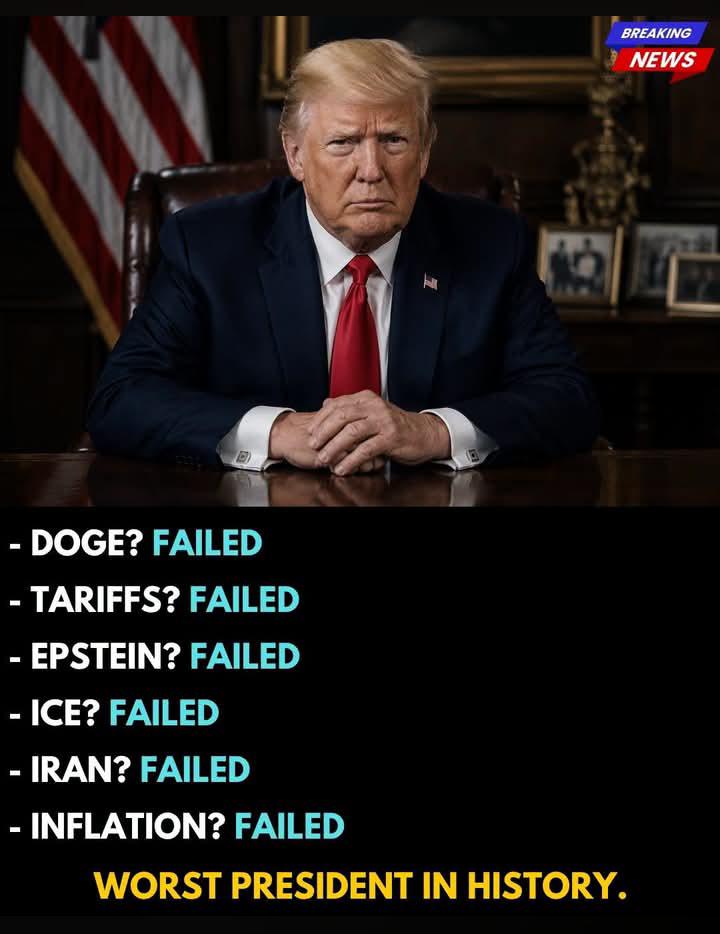
DOGE was introduced as a bold experiment in government efficiency, backed by high-profile support and framed as a way to strip waste out of Washington.
The idea sounded simple: cut bureaucracy, reduce spending, and prove that government could run leaner and faster.
But in practice, the rollout has been far more controversial.
Supporters point to restructuring efforts and canceled contracts as evidence of progress. Critics, however, argue that the savings have been overstated and that the accounting behind the claims does not always reflect real budget reductions.
Some analysts have noted that projected “savings” often rely on maximum contract values rather than actual spending, a distinction that can dramatically inflate perceived impact.
There have also been concerns raised about access to federal systems, data handling, and internal disruption across agencies. In some cases, legal challenges and internal pushback slowed or complicated implementation.
Even Elon Musk, who was closely associated with the broader efficiency narrative, later distanced himself from some aspects of the government’s fiscal direction, warning that large spending packages were difficult to reconcile with claims of strict cost control.
For critics, the core issue is not whether reform is needed; it is whether DOGE has delivered measurable efficiency or simply created a new layer of disruption inside an already complex system.
Tariffs, Trade, and Inflation Pressure on Everyday Americans
Tariffs have long been one of Trump’s signature economic tools, presented as a way to protect American industry and rebalance global trade.
In speeches, tariffs are framed as a strength, forcing foreign competitors to pay for access to U.S. markets and bringing jobs back home.
But the economic reality is more complicated.
Tariffs function as import taxes, and many economists argue that those costs are often passed down the supply chain, eventually reaching consumers.
Federal Reserve research and multiple independent economic analyses have linked recent tariff measures to upward pressure on certain goods prices. At the same time, think tanks like the Tax Foundation have estimated that tariffs can function as a broad-based cost increase on households, depending on scope and duration.
That matters because inflation remains one of the most sensitive political issues in the country.
Recent Bureau of Labor Statistics data shows inflation hovering above the long-term comfort range, keeping pressure on household budgets even as it has cooled from earlier peaks. Essentials like food, rent, insurance, and transportation continue to absorb a large share of income for many families.
Reuters/Ipsos polling in mid-2026 showed Trump’s approval ratings struggling in the mid-to-high 30s, with cost-of-living concerns consistently ranking as a top voter frustration.
Supporters argue that tariffs are part of a long-term strategy to rebuild American manufacturing strength. Critics counter that voters experience economic policy through weekly grocery bills, not long-term trade projections.
That disconnect between policy framing and household reality has become one of the defining tensions of the second term.
Epstein, ICE, Iran, and the Politics of Control vs. Consequence

Beyond the economy, several high-profile issues have fueled ongoing controversy and political debate.
The handling of the Epstein-related files has become a major flashpoint for transparency advocates. For years, political figures across the spectrum demanded full disclosure of documents tied to Jeffrey Epstein’s network. When parts of the process moved under Trump’s administration, expectations for openness collided with legal caution, redactions, and ongoing disputes over what should be released.
Officials have insisted that legal review processes must be followed, while critics argue that the delays contradict earlier calls for full transparency. The result has been renewed skepticism from both supporters and opponents who expected quicker disclosure.
Immigration enforcement under ICE has also intensified significantly, with expanded deportation efforts and increased detentions.
Supporters view the policy as long-overdue enforcement of existing law, arguing that border control and immigration compliance were central campaign commitments.
However, civil liberties groups and local officials in some states have raised concerns about detention conditions, legal challenges, and the broader social impact of large-scale enforcement actions. Reuters reporting has also highlighted increases in detention-related deaths compared to historical averages, intensifying scrutiny of the system.
Foreign policy toward Iran has added another layer of complexity.
Trump’s approach has combined pressure, negotiation, and sharp rhetoric, consistent with his broader “maximum leverage” style of diplomacy. Supporters argue this strengthens America’s position in the Middle East and deters escalation.
Critics, however, say the shifting signals between confrontation and negotiation create uncertainty for allies and adversaries alike. They also point out that Trump’s earlier political branding of the Iran negotiations as a sign of weakness has complicated perceptions of similar diplomatic efforts under his own administration.
The result is a foreign policy that is active, highly visible, and often polarizing in its execution.
A Presidency Defined by Competing Narratives
The debate over Trump’s second term is not simply about individual policies. It is about interpretation.
To supporters, this is a presidency that is aggressively confronting entrenched systems, whether in government bureaucracy, trade imbalances, immigration enforcement, or global diplomacy.
To critics, it is a presidency marked by overpromising, contested results, and constant political conflict that often overshadows measurable outcomes.
That tension has fueled renewed discussion among political historians. Some recent academic surveys and presidential ranking studies have placed Trump at the lower end of historical evaluations, particularly when judged on consensus-building, institutional stability, and long-term governance impact.
Still, it is important to note that presidential rankings are not fixed facts. They shift over time, often changing as new data, perspectives, and historical context emerge.
What is clear in the present moment is that Trump remains one of the most polarizing political figures in modern American history. His supporters see disruption as a necessary correction. His critics see it as avoidable instability.
And in the middle are voters dealing with the everyday effects of those choices, prices, policies, enforcement actions, and international uncertainty.
Whether this era ultimately strengthens or weakens Trump’s historical standing will depend not just on headlines but on outcomes measurable long after the politics fade.
For now, the second-term scorecard remains deeply contested, and the argument over success or failure is far from settled.