Lebanon Wakes Up to Smoke and Sirens After Deadly Israeli Strikes Test Fragile Ceasefire
Lebanon woke up Friday to the kind of morning that makes the word “ceasefire” feel almost cruel.
Families in the south and the Bekaa Valley were not reading diplomatic statements. They were watching smoke rise, roads jam, ambulances move, and neighbors count the missing. By the time the day’s toll began to settle, Lebanon’s Health Ministry said Israeli airstrikes and bombardments had killed at least 47 people and wounded 97 others since midnight. The dead included women and children, according to reports citing Lebanese officials.
Israel said its strikes targeted Hezbollah sites after what it described as repeated ceasefire violations and a deadly Hezbollah attack that killed four Israeli soldiers in southern Lebanon. Hezbollah denied violating the truce and accused Israel of breaking the ceasefire first. That is the brutal math of this conflict: one side calls it retaliation, the other calls it aggression, and civilians are left trying to survive the vocabulary.
The Israeli military said it struck more than 80 Hezbollah-linked targets, while later updates from Israeli officials and media referred to more than 150 targets or strikes. That distinction matters. The “80+” figure being circulated is not independently confirmed as “80 bombs.” It is a military claim about targets hit. What is confirmed is that Friday became one of the deadliest days in Lebanon since this latest round of fighting intensified in March.
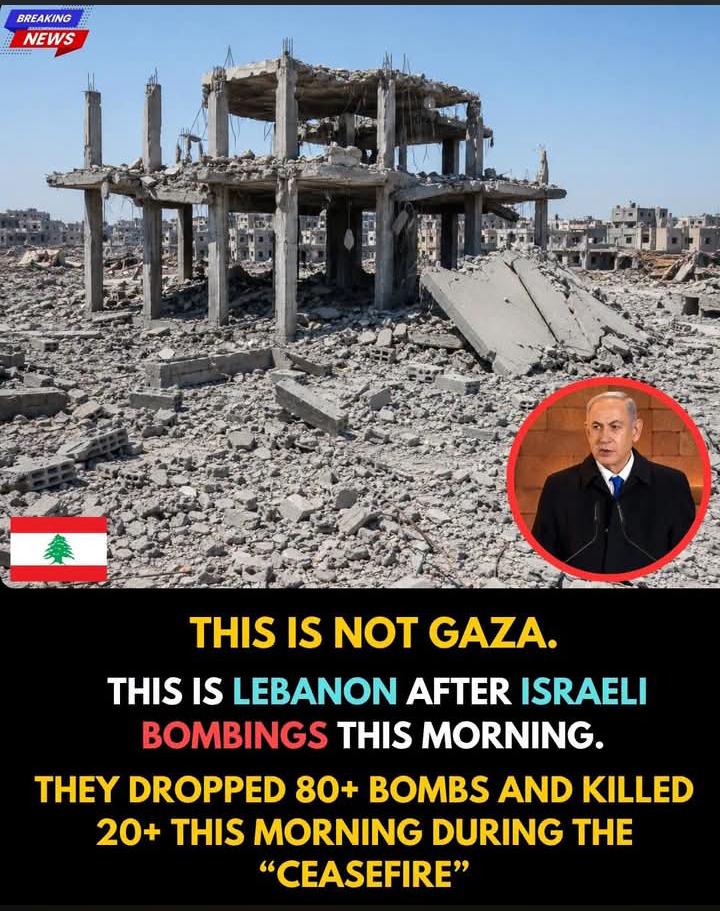
And then came the twist that made the story even more tense: a ceasefire was reportedly agreed to take effect at 4 p.m. local time.
Yes, after the strikes. Yes, after the deaths. And yes, with both sides still accusing each other of bad faith.
A senior U.S. official told Reuters, “Hezbollah and Israel have agreed to a ceasefire,” adding that after the day’s exchange of fire, “Israel and Hezbollah are now in a ceasefire.” But on the ground, the pause did not arrive with the clean click of a switch. Lebanese security sources told Reuters there were a dozen Israeli airstrikes in the first hour after the ceasefire took effect, while an Israeli military official denied conducting those strikes after 4 p.m. Reuters also reported that one of its journalists saw airstrikes ongoing inside Lebanon around 4:50 p.m.
That gap between diplomatic language and battlefield reality is the heart of the story.
A Deadly Morning Before a Ceasefire Nobody Fully Trusted
The day began with escalation, not peace.
Israel said it launched attacks across several parts of Lebanon after Hezbollah struck Israeli forces in southern Lebanon. The Israeli military reported four soldiers killed, including in an attack involving a tank near Nabatiyeh. Prime Minister Benjamin Netanyahu vowed to make Hezbollah pay a “very heavy price,” and Israeli officials said their military actions were aimed at Hezbollah operatives and infrastructure.
From Israel’s view, the strikes were part of a continuing effort to stop Hezbollah attacks and protect communities in northern Israel. One senior Israeli official put it bluntly to Reuters: “If Hezbollah does not attack us, then for us it is not a time of war.” The same official said Israeli forces would remain in southern Lebanon.
That last line is not a footnote. It is one of the reasons the ceasefire is so fragile.
Hezbollah has said it will not stop fighting while Israeli forces remain inside Lebanon. Israel says it will not withdraw until the threat is removed. So the truce begins not as a handshake, but as a staring contest.
In Lebanon, President Joseph Aoun condemned the Israeli escalation, saying the attacks in the south and the Bekaa Valley amounted to a “dangerous and condemned escalation.” He said the strikes hit innocents, including women and children, and undermined efforts to consolidate a ceasefire and end the war.
That message was aimed not only at Israel, but also at Washington. Lebanon is now caught in a much larger diplomatic storm involving Israel, Hezbollah, Iran, and the United States. A U.S.-Iran interim agreement was supposed to help lower the temperature across the region, including in Lebanon. Instead, Friday’s violence turned Lebanon into the first major test of whether that deal means anything on the ground.
For ordinary Lebanese families, the geopolitical chessboard looked more like a highway out of town.
AP quoted Mustafa Zain, who was fleeing with his six daughters in a pickup truck, saying, “The situation is lawless, we couldn’t stay.” That one sentence says more than most diplomatic briefings. When people with children pack up and run, they are not waiting to see which government wins the argument.
Israel, Hezbollah, and the Blame Game After the Strikes
Every ceasefire has two parts: the public announcement and the private suspicion.
This one has plenty of both.
Israel says Hezbollah violated the ceasefire repeatedly. Hezbollah says Israel violated it repeatedly. Israel says it is targeting Hezbollah’s military infrastructure. Hezbollah says Israel is killing civilians, destroying homes, and continuing ground incursions. Each side is building its case for why it may need to keep fighting even after agreeing to stop.
Israeli military spokesperson Brig. Gen. Effie Defrin said Israeli forces would continue their mission unless ordered otherwise, framing the military presence in southern Lebanon as necessary for the protection of civilians in northern Israel. In other words, the army was not presenting the ceasefire as an automatic end to operations. It was presenting it as something controlled by government instructions and battlefield conditions.
Hezbollah sources, meanwhile, told Reuters that once they received word of the ceasefire, they applied it from their end. But Hezbollah also described its attacks on Israeli tanks as a response to Israeli movements near Ali al-Taher hill, a strategically important area overlooking Nabatiyeh. Israel has been trying to establish and hold what it calls a forward defense zone in southern Lebanon. Hezbollah views that as an occupation.
That is why this conflict is not simply about who fired first on Friday morning. It is about territory, security, deterrence, and the unfinished business of a war that neither side fully ended.
The casualty numbers deepen the pressure. Lebanese officials reported at least 47 killed and 97 wounded on Friday. Reuters reported that Lebanon’s Health Ministry has recorded thousands killed since March 2, including medics, women, and children. Israel says its own toll in this round of hostilities includes soldiers and civilians killed by Hezbollah attacks.
For readers trying to follow the story without getting lost, here is the simplest version: Israel says it struck Hezbollah after deadly attacks on Israeli troops. Hezbollah says it was responding to Israeli violations and incursions. Lebanon says the strikes are killing civilians and threatening the ceasefire. The United States says a ceasefire is in place. Reporters on the border saw and heard fire continuing around the time the truce was supposed to begin.
That is why the word “ceasefire” is doing a lot of work here.
It is not yet the same thing as peace.
Why This Lebanon Flare-Up Is Suddenly Bigger Than Lebanon

The reason Friday’s strikes matter far beyond Lebanon is simple: they landed directly on top of a wider Middle East deal.
The U.S. and Iran had been moving through an interim agreement meant to lower regional tensions and restart talks around Iran’s nuclear program. That agreement reportedly called for a halt to military operations on multiple fronts, including Lebanon. But Israel was not directly party to the U.S.-Iran deal, and Israeli officials have been angry about any arrangement that limits their freedom to act against Hezbollah.
That tension exploded into the open on Friday.
Talks that were expected in Switzerland between U.S. and Iranian officials were delayed after the fighting in Lebanon intensified. Iranian officials reportedly insisted the violence had to stop before talks could move forward. The U.S., Qatar, and Iran were then involved in mediation that produced the reported Israel-Hezbollah ceasefire.
President Donald Trump, who has been trying to sell the Iran deal as a major diplomatic win, publicly leaned into the role of dealmaker. In a phone interview reported by NBC and carried by The Guardian, Trump said he told Israel, “You just gotta calm down sometimes and use your head.” He declined to say whether he spoke directly with Netanyahu.
That line will travel because it sounds like Trump: blunt, casual, half-warning, and half-brag. But behind it is a serious diplomatic problem. The United States is trying to keep a regional bargain alive while one of its closest allies insists it must keep striking threats it sees on its northern front.
Lebanon’s president also spoke with U.S. Secretary of State Marco Rubio, stressing that a comprehensive ceasefire was essential for talks with Israel scheduled to take place in Washington. The State Department said Rubio reiterated the need to disarm Hezbollah and support Lebanon’s sovereignty. That puts Washington in an awkward middle position: pressuring Hezbollah through Lebanon’s government, while also trying to restrain Israel enough to keep the larger Iran track from collapsing.
For Lebanon, that means its villages and cities are not just being hit by bombs and drones. They are being pulled into a diplomatic contest between bigger powers.
That is the part many readers should sit with.
The people fleeing Tire, Nabatiyeh, the Bekaa Valley, and the villages near the border are not debating the architecture of a regional security agreement. They are trying to figure out whether the road north is safer than the house behind them. They are trying to call relatives before the phone service fails. They are trying to understand whether “ceasefire at 4 p.m.” means they can breathe at 4:01.
So far, the answer is unclear.
The ceasefire may hold. It may collapse. It may become another temporary pause, with both sides accusing each other of violating it before the ink is even dry. But Friday made one thing impossible to ignore: Lebanon is now the pressure point where Israel’s security demands, Hezbollah’s armed resistance, Iran’s regional leverage, and Trump’s ceasefire diplomacy all collide.
For the families under the smoke, that collision is not a theory. It is the sound of another strike, the fear of another evacuation, and the exhausted question that keeps returning after every truce announcement:
If this is the ceasefire, what does war look like?