Doug Ford vs. Donald Trump: The Trade Fight That Could Reshape Canada-U.S. Relations
The confrontation between Ontario Premier Doug Ford and U.S. President Donald Trump looks like a battle between two blunt political personalities. In reality, it is a struggle over who can impose the greater economic cost without breaking one of the world’s most integrated trading relationships.
Ford has emerged as Canada’s most forceful provincial critic of Trump’s tariffs. His television appearances, threats of retaliation and appeals to American governors helped create his “Captain Canada” image. Yet Ford is not simply demanding a trade war. He is trying to prove that Canada can fight back while remaining essential to American industry.
The electricity surcharge changed the argument.
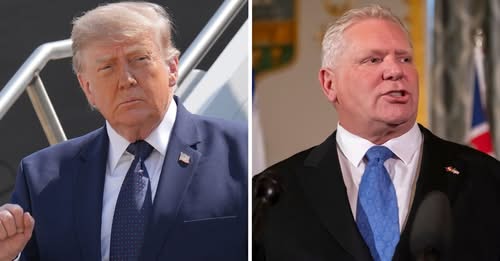
The dispute reached a dramatic point in March 2025, when Ontario placed a 25 percent surcharge on electricity exports serving about 1.5 million homes and businesses in Michigan, Minnesota and New York. Ford warned that Ontario could increase the charge or stop electricity exports if the United States escalated its tariffs.
Trump answered by threatening to double planned tariffs on Canadian steel and aluminum to 50 percent. Ford suspended the electricity charge the next day after securing talks with U.S. Commerce Secretary Howard Lutnick and the U.S. trade representative. Trump then withdrew the additional tariff threat. Neither leader won a permanent victory. Ford demonstrated that Ontario controlled a lever capable of producing an immediate White House response. Trump showed that he could target the province’s manufacturing base just as quickly. The exchange exposed both Canada’s leverage and its vulnerability.
Trump’s latest tariff threat raises the stakes.
The conflict returned in July 2026 when Trump announced 50 percent tariffs on nearly $20 billion worth of Canadian imports. The list includes wine, dairy products, cement, furniture, clothing, swimming pools and hockey sticks. The measures are scheduled to begin August 19 and cover about 5.2 percent of U.S. goods imports from Canada in 2025. The tariffs would apply even to products previously protected under the Canada-U.S.-Mexico trade agreement. Energy, potash, fish, critical minerals and goods already covered by separate national-security tariffs were excluded.
Prime Minister Mark Carney has emphasized negotiation and national unity. Ford has called for Canada to go “on offense” and put every option on the table. Asked whether Ontario might revive its electricity surcharge, Ford refused to rule it out.
Ontario stands closest to the economic blast.
Ford’s position reflects Ontario’s exposure. The province anchors the Canadian side of the North American automotive network and contains major steel, food-processing and advanced-manufacturing operations. The economies are joined by supply chains that depend on predictable movement across the border. ( Tariffs therefore do not punish one country cleanly. They raise costs across shared supply chains, weaken orders, delay investment and force manufacturers to reconsider future production.
An analysis cited by the Associated Press estimated that Trump’s latest measures could affect C$28 billion in annual Canadian exports. Ontario, Quebec and British Columbia would face the greatest provincial impact. We should therefore see Ford’s rhetoric as more than political theatre. For Ontario, this dispute concerns factory shifts, investment decisions and communities built around cross-border manufacturing.
Ford is confronting Trump while selling him a partnership.
Ford’s strategy contains an important contradiction. Even while threatening retaliation, he continues promoting deeper continental cooperation. During a June 2026 visit to Washington, Ford presented a renewed “Fortress North America” plan. It called for a stronger trade agreement, secure supply chains and cooperation in automobiles, aerospace, agriculture, energy and critical minerals.
Ontario reported that more than $1.2 trillion in goods and services moved between Canada and the United States in 2025, equal to more than $3.3 billion each day. The province also said U.S. exports to Canada support 1.8 million American jobs. His message is double-sided: Ontario can impose costs, but America gains more by treating Canada as a strategic production partner than as an opponent.
The “Captain Canada” approach could backfire
Ford’s confrontational style gives frustrated Canadians a visible defender. It also carries risk. A provincial premier controls important tools, including electricity exports, procurement and alcohol distribution. The federal government, however, conducts Canada’s international trade negotiations. An aggressive provincial response could provoke retaliation before Ottawa exhausts diplomacy.
Repeated threats also lose force when quickly suspended. Washington may eventually treat them as political performance unless Ontario is prepared to sustain the consequences. Still, Ford gives Canadian negotiators something valuable: a credible warning that public anger can produce real countermeasures. Trump’s rapid reaction to the electricity surcharge showed that provincial pressure can disrupt Washington’s calculations, even when it does not produce a lasting settlement.
This dispute is changing Canada beyond tariffs.
Ontario is attempting to reduce its dependence on the American market. The province says its non-U.S. exports have risen nearly 75 percent since 2018 and almost 28 percent in the latest year measured. Ford has also backed efforts to remove internal trade barriers and give Canadian producers access to more customers across provincial borders.
The lasting consequence may extend beyond Ford and Trump. Canada is being pushed to decide how much prosperity should depend on uninterrupted access to one country. The United States is testing how hard it can pressure its closest trading partner without weakening its own industries. Ford has proved that Canada can make Trump react. The harder test is whether that leverage can secure a durable agreement before retaliation becomes the relationship itself.