Flaky Biscuits Aren’t About Luck, The Secret Is in Those Butter-Layered Folds
A truly flaky biscuit should pull apart in layers, crumble at the edges, and leave buttery crumbs on your plate—and getting there is more about technique than a complicated recipe.
There is something wonderfully satisfying about breaking open a freshly baked biscuit and seeing those delicate layers separate. The outside is golden and lightly crisp, while the middle stays tender enough to pull apart with your fingers. Southern biscuits have been part of American cooking for generations, but the pursuit of the perfect flaky biscuit is still very much alive.
The ingredients are surprisingly ordinary: flour, fat, liquid, salt, and leavening. What changes everything is how you handle those ingredients.
Where Flaky Biscuits Got Their Character
The humble biscuit has a surprisingly long history, and Southern cooks turned it into an art of their own.
American biscuits developed from older European baking traditions, but Southern kitchens helped shape the soft, tender style now associated with buttermilk, butter, and layered dough. Regional ingredients and flour varieties also influenced how people made biscuits, and recipes passed through families and community cookbooks.
That tradition is still visible today. Kentucky chef Sara Bradley, for example, learned a traditional “church fold” technique from her mentor Miss Annie in Birmingham, Alabama. Her approach involves flattening cold butter into the flour before folding it into the dough, creating layers somewhat reminiscent of laminated pastry, as Southern Living’s account of the traditional biscuit technique explains.
Cold Butter Is Doing More Than Adding Flavor
Those pieces of butter are tiny pockets of potential flakiness waiting for the oven to do its work.
When you cut cold butter into the flour but leave it in pieces, it melts as the biscuits bake. Its water turns into steam, helping create separation between layers of dough. Food Network’s flaky biscuit technique takes this idea even further by using very cold grated butter, creating thin pieces that distribute throughout the flour.
That is why melted butter behaves differently. Once the fat is completely liquid, it spreads through the flour rather than remaining in distinct pieces. You can still make a tender biscuit that way, but the dramatic flaky layers become harder to achieve.
Temperature also matters during preparation. If the butter softens while you mix and fold, some of those carefully created pockets can disappear before the dough ever reaches the oven.
The Folding Trick Makes the Layers Multiply
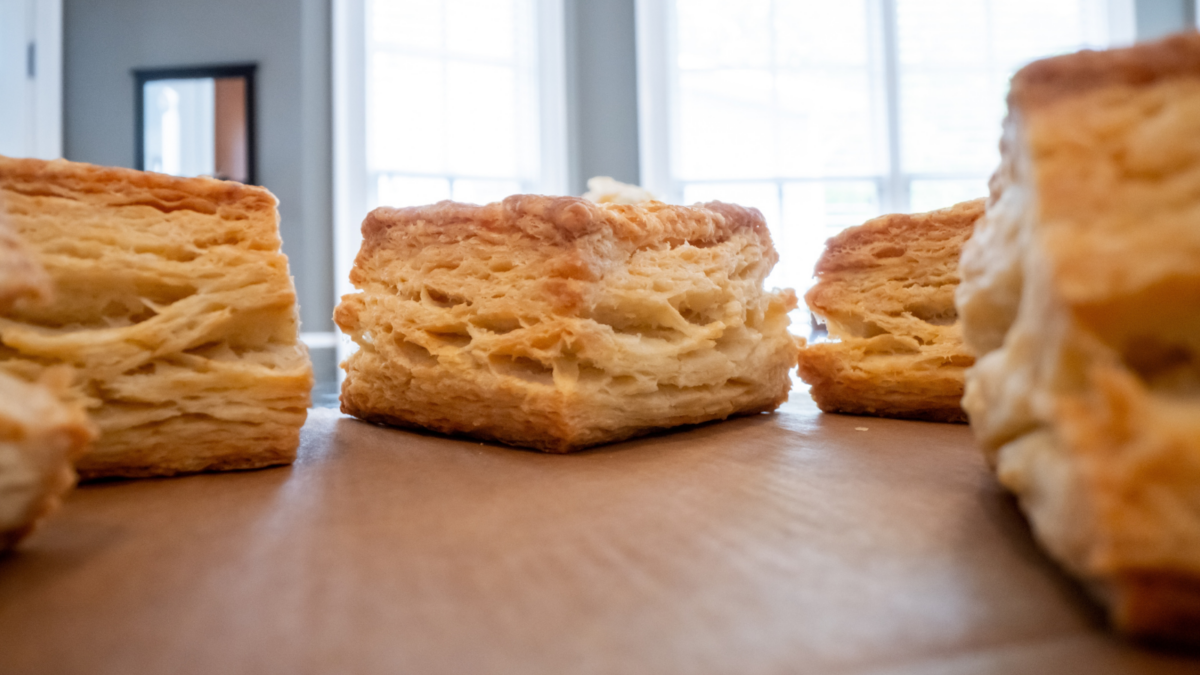
If cold butter creates the spaces, folding determines how many layers you get.
Once the dough comes together, gently flatten and fold it to stack butter and dough on top of one another. King Arthur Baking describes the process as a loose form of lamination: the butter pieces become layered, then create pockets and flakes when they heat in the oven. Its guide to folding biscuit dough recommends one to four folds, depending on how pronounced you want the layers.
The important word is gently. Biscuit dough is not bread dough, and aggressive kneading encourages gluten development. You want enough handling to create structure, but not so much that the finished biscuit becomes tough or dense.
That balance is what makes flaky biscuits slightly tricky. A little technique produces dramatically better results, but too much enthusiasm can work against you.
Flour and Liquid Change the Personality of a Biscuit
Butter gets much of the attention, but the flour and liquid quietly determine whether your biscuit is fluffy, tender, rich, or somewhere in between.
Soft-wheat flours, common in Southern baking, contain less protein than many hard-wheat flours. That can help produce a more tender biscuit because there is less potential for gluten development. All-purpose flour can still make excellent biscuits, particularly when you avoid overworking the dough.
Then there is the liquid. Buttermilk brings tang and tenderness, while whole milk produces a milder flavor. Cream can create an especially rich biscuit, while different recipes balance their liquid and fat in different ways.
That’s why two biscuits made with almost identical ingredients can taste completely different. Sometimes the smallest changes in a recipe are what make familiar foods more interesting.
The Biggest Mistake Is Usually Overworking
A biscuit does not need to look perfectly smooth before it goes into the oven.
Once liquid touches flour, gluten development begins. Stir only until the dough comes together, and do not panic if it looks slightly shaggy. That rough appearance can actually signal that you avoided unnecessary handling.
Cutting matters too. Press a biscuit cutter straight down instead of twisting it, because twisting can compress the edges and interfere with the rise. Repeatedly gathering and rerolling scraps can also make biscuits tougher, so the first cuts are usually the prettiest and flakiest.
These are exactly the sort of simple kitchen habits that seem minor until you taste the difference they make.
The Best Biscuit May Not Look Perfect
The goal is not perfectly smooth dough, it is a biscuit with enough layers to make the first break irresistible.
Some bakers grate frozen butter, others cut it into chunks, and traditional techniques flatten butter into the flour before folding. There is no single sacred method. What matters is preserving pieces of fat, creating layers without overworking the dough, and getting the biscuits into a properly heated oven.
That is why flaky biscuits are such a satisfying example of old-fashioned cooking technique. The ingredient list is short, but every movement matters. When you finally split one open and see those golden layers separating, you can actually see what the butter, flour, and folding accomplished.
When you make biscuits, do you prefer dramatic flaky layers or a softer, tender middle that practically melts in your mouth?