Gavin Newsom Blasts SAVE Act as ‘Blatant Voter Suppression’ Amid Growing Election Fight
Washington has turned voter paperwork into its latest political heavyweight fight, and California Gov. Gavin Newsom has entered the ring swinging.
Newsom attacked the Republican-backed SAVE America Act, commonly called the SAVE Act, as President Donald Trump intensified pressure on Senate Republicans to pass it before the 2026 midterm elections.
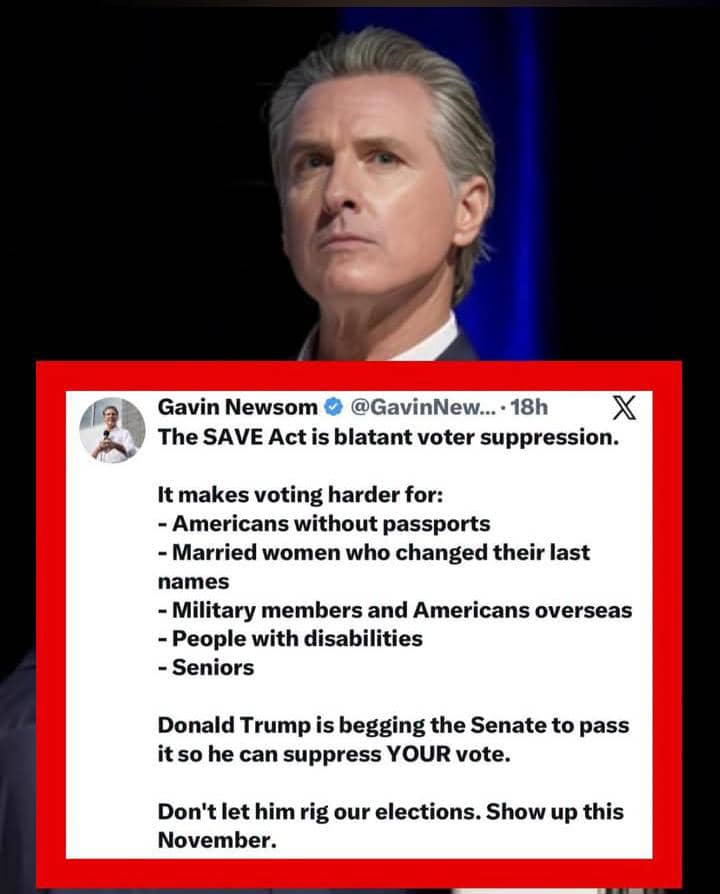
“The SAVE Act is blatant voter suppression,” Newsom said in a social media statement. He also warned Americans, “Don’t let him rig our elections,” while arguing that the bill would create obstacles for eligible citizens who lack passports or have difficulty matching their current names to older documents.
The legislation’s supporters reject that description. They say the bill applies a simple principle: Only American citizens should decide American elections. The argument sounds straightforward, but the practical details have created a fierce battle over whether the proposal protects elections or makes legal voters jump through unnecessary hoops.
Newsom Says the Paperwork Could Become a Roadblock
The SAVE America Act would require people registering for federal elections to provide documentary proof of U.S. citizenship. In many cases, that could mean presenting a passport or combining a government-issued photo ID with a birth certificate, naturalization certificate or another accepted citizenship document.
Newsom argued that the requirement could particularly affect Americans without passports, married women whose surnames no longer match their birth certificates, military personnel and citizens living abroad. He also listed seniors and people with disabilities among those who could face additional difficulties.
Those concerns are not purely theoretical. A 2023 national survey cited by several voting-rights organizations found that roughly 21.3 million adult citizens either lacked documentary proof of citizenship or could not quickly access it. PolitiFact rated the broader claim that about 9% of Americans lack ready access to the necessary documents “Mostly True,” while noting that some respondents owned the paperwork but stored it elsewhere.
Older voters may face particular complications. AARP noted that name changes, expired identification, frequent moves and difficulty retrieving birth or marriage records could make the process more demanding for some seniors. The organization also said a married voter whose current name differs from the name on a birth certificate might need additional documentation connecting the two identities.
The bill does instruct states to establish procedures for document discrepancies and provide reasonable accommodations for applicants with disabilities. Supporters point to those provisions as evidence that eligible citizens would still have ways to prove their status. Critics respond that an alternative process does not necessarily make that process quick, affordable or easy to navigate.
Republicans Call It Election Security, Not Suppression
House Speaker Mike Johnson has described the proposal as “common sense legislation to just ensure that American citizens decide American elections.” The bill passed the House on February 11, 2026, by a 218-213 vote, with one Democrat joining Republicans.
Supporters argue that requiring proof of citizenship would strengthen public confidence and close gaps in voter-registration systems. The White House has promoted the legislation as a popular election-security measure, pointing to polling showing broad support for voter identification requirements.
There is, however, an important distinction between voter ID and documentary proof of citizenship. A driver’s license may confirm identity, but most licenses do not state whether the holder is a citizen. Under the bill, many applicants would therefore need an additional document before registering or updating an existing registration.
Federal law already prohibits noncitizens from voting in federal elections. Election officials and independent researchers have generally found such voting to be rare, although isolated registrations and ballots involving noncitizens have occurred. Republicans argue that rarity is not a reason to ignore the possibility, while Democrats say the proposed solution could burden far more lawful voters than unlawful ones.
That is the real fault line. One side views citizenship documents as a reasonable lock on the ballot box. The other sees a large lock placed on a door that millions of citizens have a constitutional right to enter.
Trump Wants Action, but the Senate Remains Stuck
Trump has made the SAVE America Act one of his biggest legislative demands ahead of the midterms. On July 27, he called on Senate Majority Leader John Thune to keep senators in Washington rather than begin their August break.
“John Thune should not allow the United States Senate to ‘leave town’ until it passes The Save America Act,” Trump wrote. He has also repeatedly urged Republicans to eliminate or bypass the filibuster, which creates an effective 60-vote threshold for most legislation.
That is where the political arithmetic becomes stubborn. Republicans hold 53 Senate seats, and Thune has said the votes do not exist to pass the bill or change Senate rules. After repeated attempts to move the proposal, he asked reporters, “Show me how this ends. What’s the picture of victory?”
House Republicans have tried other routes. On July 23, the House approved a defense authorization bill containing the SAVE America Act, while lawmakers also pursued election-related funding through the budget process. Neither strategy had secured enough Senate support by July 30.
Newsom’s criticism therefore arrives during more than a policy debate. It comes during a Republican family argument over tactics, a presidential pressure campaign and a rapidly approaching midterm election.
Whether voters see the SAVE America Act as protection or suppression may depend on which risk worries them more: an ineligible ballot being cast, or an eligible citizen being unable to produce the right piece of paper in time.