Georgia’s 36,599-Voter Registration Gap Reignites Election Debate Ahead of the 2026 Vote
Few political numbers are more explosive than 11,779.
That was Joe Biden’s certified margin of victory over Donald Trump in Georgia during the 2020 presidential election. Now, another number is circulating alongside it: Georgia reportedly had 36,599 more registered voters than its citizen voting-age population.
Placed side by side, the figures appear dramatic. Thirty-six thousand is much larger than eleven thousand. Case closed, right?
Not so fast.
The 36,599 figure comes from real federal election data, but it does not show that 36,599 ineligible voters cast ballots. It compares two measurements, one of which includes inactive registration records and the other a Census survey estimate. Understanding that distinction matters as Georgia enters another fiercely contested election season in 2026.
The 36,599 Figure Needs Context

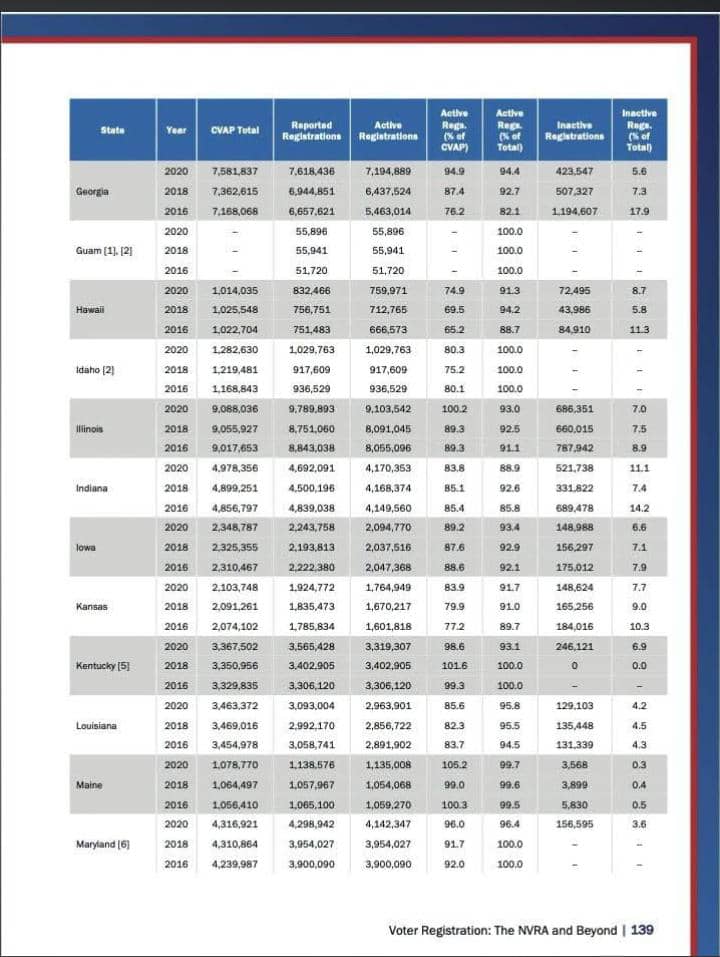
According to the U.S. Election Assistance Commission, Georgia reported a total of 7,618,436 registered voters for the November 2020 election. The commission listed Georgia’s estimated citizen voting-age population, commonly called CVAP, at 7,581,837.
Subtract the second number from the first, and the result is exactly 36,599. The arithmetic is correct. The political conclusion often attached to it is not.
Georgia’s total registration figure included 423,547 inactive registrations. Its active registration total was 7,194,889, nearly 387,000 below the estimated citizen voting-age population.
Inactive voters are not automatically fraudulent, imaginary or ineligible. Registration records can become inactive when election mail is returned, when officials cannot confirm a voter’s address, or when a person does not participate in elections for an extended period. Federal law also limits how quickly states can remove certain records.
The citizen voting-age population is not a live head count of every person legally eligible to vote. It is an estimate developed using Census Bureau survey data. The Election Assistance Commission also uses the previous year’s estimate because election-year Census figures are not available when its report is prepared.
In other words, the comparison is a little like placing an administrative mailing list beside a population estimate and expecting them to match perfectly.
Most importantly, registrations are not ballots. Georgia recorded roughly 5.02 million participating voters in the 2020 election, far below either registration figure. Nothing in the 36,599 calculation identifies illegal voters, connects inactive records to cast ballots, or shows that those records benefited Biden.
Georgia’s 2020 Result Survived Multiple Reviews
Georgia did not simply announce Biden as the winner and lock away the paperwork.
The state conducted a full manual audit of approximately five million presidential ballots. Officials said the hand tally confirmed the winner identified by the voting machines. Most counties reported changes involving fewer than 10 ballots, and the largest county-level error rate was 0.73%.
Georgia then performed another recount requested by the Trump campaign. The result was again upheld, and the state recertified the outcome.
Secretary of State Brad Raffensperger said the reviews showed that Georgians’ votes “were counted accurately, fairly, and reliably.”
That does not mean Georgia’s voter rolls were flawless. No large database is permanently perfect. People move, die, change names, or register elsewhere. Election officials must constantly update millions of records while obeying state and federal laws designed to prevent both improper voting and improper removal.
But finding more total registrations than the estimated population of a category is not the same as finding more ballots than eligible voters. The official investigations, audit and recount did not establish that enough unlawful votes existed to erase Biden’s 11,779-vote margin.
The 2020 Fight Is Shaping Georgia’s 2026 Election

Georgia voters return to the polls on November 3, 2026, for elections that include the governor, U.S. Senate, secretary of state, attorney general, and all 14 congressional seats.
The Senate contest places Democratic Sen. Jon Ossoff against Republican Rep. Mike Collins. Ossoff is defending his seat in a state Trump carried in the 2024 presidential election, making the race one of the country’s most closely watched battles for control of the Senate.
Collins has promised a campaign focused on “building coalitions and finding common ground,” while Ossoff has made Trump’s continued influence part of his argument, calling him the “world’s most famous sore loser.”
The governor’s race features Republican businessman Rick Jackson against former Atlanta Mayor Keisha Lance Bottoms, a Democrat. After winning the Republican nomination, Jackson declared, “We proved the people of Georgia are in charge.”
Election administration is also directly on the ballot. Republican Tim Fleming and Democrat Penny Brown Reynolds are competing to succeed Raffensperger as secretary of state, placing questions about voting systems, registration records and public confidence at the center of the campaign.
Georgia lawmakers have already changed some election procedures ahead of the vote. Legislation signed in June allows the state to continue using QR-code ballot tabulation until 2028 and requires hand recounts in certain extremely close statewide races. The recount requirement applies when the margin is no more than half a percentage point, except in federal contests such as the U.S. Senate race.
That debate reveals the real political importance of the 36,599 figure. It may not prove election fraud, but it speaks to a public that remains deeply suspicious of election systems.
Georgia’s 2026 campaigns will therefore be fought on two levels. Candidates will argue about taxes, health care, immigration, and the economy. At the same time, they will battle over whether voters can trust the machinery recording their choices.
The numbers deserve scrutiny. But they also deserve labels. Total registrations, active voters, population estimates, and ballots cast are not interchangeable. When those categories are blended together, a statistical curiosity can quickly become a political accusation that the underlying evidence does not support.