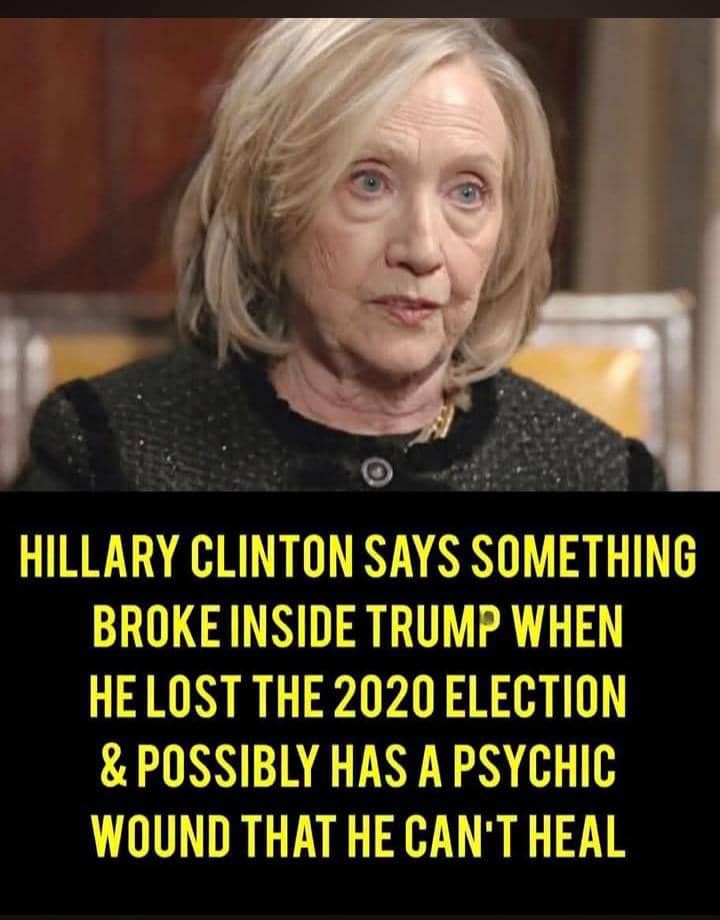
Hillary Clinton Says Something “Broke” Inside Trump After 2020 Loss, Suggests He Carries a Wound He Cannot Heal
Former Secretary of State Hillary Clinton has offered a striking interpretation of Donald Trump’s post-2020 election behavior, saying she believes something changed inside him after he lost to Joe Biden and suggesting the defeat may have left what she described as a “psychic wound” that has never fully healed.
Clinton, who faced Trump herself in the 2016 presidential election, made the comments while discussing Trump’s continued focus on the 2020 election and his repeated claims that the contest was unfair despite courts, election officials, and members of his own administration rejecting allegations of widespread fraud.
Her remarks have reignited a long-running debate over whether Trump’s political actions after 2020 are driven by strategy, personal grievance, or a deeper reaction to the most significant electoral defeat of his political career.
Clinton Says Trump’s 2020 Defeat Changed Him
Clinton has long argued that Trump’s refusal to accept the 2020 election results represented a turning point. In her view, the loss affected Trump on a personal level and influenced his political approach afterward.
Speaking about Trump’s reaction to the election, Clinton said something “broke” inside him after losing. She suggested that the defeat was not simply a political setback but an event that deeply affected the former president’s identity and public behavior.
“I think something broke inside of him when he lost the 2020 election,” Clinton said, describing what she viewed as a lasting emotional impact.
Her comments were not a medical diagnosis, but rather her personal interpretation of Trump’s public actions and statements. She pointed to his continued focus on the 2020 election, his criticism of the legal system, and his repeated references to the election as evidence of an unresolved issue.
Trump has consistently rejected the idea that he lost fairly. He has maintained that the 2020 election was affected by irregularities, although numerous investigations, recounts, and court decisions did not find evidence that would have changed the outcome.
The official result was confirmed with Biden winning 306 electoral votes to Trump’s 232. Biden was inaugurated on January 20, 2021.
Trump Has Continued to Talk About the 2020 Election
The 2020 election remains one of the defining moments of Trump’s political career. Even years later, it continues to influence his speeches, campaigns, and relationship with his supporters.
Trump has repeatedly criticized the election process and argued that he was treated unfairly. His claims became a central part of his political message after leaving office and during his campaigns to return to the White House.
His critics, including Clinton, argue that his continued focus on the election reflects an inability to move beyond the defeat.
Supporters of Trump, however, argue that he is raising concerns about election integrity and believe he has the right to question the process.
The disagreement highlights a deeper political divide in the United States. For many Democrats and Trump critics, the 2020 election represents a moment when democratic institutions were tested. For many Trump supporters, it represents a moment when they believe their concerns were ignored.
The controversy reached its most dramatic point on January 6, 2021, when a mob attacked the U.S. Capitol during the certification of the electoral results. Trump was later charged in a federal case related to efforts to overturn the election, though legal proceedings have continued through a complicated political and judicial landscape.
Trump has denied wrongdoing and argued that the cases against him are politically motivated.
Clinton’s Comments Reflect a Broader Political Battle

Matt Johnson from Omaha, Nebraska, United States, CC BY 2.0, via Wikimedia Commons
Clinton’s comments also carry personal history. She lost the 2016 presidential election to Trump in one of the most unexpected political outcomes in modern American history.
Although Clinton won the popular vote, Trump secured victory through the Electoral College. After that election, Trump frequently criticized Clinton and the Democratic Party, while Clinton later wrote and spoke about the impact of the loss.
Her latest remarks show that the rivalry between the two figures remains one of the most recognizable conflicts in American politics.
The phrase “psychic wound” has attracted attention because it suggests something deeper than ordinary political disappointment. Clinton used it as a way to describe what she believes is a lasting emotional injury connected to Trump’s defeat.
However, the claim remains her interpretation. There is no public evidence proving what Trump personally feels or whether he views the 2020 election loss as Clinton described.
Trump has instead framed his actions as part of a fight for political accountability and election reform.
The debate over Trump’s reaction to 2020 continues because the election was not simply a moment in history. It became a defining chapter in American politics, shaping Trump’s movement, his supporters, and his critics.
Clinton’s comments add another perspective to that ongoing conversation, portraying the loss as a moment that changed Trump’s relationship with defeat and power. Whether viewed as a political strategy or a personal reaction, the impact of the 2020 election remains central to understanding Trump’s public life today.