Mamdani’s New York Sweep Just Put AOC Back at the Center of the 2028 Conversation
New York politics has a habit of turning local races into national warnings, and this week, the warning came with flashing lights. Mayor Zohran Mamdani’s preferred candidates did not merely win a few Democratic House primaries. They swept through them with enough force to make party insiders look up from their spreadsheets and ask a bigger question: if this is where the Democratic base is moving, is Alexandria Ocasio-Cortez now looking at a White House lane?
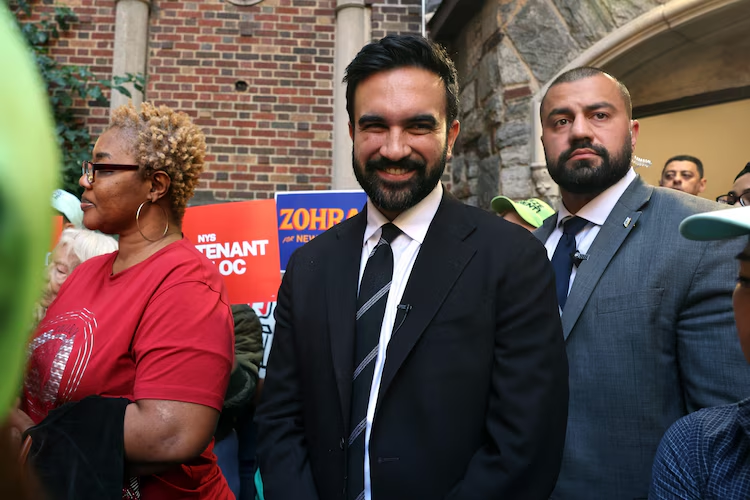
That question is no longer political gossip whispered around campaign fundraisers. It has become part of a much larger argument over the future of the Democratic Party. Mamdani’s allies won three key New York congressional primaries, including races where establishment Democrats expected experience, name recognition, and old relationships to carry the day. Instead, insurgent energy carried the night.
Darializa Avila Chevalier, Claire Valdez, and Brad Lander all benefited from Mamdani’s support. Their victories gave the mayor a new reputation as a political kingmaker, but the impact did not stop at City Hall. For progressives, the sweep looked like proof that their message can still move voters when it is organized, disciplined, and unapologetic. For moderates, it looked like a siren blaring over the party’s national brand.
That is where AOC enters the story.
Ocasio-Cortez has been one of the most recognizable progressive figures in American politics since her 2018 upset victory over Joe Crowley. For years, Democrats have debated whether she was a movement celebrity, a future Senate challenger, or a potential presidential contender. Mamdani’s sweep gives that debate new fuel because it suggests the political ecosystem around her is no longer theoretical. It is winning races.
The biggest lesson from New York is not that every Democrat is suddenly a democratic socialist. That would be too simple. The sharper point is that the left has learned how to build power where it has the right voters, the right field operation, and the right mood. New York’s primary results showed that progressive candidates can turn affordability, housing, labor, Gaza, generational frustration, and anti-establishment anger into a working election machine.
That machine matters for AOC because presidential campaigns are not built on vibes alone. They need volunteers, donors, digital reach, local validators, and proof that enthusiasm can survive contact with a ballot box. Ocasio-Cortez already has national fame. What Mamdani’s movement offers is something more practical: evidence that a younger, sharper-edged left can organize beyond social media applause.
Still, there is a difference between winning New York City primaries and winning a Democratic presidential nomination. That difference is enormous. New York’s deep-blue districts are not Michigan suburbs, Georgia exurbs, or union towns in Pennsylvania. A message that electrifies Brooklyn may not automatically travel to Phoenix, Milwaukee, or Las Vegas. The Democratic Party knows this, which is why the reaction to Mamdani’s sweep has been split between celebration and panic.
Progressives see a breakthrough. They argue that voters are tired of cautious politics that promise stability while rent, groceries, medical bills, and student debt keep squeezing working families. To them, the wins show that the party should stop treating bold economic language as a liability. They believe Democrats lose when they sound managed, polished, and afraid.
Centrists see a trap. They worry Republicans will use the New York results to paint the entire Democratic Party as too far left, especially in competitive districts where control of Congress can turn on a few percentage points. For them, Mamdani’s sweep is not just a local success story. It is opposition research with a skyline.
AOC, meanwhile, has not announced a presidential run. She has also not slammed the door shut. That is part of what keeps the conversation alive. Every time she dodges the question, every time another progressive wins with a message that sounds close to hers, the political class hears the same quiet drumbeat: maybe 2028 is not as far away as it looks.
There is also another path being discussed: a possible Senate challenge against Chuck Schumer. That route may look more natural on paper. It would keep Ocasio-Cortez in New York, place her in a more powerful chamber, and allow her to challenge the old Democratic hierarchy directly. But Mamdani’s sweep complicates that calculation. If the left is gaining confidence nationally, why settle for one state when the national stage is opening?
That is the real drama now. AOC does not need to declare anything for her shadow to stretch across 2028. The party is already arguing over what she represents. Is she a warning sign for Democrats who fear ideological overreach? Or is she the clearest symbol of where the party’s most energized voters are headed?
Mamdani’s victory lap gave that argument a New York accent, but the consequences may travel much farther. His candidates proved that organized progressives can beat familiar Democrats, not just protest them. They showed that the left’s younger base is not content to cheer from outside the building. It wants the keys.
For Ocasio-Cortez, that changes the temperature around every future move. A House seat is no longer the ceiling people imagine for her. A Senate race is no longer the only next step. And a White House bid, once easy for skeptics to dismiss as fantasy, now sits in the room like an uninvited guest everyone keeps pretending not to see.
The New York primaries did not launch AOC’s 2028 campaign. But they did something almost as important. They made the idea feel less impossible.