New Medicaid Work Requirement Raises Big Question: Will It Stop Abuse or Cut Off Eligible Americans?
President Donald Trump’s administration is preparing to put millions of Medicaid recipients through a new eligibility test: prove that you are working, studying, volunteering, or participating in another approved activity.
The policy has been promoted as a way to protect Medicaid for people who genuinely need it while preventing able-bodied adults from receiving taxpayer-funded health coverage without meeting the program’s new conditions. Yet the rule is not simply a fraud sweep aimed at criminals or people using fake identities. It is a broad eligibility requirement that could also affect workers with unstable hours, people with health problems, and recipients who fail to complete the required paperwork.
The Centers for Medicare & Medicaid Services issued the interim final rule on June 1, 2026, implementing changes Trump signed into law on July 4, 2025. Most affected states must begin enforcing the requirements by January 1, 2027, although some may start earlier.
Who Must Prove They Are Working?

The rule generally covers adults between 19 and 64 who receive Medicaid through the Affordable Care Act’s expansion population or certain demonstration programs. It does not apply to every person enrolled in Medicaid.
Affected adults must complete at least 80 hours of qualifying activity each month. That can include paid employment, community service, an approved work program, or a combination of those activities. Enrollment in an educational program at least half-time also qualifies.
A person can satisfy the requirement through earnings instead of documenting every hour. For 2026, CMS set that threshold at $580 per month, equal to 80 hours multiplied by the federal minimum wage. Seasonal workers will be evaluated under a separate calculation.
States must check compliance when someone applies for Medicaid and again when eligibility is renewed. They may conduct checks more frequently. When the state cannot confirm compliance, it must notify the recipient and provide 30 days to produce evidence, establish an exemption, or correct the problem. Failure to respond could result in an application being denied or existing coverage being terminated.
People who lose coverage can reapply, but they will face another eligibility review. In other words, the door is not permanently locked, but getting back through it may require another round of documentation.
Numerous groups are excluded or exempt. They include pregnant people, those receiving postpartum coverage, medically frail individuals, certain people with disabilities, fully disabled veterans, former foster youth, participants in drug or alcohol treatment, and American Indians and Alaska Natives.
Parents and caregivers of children aged 13 or younger are also exempt, as are some people caring for individuals with disabilities. States may offer temporary hardship protections for residents of disaster areas, counties with unusually high unemployment, people receiving inpatient medical services, and those traveling for serious medical care.
The Administration Says Accountability Protects Medicaid
CMS Administrator Dr. Mehmet Oz has presented the rule as a path toward employment, independence, and better use of public resources.
“This rule helps Americans build skills and independence through work, education, job training, or community service,” Oz said when CMS announced the framework.
He has also used tougher language when discussing people who falsely claim compliance. During the rule’s rollout, Oz warned that the administration was “serious about the consequences of dishonesty in self-attestation.”
CMS intends for states to use electronic information, including wage records, benefit databases, and medical claims, when possible. That could allow many recipients to be verified automatically instead of uploading pay stubs or repeatedly visiting an eligibility office.
The federal government has made $200 million in grants available to help states modernize their systems. CMS also says private technology companies have committed more than $600 million in assistance for eligibility technology and beneficiary outreach.
However, the policy’s financial effect extends far beyond the cost of new computer systems. The Congressional Budget Office estimated that the work requirement provisions will reduce federal Medicaid spending by approximately $326 billion over 10 years. That is a projected reduction in program spending, not an estimate of money stolen by scammers and recovered through fraud investigations.
The difference matters. Medicaid fraud usually involves intentional deception, such as billing for services that were never provided or concealing information to obtain benefits. A recipient can lose coverage under the work rule without being accused of fraud. Missing a reporting deadline, failing to document irregular work hours, or being unable to prove an exemption could be enough.
Critics See a Paperwork Trap Coming
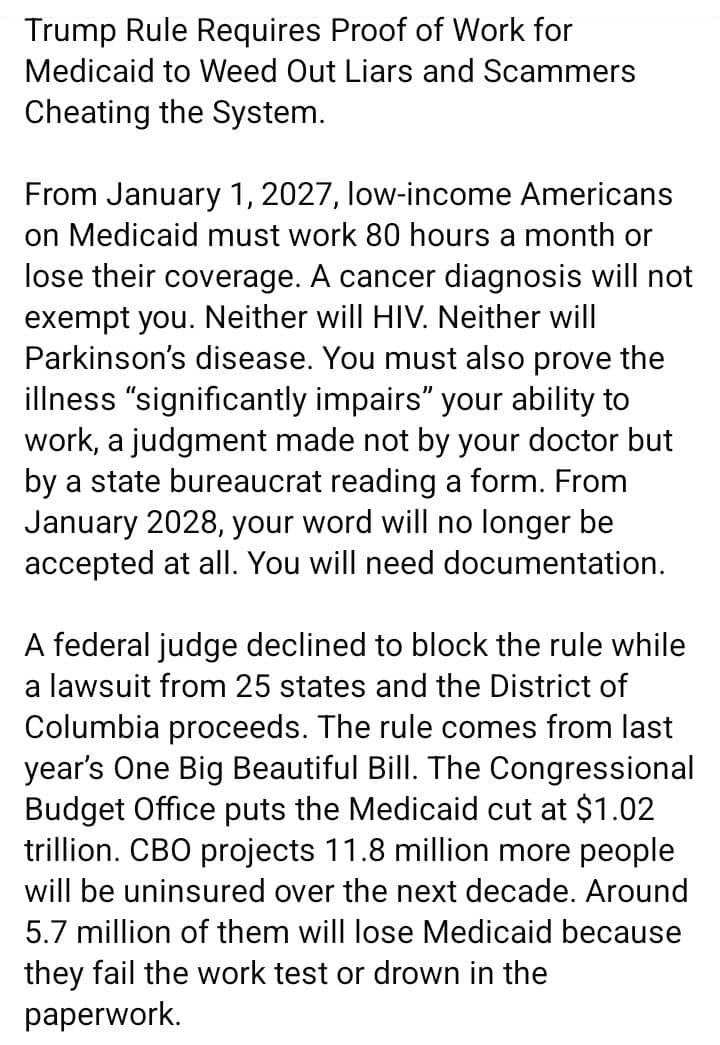
Opponents argue that the rule may remove eligible people rather than uncover large numbers of dishonest recipients.
Most Medicaid adults affected by the requirements are already working or face circumstances that could qualify them for an exemption, according to KFF. Many work in restaurants, retail stores, farms, care facilities, and other industries where employer-sponsored insurance is limited or unavailable.
New Jersey Democratic Rep. Frank Pallone called the policy “work requirements on steroids,” arguing that people could lose health coverage because they become buried in paperwork rather than because they refused to work.
Oregon Gov. Tina Kotek has also challenged the implementation process. She said states were being asked to enforce a complicated mandate “without clear rules, without enough time” and with the danger that qualified residents could lose coverage because of system failures.
Previous experience gives those concerns some weight. More than 18,000 people lost Medicaid coverage after Arkansas introduced work and reporting requirements in 2018. A study published in the New England Journal of Medicine found that the policy caused significant insurance losses but produced no significant increase in employment.
The Trump administration argues that the nationwide system will operate differently, with better data sharing, automatic verification, broader exemptions, required outreach, and a 30-day opportunity to correct problems. Whether those protections work will largely depend on how individual states build and manage their systems.
The rule therefore presents a straightforward principle wrapped in a complicated reality. Requiring proof may expose people who deliberately lie about their circumstances. It may also test whether government databases can distinguish a scammer from a nursing aide whose shifts were cut, a construction worker paid irregularly, or a chronically ill applicant whose exemption was not properly recorded.
By January 2027, that distinction will no longer be theoretical. It will determine who keeps a Medicaid card and who receives a notice saying their coverage is ending.