Pete Buttigieg May Take the Lead, but Democrats’ 2028 Puzzle Just Got Harder
The Democratic Party may finally have an early leader for 2028, but it still does not have anything close to a settled answer. Pete Buttigieg has moved to the front of a crowded field, giving the former transportation secretary something every possible presidential candidate wants: a headline that says momentum.
A new Emerson College Polling survey places Buttigieg at 19 percent among likely Democratic primary voters. California Gov. Gavin Newsom follows at 17 percent, while Georgia Sen. Jon Ossoff and New York Rep. Alexandria Ocasio-Cortez each draw 13 percent. Former Vice President Kamala Harris sits at 8 percent, and 13 percent of voters remain undecided. Those figures turn Buttigieg from an interesting possibility into the person every rival must now measure against. Still, a two-point advantage nearly two years before the first votes is less a throne than a folding chair. It can be moved quickly.
A Quiet Lead Becomes a Loud Political Signal

Buttigieg’s rise did not arrive with a campaign launch, a balloon-filled rally or a dramatic television announcement. It came quietly, through travel, interviews, fundraising, endorsements and steady appearances in states where Democrats are fighting to recover ground before the 2026 midterms. That makes the poll especially valuable. Buttigieg is leading without formally saying he is running, which allows him to collect the benefits of presidential attention without carrying the full burden of a declared candidacy. When asked during a July visit to Iowa whether he would rule out a 2028 run, his answer was one word: “Nope.”
He immediately redirected attention to the nearer contest. “I’m super focused on this year’s election,” Buttigieg said, adding that the future would come later and that Democrats had important races directly in front of them. It was a careful answer, but not a mysterious one.
The numbers also reveal why his position deserves notice. Emerson found Buttigieg receiving 19 percent support from both men and women, giving him a more balanced base than several rivals. Newsom performed much better among women than men, while Ossoff showed the opposite pattern. That balance could become Buttigieg’s most valuable early asset. Democrats are not merely searching for the candidate who excites one faction. They are searching for someone who can hold together college-educated suburban voters, younger activists, working families, Black voters, Latino voters and independents who may dislike both parties.
The New Primary Calendar Could Expose His Biggest Weakness
The race became more complicated on the same day Buttigieg’s poll lead drew national attention. Democratic officials selected South Carolina to open the party’s 2028 presidential nominating calendar, once again giving a diverse Southern electorate enormous influence over who survives the opening stage of the contest. That decision matters because Buttigieg’s 2020 campaign told two different stories. He became a top finisher in Iowa and placed a strong second in New Hampshire, proving he could organize, debate and charm voters in retail political settings. Then the contest moved to South Carolina, where Joe Biden dominated with powerful support from Black voters and Buttigieg’s campaign stalled.
Buttigieg dropped out shortly afterward, before Super Tuesday. The loss did not end his national career, but it exposed the central question that would follow him into another presidential bid: Can he build a coalition that looks like the entire Democratic Party, rather than the electorates of a few mostly white early states?
South Carolina going first removes the possibility of hiding that question behind an Iowa victory. Buttigieg would need trusted validators, deep local relationships and a message that speaks directly to Black communities from the opening bell. Television polish alone would not carry him through. Harris could benefit from the calendar because of her historic role as the nation’s first Black and South Asian vice president. Other possible contenders, including Ossoff, could also argue that their experience campaigning in the South gives them a clearer path. Buttigieg’s lead is real, but the route ahead now runs through terrain that caused him serious trouble before.
Buttigieg’s Strength Is Also the Party’s Gamble
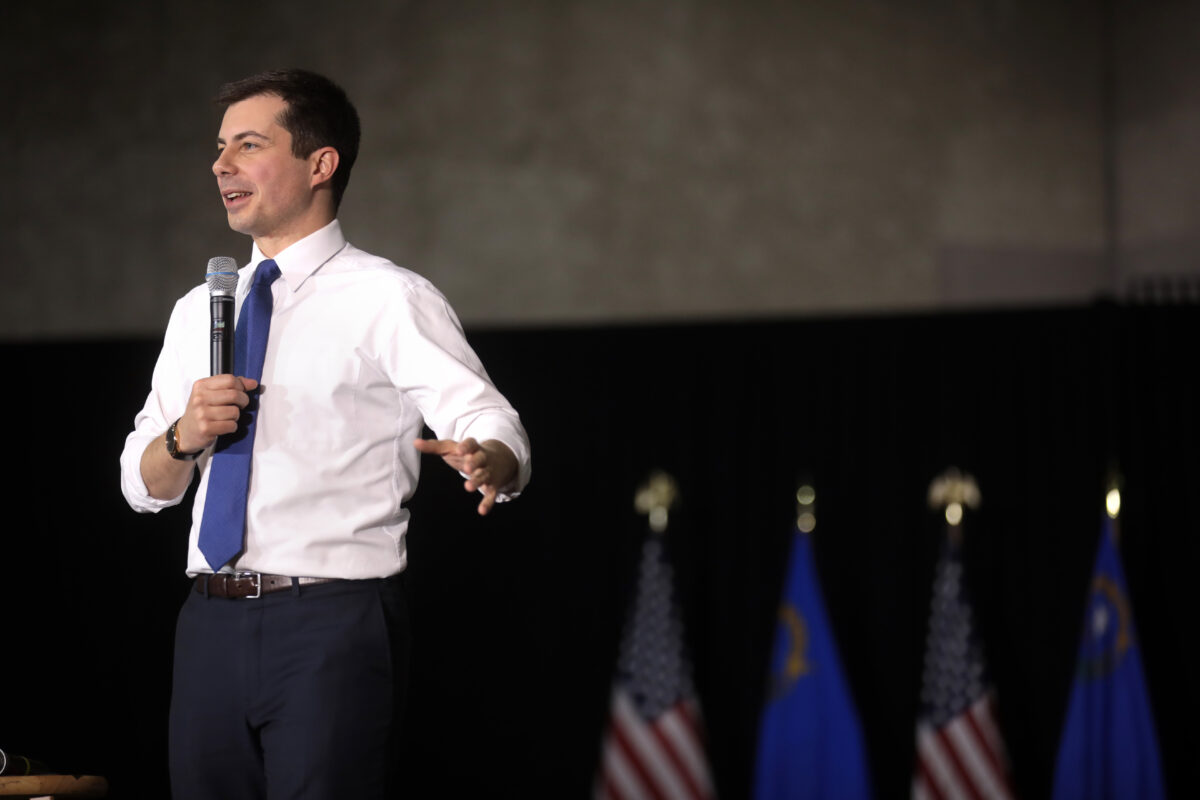
Buttigieg enters this early contest with advantages he did not possess in 2020. He is no longer simply the young mayor of South Bend, Indiana. He has served in a presidential Cabinet, managed a sprawling federal department and spent years defending Democratic policies in hostile interviews. His time as transportation secretary gave him a nationwide record to discuss. During a recent Florida appearance, he pointed to more than 70,000 infrastructure projects supported during the Biden administration, including airport modernization and new transportation investments. That provides him with something concrete to place beside his polished speeches.
He is also one of the party’s clearest communicators. Buttigieg can translate complicated policy into ordinary language, move from cable television combat to a local town hall and speak about patriotism without sounding embarrassed by it. In a political era filled with shouting, his controlled style can feel almost rebellious.
Yet that same polish can become a vulnerability. Rivals may portray him as too rehearsed, too closely tied to the Biden administration or too comfortable with elite political spaces. Democrats angry about the party’s 2024 defeat may want a fighter who sounds less like a briefing book and more like a battering ram. Newsom offers confrontation. Ocasio-Cortez offers ideological energy. Ossoff offers a younger swing state profile, while Harris retains unmatched national recognition. Buttigieg’s lane is competence, discipline and generational change, but he must prove that those qualities can generate emotional loyalty, not merely respectful applause.
The Emerson survey should therefore be read as an opening signal, not a prediction. It was conducted July 19 and 20 among 1,100 likely voters, with a credibility interval of plus or minus 2.9 percentage points for the overall sample. Smaller party and demographic groups carry wider uncertainty. For now, Buttigieg has earned the most useful title in early presidential politics: frontrunner. It gives him attention, donors, invitations and scrutiny in equal measure. The hard part begins when Democrats stop asking who looks good in a poll and start deciding who can survive South Carolina, unite a restless party and win the White House.