Stanford Commencement Walkout: When Silicon Valley’s Default Future Was Challenged on Stage
A Graduation Ceremony Split Into Two Realities
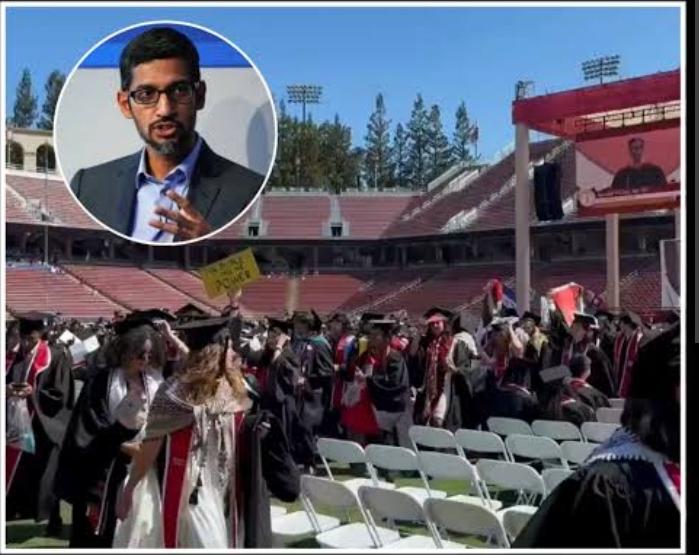
We witnessed a graduation ceremony that functioned like two events happening in the same physical space but operating in completely different moral universes.
On one side, Stanford University’s 135th Commencement celebrated achievement, legacy, and entry into elite global networks. Families recorded videos, faculty applauded, and Sundar Pichai, CEO of Google and Alphabet, stood on stage as a symbol of Stanford’s most recognizable success pathway into Silicon Valley power.
On the other side, a visible group of graduating students made a different kind of statement. They walked out during the keynote address, turning a ceremonial moment into a rupture in narrative control.
This was not spontaneous confusion or background noise. It was a coordinated interruption of what commencement is designed to do: unify a graduating class into a shared story of progress.
Instead, the class revealed a fracture.
The Hidden Structure Behind the Walkout: Stanford as Silicon Valley’s Talent Engine
Stanford is not just a university. It functions as a high-efficiency talent pipeline feeding directly into companies like Google, Apple, Meta, Amazon, and hundreds of venture-backed startups across the Bay Area.
For decades, this pipeline has operated with near default status:
- Study at Stanford
- Intern in Silicon Valley
- Join a Big Tech company
- Scale products used by billions
The walkout disrupted that assumed sequence.
Students were not only rejecting a speaker. They were symbolically questioning whether that pipeline still represents an acceptable moral trajectory.
What made this moment unusual was that it occurred at the exact point where that pipeline is most publicly celebrated: commencement.
Sundar Pichai as Symbol, Not Just Speaker
Sundar Pichai’s presence carried layered meaning beyond a typical keynote invitation.
He represents:
- A Stanford-trained engineer turned global CEO
- The architect of Google’s modern cloud and AI expansion
- A figure associated with both consumer innovation and government-scale infrastructure
That combination is precisely why the protest carried weight.
For critics, Pichai was not simply delivering a speech. He was embodying the overlap between elite education and global technological power structures that extend into surveillance, defense contracting, and geopolitical systems.
This is where the tension sharpened: commencement is meant to feel aspirational, but the symbol on stage was also tied to systems that are the subject of ethical dispute.
The Protest Was About Infrastructure, Not Just Ideology
A critical mistake in early interpretations of the walkout is to reduce it to a general political expression.
In reality, the protest centered on infrastructure-level concerns:
- Cloud computing contracts tied to governments
- AI systems embedded in public and defense environments
- Corporate involvement in contested geopolitical contexts
- The lack of transparency around deployment boundaries
This is why Project Nimbus became a focal reference point in broader debates.
Project Nimbus is a cloud computing agreement between Google and Amazon to provide services to government sectors, including Israel. While companies have stated limits on the scope of use, critics argue that the infrastructure itself cannot be separated from its downstream applications.
The students’ protest reflected a shift in thinking:
They were not asking whether technology is “good or bad.”
They were asking whether ownership of infrastructure equals responsibility for outcomes.
The New Student Question: “Where Does My Work End Up?”
A defining feature of this generation of graduates is not opposition to technology itself, but refusal to remain detached from its final deployment layer.
Earlier Silicon Valley narratives encouraged separation:
- Engineers build systems
- Business units sell systems.
- Governments use systems
The walkout signals rejection of that separation.
Instead, the emerging question is:
“If I build it, do I remain responsible for how it is used anywhere in the world?”
This represents a structural shift in expectations of professional ethics, not just in campus activism.
Commencement as a Controlled Narrative Environment
Graduation ceremonies are carefully constructed symbolic environments.
They are designed to:
- Reinforce institutional prestige
- Confirm career pathways
- Normalize elite success trajectories.
- Align graduates with alumni identity networks.
The walkout disrupted that controlled environment in real time.
What made it especially powerful was its timing. It did not occur before or after the speech. It occurred during it, forcing a visible split between participation and refusal.
In media terms, it transformed a scripted moment into an unscripted dual narrative:
- Official speech narrative
- Live student counter-narrative
Both occur simultaneously in the same frame.
The Emerging Divide: Builders vs. Consequence Bearers
A deeper structural divide is becoming visible across top universities:
Builders
- Engineers, executives, founders
- Focused on systems, scale, performance
- Embedded within institutional product pipelines
Consequence Bearers
- Students, communities, end users
- Experiencing downstream effects of deployed systems
- Increasingly vocal about ethical visibility
The Stanford walkout sits precisely at this boundary line.
It is not simply protest culture. It is a demand for the collapse of the distance between creation and consequence.
Why This Moment Became Nationally Visible

The walkout gained traction because it was visually and structurally simple:
- A global CEO speaking.
- Graduates standing and leaving.
- A prestigious institution caught between celebration and dissent
But its real significance is not visual, it is institutional.
It signals that elite universities are no longer neutral transition zones into Big Tech. They are becoming contested spaces where the legitimacy of that transition is actively questioned.
A Future Defined by Ethical Visibility, Not Just Innovation
The Stanford commencement walkout reflects a broader transformation in how technological success is evaluated.
The next generation of engineers and graduates is not rejecting innovation.
They are rejecting invisible impact.
The question is no longer:
“What can we build?”
It is becoming:
“What systems are we willing to be visibly accountable for after we build them?”
That shift does not end Silicon Valley’s influence. But it does change the emotional contract between institutions, companies, and the students they recruit.
Structural Insight
This was not a disruption of a graduation ceremony.
It was a disruption of a default future.