Texas Man Accused of Charging Migrants $200 for Ride Sparks Debate Over Where the Line Is Drawn
A strange and controversial immigration story has sparked heated debate online: a Texas man was reportedly accused of charging migrants $200 each while promising to transport them to places where they could seek asylum. Authorities allegedly say the trip did not go as the migrants expected, raising questions about whether the man was helping people navigate a complicated system or taking advantage of vulnerable individuals.
The case has attracted strong reactions because it sits at the intersection of several sensitive issues: immigration enforcement, asylum procedures, transportation of migrants, and the criminal laws surrounding human smuggling.
However, details surrounding the reported arrest remain limited. Publicly available information has not confirmed the man’s identity, the exact location of the arrest, or whether formal charges have been filed. Similar cases involving alleged migrant transportation-for-profit have resulted in arrests across Texas, but each case depends on its own facts and evidence.
A $200 Ride That Raised Questions

According to reports circulating online, the man allegedly offered migrants transportation for $200 per person while claiming he would take them somewhere they could pursue asylum.
The central question is not simply whether someone transported migrants. Transportation alone is not automatically a crime. The legal issue often depends on intent, circumstances, and whether authorities believe someone knowingly assisted unlawful entry or movement in exchange for money.
Federal authorities have prosecuted numerous cases where people were accused of transporting migrants for financial gain. In past cases, prosecutors have alleged that drivers concealed migrants, avoided checkpoints, or participated in organized smuggling operations.
That is why investigators typically look beyond the payment itself. They examine what promises were made, where people were taken, whether they were misled, and whether the transportation was part of a broader scheme.
The reported Texas case has created debate because some people view the alleged actions through a different lens. Supporters argue that if the man prevented migrants from being placed in dangerous situations, his actions deserve a different interpretation. Critics argue that charging vulnerable people for transportation under false promises, if proven, would represent exploitation.
The final answer depends on what investigators can prove.
Why Migrant Transportation Cases Are Complicated
The U.S. immigration system is filled with complicated procedures that many migrants struggle to understand. Asylum seekers often rely on information from family members, community networks, legal organizations, or other individuals who claim to know the process.
That creates opportunities for both legitimate assistance and potential abuse.
Human smuggling cases in Texas have frequently involved allegations that migrants were transported under dangerous or deceptive conditions. Authorities have previously reported cases involving hidden compartments, overcrowded vehicles, and attempts to avoid law enforcement checkpoints.
In one Texas case, federal prosecutors alleged that a driver transported dozens of migrants hidden inside a box truck. Another case involved migrants allegedly concealed inside a vehicle compartment. These cases highlight why authorities pay close attention to anyone making money from transporting people across immigration routes.
But the reported $200-per-person case raises a different question: what happens when someone claims to be helping migrants but authorities believe the situation was something else?
That is where public opinion becomes divided.
Some argue that anyone charging migrants for transportation is part of the problem. Others believe the circumstances matter and that not every person involved in migrant transportation has the same motives.
Was He Right or Wrong? The Answer Depends on the Evidence
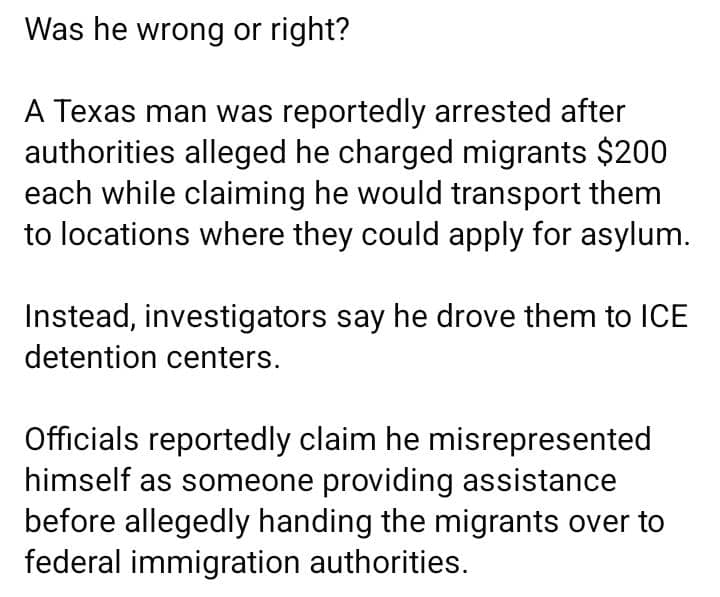
The public reaction to the story has been sharply divided.
Some people have praised the idea that someone may have prevented migrants from making dangerous journeys or being exploited by criminal networks. Others say that taking money from migrants while promising one destination and allegedly delivering another would be a serious violation of trust.
Legally, the key issue is not whether people agree with the man’s political views or immigration opinions. The question is whether authorities can prove that he committed a crime.
If investigators establish that he knowingly deceived migrants, profited from their vulnerability, or illegally assisted in their movement, prosecutors could argue that enforcement action was justified.
If the facts show something different, such as a misunderstanding or lawful transportation, the situation could look very different.
Similar immigration-related arrests have shown that accusations alone do not determine guilt. Court proceedings, evidence, and legal arguments ultimately decide the outcome.
For now, the case remains a reminder of how complicated America’s immigration debate has become. A simple question about a ride can quickly become a larger argument about law enforcement, compassion, responsibility, and the limits of personal action.
Until verified details emerge from authorities or court records, the most accurate conclusion is this: the man’s actions may have been viewed differently by different groups, but whether he was right or wrong depends on facts that have not yet been fully established.