The Unlikely Senate Friendship Between Fetterman and McCormick That Has Republicans Curious and Democrats Concerned
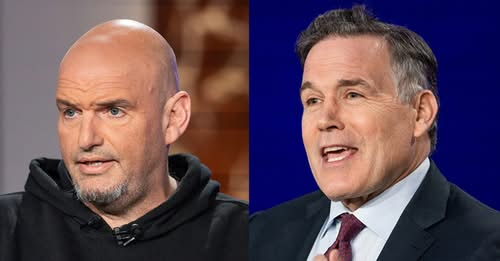
Pennsylvania’s two U.S. senators were supposed to represent opposite sides of America’s political divide. Instead, Democrat John Fetterman and Republican Dave McCormick are increasingly behaving like partners, creating an unusual Senate alliance that Republicans are embracing and some Democrats are watching with growing unease.
The relationship between Sen. John Fetterman, D-Pa., and Sen. Dave McCormick, R-Pa., has moved far beyond ceremonial cooperation between two lawmakers representing the same state. They have appeared together, introduced legislation together and publicly praised one another, while maintaining a noticeably friendly relationship in a Senate where partisan conflict often dominates the headlines.
Their partnership has become even more politically significant because Fetterman has increasingly separated himself from parts of the Democratic Party on several major issues. McCormick, meanwhile, has openly praised his Democratic colleague for challenging his own party.
What we are seeing in Pennsylvania is therefore more than an unusual friendship. Fetterman and McCormick are testing whether a Democrat and a Republican from one of America’s most important battleground states can build a political partnership without paying a steep price inside their own parties.
John Fetterman and Dave McCormick Keep Finding Common Ground
The partnership has produced tangible legislative work.On August 10, Fetterman’s Senate office announced that he and McCormick had introduced legislation targeting the spread of spotted lanternflies, an invasive species that has caused significant problems for Pennsylvania agriculture. The bill would make the pest a high-priorityresearch initiative within the National Institute of Food and Agriculture.
It was hardly their only recent collaboration. The two senators also introduced the Workforce Recovery and Resilience Act, legislation designed to strengthen the workforce providing addiction prevention, treatment, and recovery services. The proposal would expand workforce programs available to communities struggling with substance use disorders, including those affected by the opioid and fentanyl crisis.
That cooperation matters in Pennsylvania, where both lawmakers have strong political incentives to show voters that Washington can produce practical results. But their relationship has gone considerably further than sponsoring legislation.
A Bipartisan Friendship Became a Political Partnership
Fetterman and McCormick have spent more than a year demonstrating that their relationship is unusually cordial. During a June 2025 forum at the Edward M. Kennedy Institute, the senators discussed subjects ranging from Israel and Iran to U.S. Steel, federal spending and Pennsylvania’s economy. Despite belonging to opposing parties, the two found substantial areas of agreement during the discussion.
Their similarities were particularly noticeable on foreign policy. Both have strongly supported Israel, taken hawkish positions toward Iran and backed a tough approach toward Russia. During the forum, Fetterman also praised several actions taken by President Donald Trump, while maintaining his opposition to Republican proposals that he believed could cut programs such as Medicaid and SNAP.
The distinction is important. Fetterman has not simply adopted McCormick’s Republican platform. Instead, he has been willing to agree with Republicans publicly when he believes they are right while opposing them elsewhere. That approach has helped create an unusual political identity for the Pennsylvania Democrat. McCormick appears to appreciate it.
Why Republicans Are Paying Attention to Fetterman
McCormick publicly praised Fetterman again on August 9, saying he respected his colleague’s willingness to challenge Democrats even though Fetterman continues to vote with his party on the overwhelming majority of issues.
McCormick described Fetterman as a valuable Pennsylvania partner and argued that his willingness to criticize positions within his own party had increased his popularity with some voters. Polling helps explain why Republicans have noticed.
A July Quinnipiac University poll cited in reporting on McCormick’s comments showed Fetterman with strikingly different ratings across party lines: 77 percent of Republicans approved of his performance, while 69 percent of Democrats disapproved.
For a sitting Democratic senator, those numbers represent a remarkable political inversion. Fetterman entered national politics with a reputation as an unconventional progressive. He supported Bernie Sanders during his earlier presidential campaigns and became known for positions associated with the Democratic Party’s populist left.
Yet his Senate record has complicated that image. His unapologetic support for Israel has placed him at odds with progressive Democrats. He has also backed some Trump administration nominees and policies that most members of his party opposed.
That does not automatically make Fetterman a Republican. It does, however, explain why conservatives increasingly see him differently from most Democratic senators.
Democrats Have More Reason to Watch the Partnership Closely
The political danger for Democrats is not merely that Fetterman occasionally votes with Republicans. It is that his relationship with McCormick provides a competing model of what a Democratic senator from a battleground state could look like.
Pennsylvania remains central to presidential and congressional politics. A Democrat who attracts significant Republican support while maintaining enough independents and traditional Democratic voters could potentially build an unusual statewide coalition.
That possibility becomes more interesting as progressive candidates push the Democratic Party in a different direction elsewhere.
Fetterman has repeatedly insisted that he remains a Democrat. In a May Washington Post opinion article, he said he had “no plans to leave” the party while defending his willingness to work with Republicans and put Pennsylvania ahead of partisan expectations. Still, political speculation has persisted.
Republican lawmakers have defended him against criticism from Democrats, while some conservative organizations have previously run advertising encouraging his independent behavior. Democratic Sen. Ruben Gallego of Arizona even suggested in 2025 that Republicans were trying to politically court Fetterman.The growing McCormick relationship only gives those suspicions more oxygen.
Their Joint Fundraising Move Raised the Stakes
Perhaps the clearest indication that this relationship had become something more unusual arrived in July.
Federal Election Commission records showed that Fetterman and McCormick established Common Ground PA, a joint fundraising committee connected to both senators’ political organizations. The arrangement allows the Democratic and Republican senators to raise money through the same bipartisan committee.
That is where friendship begins to overlap unmistakably with electoral politics. Fetterman faces reelection in 2028, while McCormick’s next scheduled Senate election comes in 2030. Their fundraising alliance therefore creates political infrastructure that could survive well beyond individual pieces of legislation.
For Democrats already uneasy about Fetterman’s ideological independence, such an arrangement naturally attracts attention. It also strengthens McCormick’s image as a Republican capable of working across party lines without abandoning his conservative identity.
Pennsylvania Comes Before the Party Label
The senators have repeatedly framed their cooperation around Pennsylvania rather than Washington’s partisan battles. That was especially visible when they worked together to ensure Pennsylvania had a presence at the Great American State Fair connected to celebrations surrounding America’s 250th anniversary.
After Pennsylvania Gov. Josh Shapiro chose not to participate through the state government, McCormick and Fetterman helped organize a privately backed Pennsylvania presence at the event, emphasizing the state’s historical, agricultural and economic importance. Their approach illustrates why the partnership may be politically durable.
State delegations have traditionally worked together on infrastructure, agriculture, disaster assistance, military facilities and local economic priorities regardless of party. Fetterman and McCormick have taken that traditional cooperation and made it unusually visible. They also appear personally comfortable with each other.
Earlier reporting described McCormick saying Fetterman had been a “real role model” during his first period in the Senate. Fetterman, in turn, has emphasized avoiding personal attacks between them even when campaigns and party politics become more contentious.
That may sound ordinary outside Washington. Inside a highly polarized political environment, it is considerably more unusual.
The Senate Odd Couple Could Become a Battleground-State Experiment
The real question surrounding John Fetterman and Dave McCormick is not whether they agree on everything. They clearly do not. Fetterman still supports many Democratic economic and social policies. McCormick remains a Republican aligned with a fundamentally different governing agenda. Their importance comes from what happens when they disagree.
Instead of treating every disagreement as evidence that the other senator is dangerous, dishonest, or unacceptable, they have created room for cooperation on the subjects where their interests overlap. That model could become especially important as both parties prepare for future elections in Pennsylvania.
Republicans can point to Fetterman as evidence that some Democratic voters and politicians reject parts of the progressive agenda. Democrats, however, face a more complicated calculation. Attacking Fetterman too aggressively could alienate voters attracted to his independence, while allowing his departures from the party to go unanswered could encourage other battleground-state Democrats to follow his example.
That is what makes this Senate odd couple politically consequential. McCormick gains bipartisan credibility. Fetterman strengthens an independent identity that increasingly separates him from Democratic orthodoxy. Pennsylvania gets two senators who appear willing to cooperate when state interests are involved.
Whether that formula eventually strengthens Fetterman’s position inside the Democratic Party or pushes him further toward its edges remains uncertain.
For now, however, the unusual alliance is becoming increasingly difficult for Washington to dismiss as a novelty. John Fetterman and Dave McCormick have turned an unlikely friendship into a functioning political partnership, and both Republicans and Democrats are beginning to recognize that the consequences could extend far beyond Pennsylvania.