Trump’s Great American State Fair Turns America’s 250th Celebration Into a Test of Unity, Identity, and Political Meaning.
A National Celebration Built Like a Stage Production, Not a Neutral Gathering
The Great American State Fair on the National Mall was designed to feel like a national reunion, but what unfolded was more like a carefully choreographed civic production.
Set between the Capitol and the Washington Monument, the fair stretches across one of the most symbolically charged public spaces in the United States. Visitors move through state pavilions, patriotic installations, food corridors, and entertainment zones under the same skyline that hosts inaugurations, protests, and national memorials. The setting alone elevates every detail into something larger than a typical fairground experience.
At the center of it all is the broader “Freedom 250” framework marking America’s 250th anniversary, an initiative that blends historical commemoration with large-scale public programming, military displays, cultural exhibitions, and national branding. The result is not just a celebration of history, but a live attempt to define what that history means in the present moment.
And that is where the tension begins.
Because while the fair presents itself as a nonpartisan expression of national unity, its design, messaging, and launch moments inevitably invite political interpretation. Even before visitors arrive, meaning has already been assigned to the experience.
Manufactured Unity vs. Lived Experience: Two Versions of the Same Fair
The most striking feature of the Great American State Fair is not what is present, but how differently it is interpreted.
We can see two parallel experiences unfolding at once:
On one side is the intended narrative:
- A unified national celebration
- States and territories gathered in one shared space.
- Families enjoying entertainment, food, and cultural displays
- A symbolic “America at 250” moment of collective pride
On the other side is the interpreted reality:
- A politically branded national spectacle
- A celebration shaped by presidential imagery and messaging
- Uneven participation from states and cultural groups
- Performative unity that feels staged rather than organic
This is what makes the fair unusual. It does not simply host a crowd. It hosts two competing versions of America occupying the same physical space.
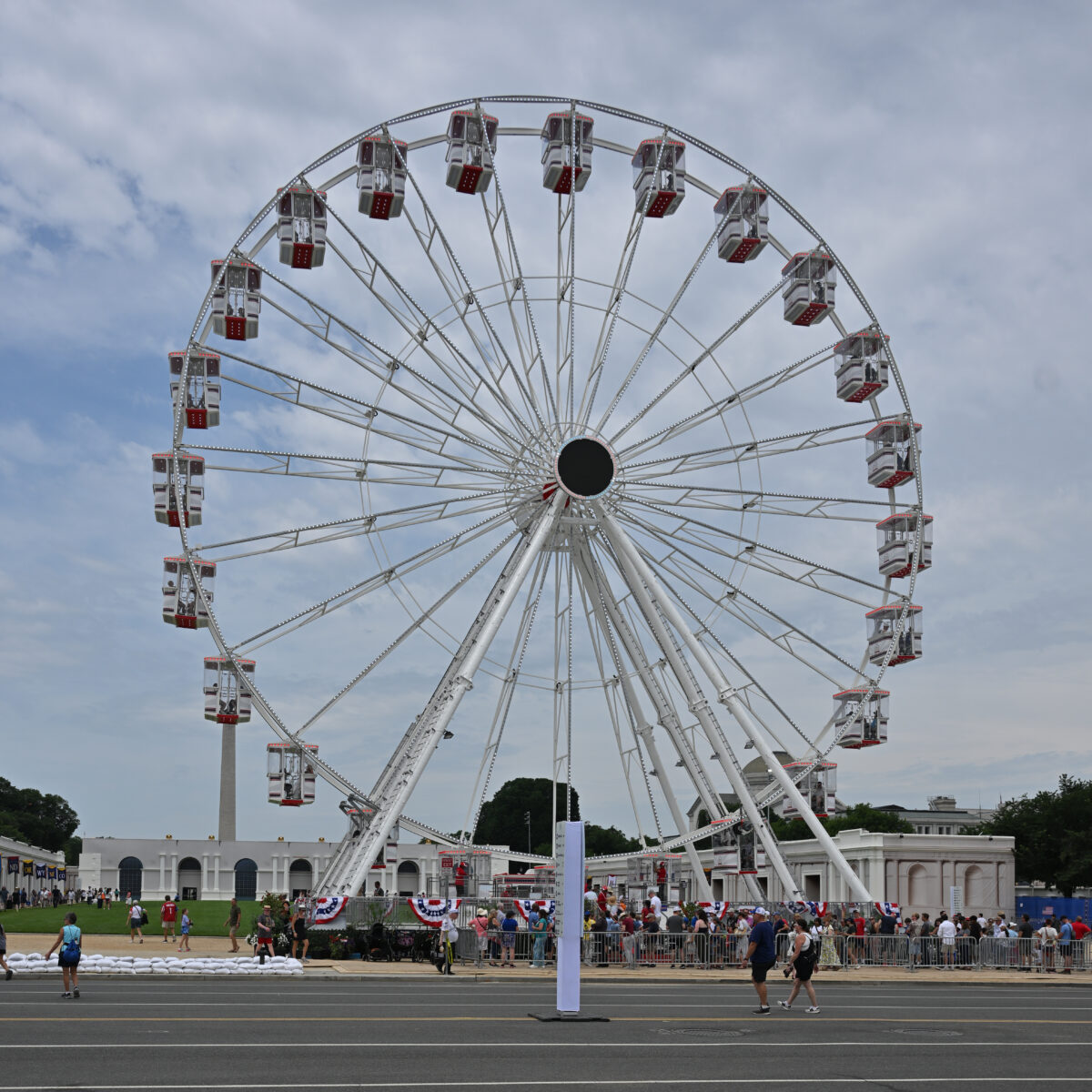
Visitors walking past Ferris wheels and state exhibits may experience joy, curiosity, and nostalgia. At the same time, media coverage, political context, and symbolic staging push the event into a second layer of meaning that many cannot ignore.
The result is a rare modern phenomenon: a celebration that cannot settle on what it is celebrating.
The Invisible America Problem: What Is Missing Matters as Much as What Is Displayed
A national fair built on the idea of “all states represented” carries an expectation of completeness. Yet the reality is more fragmented.
Some states and cultural groups are visibly underrepresented or absent from official participation. Several announced performances and cultural contributions were scaled back or withdrawn before or during the opening phase. Certain exhibit spaces remain minimally staffed or inconsistent in engagement, creating gaps in what is presented as a fully unified national showcase.
These absences do not dominate the physical layout of the fair, but they reshape its meaning.
Because in a celebration built on total inclusion, a lack of participation becomes a message in itself.
It raises uncomfortable questions:
- Who feels represented in this national narrative?
- Who chooses not to participate in it?
- And what does “America at 250” mean when parts of America are not fully present?
The fair becomes not just a display of identity, but a quiet map of national hesitation.
Trump’s Presence and the Political Weight of Celebration
President Donald Trump’s association with the fair’s opening ensures it cannot be viewed as purely ceremonial. The kickoff programming placed presidential presence at the center of attention, aligning the event visually and symbolically with a familiar political style that emphasizes scale, patriotism, and direct public spectacle.
Even when attendees do not focus on politics, the structure of the event carries political meaning through:
- Branding language tied to “Freedom 250”
- Military flyovers and ceremonial staging
- Rally-style opening elements
- High-visibility executive association
This creates a paradox. The fair invites Americans to step outside political division, while simultaneously embedding itself within a highly recognizable political environment.
For supporters, this enhances the sense of pride and national energy. For critics, it reinforces concerns about the personalization of national celebration. For many visitors, it creates a blended experience where entertainment and interpretation cannot be fully separated.
Two Americas on the Same Lawn: Experience vs Interpretation
The Great American State Fair reveals a broader cultural divide that extends beyond politics into perception itself.
America One: The Experiential Lens
- Families enjoying rides, food, and exhibits
- Children react to animals, colors, and performances.
- Tourists taking photos near monuments.
- Visitors engaging with state displays as cultural learning.
America Two: The Interpretive Lens
- The media framed the event through political symbolism.
- Online debates about representation and intent
- Commentary on branding, participation, and messaging
- Questions about national identity and ownership
Both versions are real. Both are happening simultaneously.
The difference is not in what people see, but in how meaning is assigned to what they see. The fair becomes a shared physical environment interpreted through entirely different cultural frameworks.
This is what makes the event less like a traditional fair and more like a national “meaning field,” where interpretation is as important as participation.
The National Mall Effect: Why Location Turns Celebration Into Symbolism
The National Mall is not a neutral venue. It is the symbolic center of American civic identity.
Every structure surrounding the fair contributes to its amplified meaning:
- The Capitol signals governance and political authority.
- The Washington Monument represents national memory.
- The Lincoln Memorial embodies unity and the resolution of civil conflict.
- Smithsonian institutions frame historical narrative.
When a fair is placed in this environment, it cannot remain purely recreational. Every booth, performance, and installation becomes part of a larger civic dialogue, whether intended or not.
Even simple attractions such as Ferris wheels or food stalls take on symbolic weight because they exist within a space historically reserved for national reflection and public expression.
This transforms the fair from an event into a statement about what America chooses to display in its most iconic public space.
The Emotional Split: Nostalgia, Fatigue, and the Search for Shared Meaning
Visitor reactions reflect a deeper emotional divide in American civic life.
Some attendees approach the fair with nostalgia, seeing it as a rare moment of national pride and public gathering. Others experience fatigue, interpreting the same imagery through a lens of political saturation and cultural overexposure.
Three emotional patterns dominate:
- Nostalgia for shared national celebrations that feel simpler
- Fatigue with the constant political interpretation of public life
- Curiosity mixed with skepticism about national branding efforts.
This emotional split matters because it shapes whether Americans experience the fair as a celebration or a commentary on division.
A Nation Attempting to Brand Itself at 250 Years
At its core, the Great American State Fair is not only a celebration. It is also a form of national storytelling at scale.
It attempts to present America as:
- Diverse but unified
- Historic yet modern
- Patriotic yet inclusive
- Local yet national
But branding a nation is not the same as unifying it.
The fair highlights a central challenge of the 250th-anniversary moment: America is not only remembering its past but also actively negotiating what its identity should look like in the present.
And unlike commercial branding, national identity cannot be fully designed. It must be accepted, contested, and lived.
A Celebration That Reflects a Divided Interpretation of America
The Great American State Fair succeeds most clearly in one area: it reveals what America looks like when it tries to celebrate itself in public at scale.
What it does not resolve is whether that celebration can be interpreted in a shared way.
For some, it is a joyful national gathering filled with exhibits, culture, and family experiences. For others, it is a politically framed spectacle layered onto a divided national mood. For many, it is both at once.
That duality may be the most accurate reflection of America at 250 years old.
A country still capable of gathering.
A country is still uncertain what it is gathering for.