Warren Slams Trump’s Haiti TPS Move as Massachusetts Braces for Workforce Shock
Sen. Elizabeth Warren is criticizing President Donald Trump’s decision to end Temporary Protected Status (TPS) for Haitians, arguing that the move threatens people who have legally worked, paid taxes, and contributed to the Massachusetts economy.
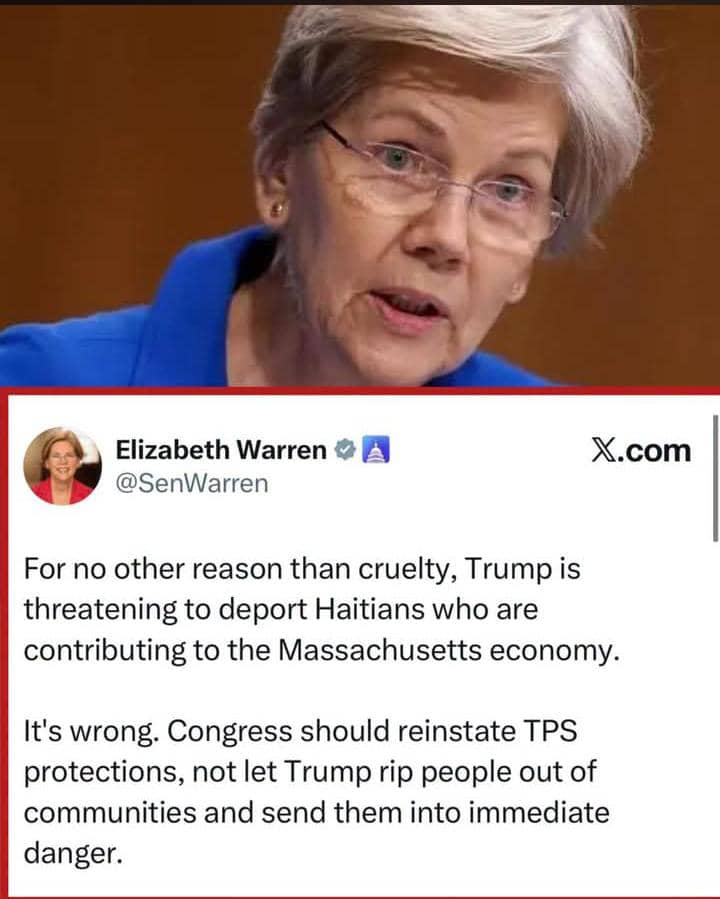
“For no other reason than cruelty, Trump is threatening to deport Haitians who are contributing to the Massachusetts economy,” Warren said. “It’s wrong. Congress should reinstate TPS protections, not let Trump rip people out of communities and send them into immediate danger.”
The statement came after Haitian TPS protections expired on July 27 following a Supreme Court ruling that allowed the Trump administration’s termination plan to move forward.
The decision immediately placed thousands of Haitian nationals in a difficult position. Without another legal status, many could lose their ability to work and may face immigration enforcement proceedings.
The Supreme Court ruling changed the legal battle over TPS
The Supreme Court’s decision did not declare Haiti safe for return. Instead, the ruling focused on whether federal courts had the authority to block the Department of Homeland Security’s decision to end TPS protections.
In a 6-3 decision, the court ruled that immigration authorities have broad discretion over TPS designations and terminations. The justices found that challengers had not shown enough legal grounds at that stage to stop the policy.
The ruling allowed the administration’s decision to end protections for Haitian TPS holders to take effect.
Warren strongly criticized the outcome, saying the ruling could put thousands of families at risk.
“This decision is a disaster for the rule of law and a disaster for thousands of families in Massachusetts,” Warren said.
The Trump administration defended the move, arguing that TPS was created as a temporary protection and should not become a permanent immigration program.
DHS General Counsel James Percival said the decision supported “the rule of law and common sense,” adding that TPS “was always supposed to be temporary and can be cancelled at the appropriate time.”
The administration has argued that conditions in Haiti have changed enough to allow returns, although the situation in the country remains a major point of debate.
Massachusetts leaders warn about economic consequences
The fight over TPS extends beyond immigration policy. Massachusetts officials say Haitian workers play important roles in industries already facing staffing challenges.
Gov. Maura Healey’s office estimates that tens of thousands of Haitian TPS holders live in Massachusetts, with many working in health care, elder care, construction, hospitality, and other essential industries.
“Haitian TPS holders are essential contributors to our state’s workforce, filling roles that are vital to our economic stability and growth,” Healey said.
Healthcare providers have raised particular concerns.
Nursing homes and care organizations say losing experienced employees could worsen existing worker shortages and create additional pressure on facilities that rely on immigrant labor.
A report from Warren, Sen. Ed Markey, and Rep. Ayanna Pressley highlighted concerns from Massachusetts employers who said TPS uncertainty was already affecting staffing.
One organization reported losing more than 100 Haitian employees and struggling to replace them, leading to increased overtime costs and operational challenges.
“Our care economy does not run on apps or algorithms, it runs on people,” Markey said. “And many of those people are the Haitian TPS holders in our communities.”
For patients and families, the issue is personal. A missing healthcare worker can mean longer waits, fewer available caregivers, and additional stress for vulnerable residents who depend on consistent support.
United Way of Massachusetts Bay President Marty Martinez said the end of TPS has left thousands of families uncertain about their futures.
Congress faces pressure to act as Haitian families wait
With the court decision allowing the termination to proceed, supporters of TPS protections are turning their attention to Congress.
Lawmakers have introduced legislation that would restore protections for Haitians, but the proposal faces political challenges.
The Trump administration has opposed efforts to extend TPS, arguing that the program should remain temporary and that immigration decisions should reflect national interests.
Supporters of TPS argue that many Haitian recipients have built lives in the United States. They point to workers who have spent years contributing to local economies, raising families, and filling critical jobs.
The debate also centers on conditions in Haiti itself.
The U.S. State Department continues to warn travelers about serious risks in Haiti, including violent crime, kidnapping, unrest, and limited access to healthcare.
Critics of ending TPS argue that sending people back while the country faces severe instability creates unnecessary danger.
The administration maintains that immigration law requires TPS decisions to be reviewed and that temporary protections cannot continue indefinitely.
For Haitian families in Massachusetts, however, the issue is immediate.
A program that was originally temporary lasted long enough for many people to establish careers, communities, and deep connections in the United States.
Now, lawmakers must decide whether to restore those protections or allow thousands of Haitian TPS holders to face an uncertain future.