Why Some Walmart Products Have Electronic Tags and What They’re Used For
If you have ever noticed a small electronic label attached to a product at Walmart, it does not automatically mean you are looking at an anti-theft device.
Some electronic labels are designed to help retailers keep track of merchandise and manage inventory. Others can be part of a store security system. Some technologies can support both jobs when they are used with compatible equipment.
The difference comes down to the technology behind the label and the system using it.
RFID is mainly about knowing where merchandise is
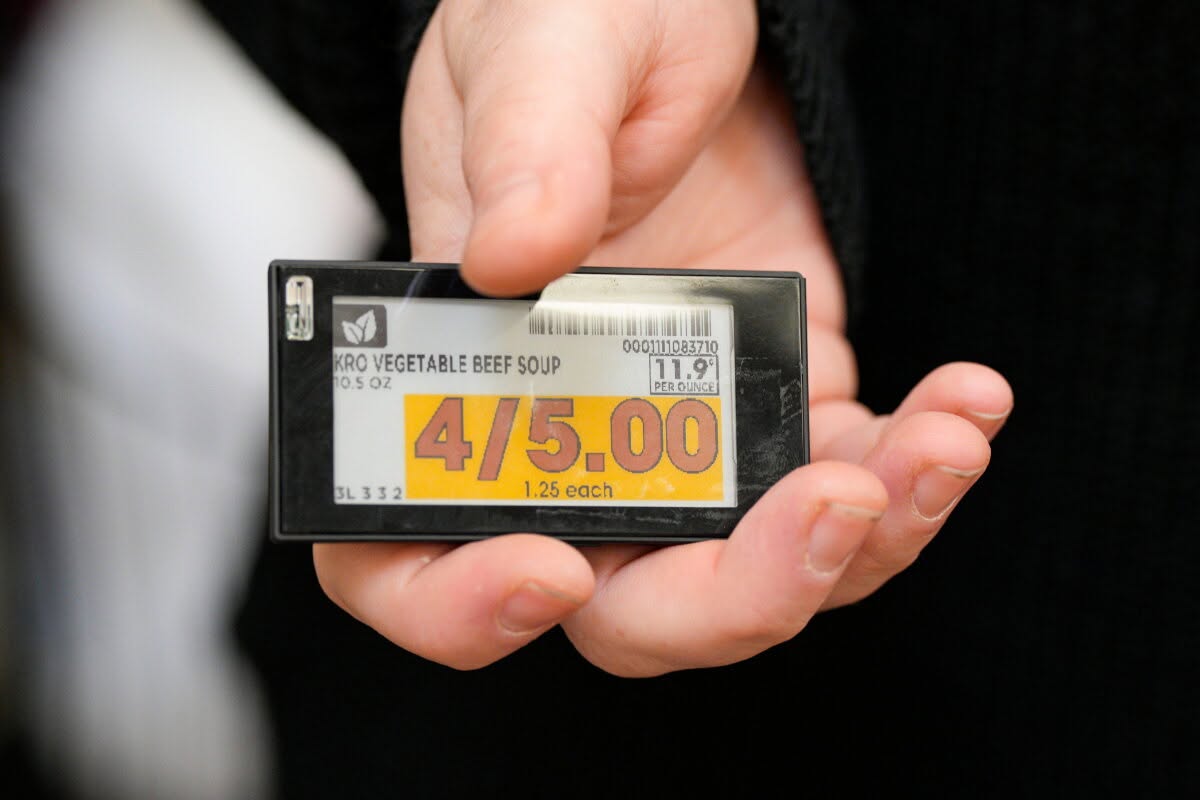
One of the technologies shoppers may encounter is RFID, short for radio-frequency identification. Instead of relying on a printed barcode that has to be visually scanned, an RFID tag communicates identifying information wirelessly using radio signals.
Walmart’s RFID supplier program has been introduced in phases by product category. Avery Dennison’s guidance for Walmart suppliers describes the program as an inventory-management system designed around item-level identification.
That gives retailers a more detailed way to understand what merchandise they have on hand. The basic idea is straightforward: the electronic identity attached to an item can help employees count and locate products as they manage store inventory.
An RFID tag can identify an individual item
There is an important difference between a regular product barcode and an RFID identity.
Two identical products can carry the same UPC because they are the same product. An RFID system, however, can give individual units their own electronic identities. Walmart supplier materials describe the Electronic Product Code, or EPC, as combining a product identifier such as a UPC with a serial number.
That distinction can make inventory work more precise. RFID readers can identify and count multiple tagged products quickly, rather than relying solely on someone locating and scanning individual items.
For shoppers, the practical purpose is less mysterious than it might look. The technology is about identifying merchandise electronically.
The technology can help with everyday inventory problems
Electronic identification becomes particularly useful when a store needs to understand what is actually on its shelves or in its inventory.
Walmart’s RFID guidance describes applications that include counting merchandise and reviewing inventory by item, color, size, and SKU. It can also help identify missing sizes or colors that need replenishment.
That means the technology can connect a physical product with the inventory information associated with it.
It does not guarantee that a particular item will always be available. Instead, it provides a tool for understanding merchandise levels and identifying items that may need attention.
Not every electronic label is an anti-theft tag
This is where the terminology can get confusing.
Retail security systems commonly use electronic article surveillance, or EAS. These systems can detect compatible active labels when merchandise passes through a detection zone. Traditional EAS technologies include acousto-magnetic, or AM, and radio-frequency, or RF, systems.
RFID is different because its documented inventory role is to identify merchandise and support stock management.
There can also be overlap. Sensormatic’s documentation describes RFID labels that can support inventory applications while also working with RFID-based EAS systems. In other words, a compatible label and system can potentially serve both inventory and security purposes.
So seeing an electronic label on a product is not enough to determine what that particular label does.
Security labels can be applied before products reach the store
Another reason an electronic label may already be attached to merchandise is that some security labeling takes place during manufacturing.
Sensormatic describes security labels that can be applied during manufacturing, so products arrive at the retailer ready for sale. Walmart’s supplier guidance also outlines responsibilities involving tag selection, encoding, and placement.
Placement can vary depending on the product.
That means an unfamiliar electronic label should not automatically be assumed to have been added by a Walmart employee in the store. The available documentation shows that electronic labeling can be part of the merchandise process before a product reaches the sales floor.
A digital watermark is something different
There is another technology that can make this subject even more confusing: digital watermarks.
May 2025 reporting described Great Value packaging that incorporated Digimarc digital watermarks into the artwork. Compatible scanners can read identifiers from areas of the package away from the conventional visible barcode.
But a digital watermark incorporated into packaging artwork is not the same thing as a physical RFID or EAS label.
It helps to think of these as three separate concepts: the familiar printed barcode, a physical electronic tag, and a digital watermark built into packaging artwork.
They can all help identify products in different ways, but they should not be treated as interchangeable technologies.
Walmart has also explored RFID for fresh categories
Electronic labeling is not limited to the traditional inventory question of counting products.
October 2025 retail trade reporting described Walmart’s work with Avery Dennison on RFID labels for fresh categories including meat, bakery, and deli products. The reported goals included faster inventory tracking, improved stock availability, better rotation, and more informed markdowns using digital use-by dates.
That example shows how electronic identification can be connected to several parts of merchandise management.
It also has an important limitation: the October 2025 development does not establish that the same system is available on every product or at every Walmart location.
What shoppers should take from those little labels
The simplest takeaway is that an electronic label can have more than one possible purpose.
It may help identify individual merchandise and support inventory management. It may work as part of a compatible retail security system. In some implementations, it can support both functions.
What the label looks like or where it happens to be attached does not, by itself, reveal its exact purpose.
So the next time you notice an electronic tag on a Walmart product, there is no need to assume it is automatically an anti-theft sticker. It may simply be one small part of a much larger system retailers use to identify, count, manage, and secure merchandise.