Reflecting Pool Fallout Deepens: Arrest Claims, Algae Surge, and the National Mall’s Most Contested Renovation in Years
A National Landmark Caught Between Symbolism, Science, and Suspicion
We are witnessing an unusual collision at the heart of Washington, D.C., where a historic landmark, a multimillion-dollar renovation, and a rapidly escalating narrative of vandalism are unfolding simultaneously.
The Lincoln Memorial Reflecting Pool, one of the most visually iconic spaces in the United States, has become the center of competing explanations: political claims of deliberate sabotage, law enforcement activity tied to alleged damage, and environmental factors that experts say have long challenged the site’s stability.
What makes this moment different is not just the condition of the pool, but how quickly it shifted from a completed renovation into a national controversy.
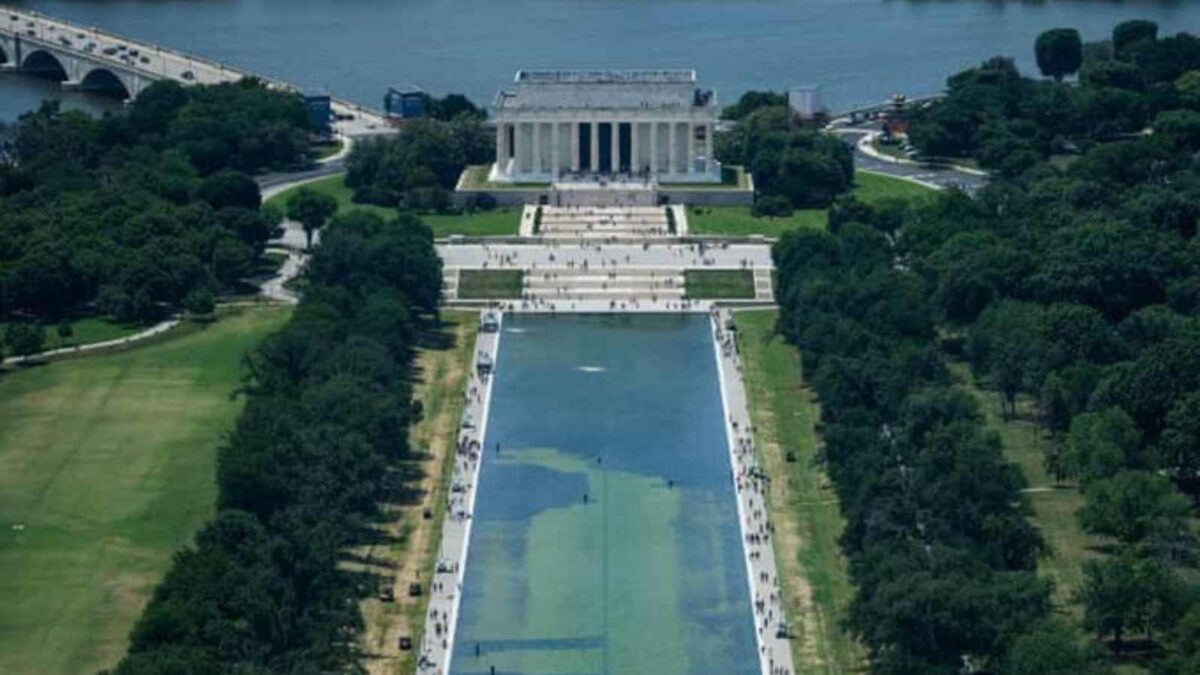
Within days of reopening, visible algae growth appeared in the water. Shortly after, sections of the newly applied blue surface began to peel and separate. Almost immediately, accusations followed.
President Donald Trump publicly alleged that vandals had intentionally damaged the pool and suggested chemical interference. He later stated that arrests had been made and that additional individuals were being investigated in connection with what he called “seriously vandalized” conditions.
Federal authorities have confirmed enforcement actions and citations linked to the site, and have warned that further prosecution is possible. But key details remain limited, and the full breakdown of what happened has not yet been publicly established.
The Reflecting Pool’s Fast-Track Failure Cycle
The speed of visible deterioration has become one of the defining elements of this case.
The Reflecting Pool was recently reopened following a high-cost renovation aimed at improving its appearance ahead of national milestone celebrations tied to America’s 250th anniversary. The upgrade included a renewed surface treatment and water restoration efforts designed to produce a cleaner, more vivid visual effect.
Instead, the sequence that followed was unusually compressed:
- Renovation completed and water refilled
- Blue-toned surface and visual enhancements introduced.
- Algae growth appeared within days.
- Surface peeling and irregular detachment were observed shortly after
- Public and media attention escalated almost immediately.
This rapid progression has fueled competing interpretations. Some view it as evidence of intentional interference. Others see it as a predictable outcome of water chemistry, heat exposure, shallow-basin conditions, and historically recurring algal cycles.
What is undisputed is the problem’s visibility. Few infrastructure issues in Washington escalate into a national debate within such a short window.
Arrests, Citations, and the Fragmented Accountability Chain
Law enforcement activity has become a central part of the narrative,but also one of its least clearly defined components.
One publicly identified case involves David Hearn, a former Olympic canoeist, who was arrested by U.S. Park Police and charged with misdemeanor destruction of government property. He has denied any intent to vandalize, stating that he only briefly interacted with a loose piece of material before being detained.
Officials have also cited additional enforcement actions tied to the Reflecting Pool area. However, the full scope of arrests, identities of other individuals, and specific allegations have not been comprehensively disclosed.
This creates a fragmented accountability chain:
- Political claims assert deliberate sabotage.
- Law enforcement confirms citations and arrests in limited form.
- Prosecutors signal willingness to pursue charges.
- Public documentation remains partial and evolving.
In the absence of a complete public record, interpretation fills the gap,fueling competing narratives that outpace verified facts.
The Engineering Reality Behind a Politically Charged Water Feature
Beyond the legal and political tension lies a less visible but critical layer: the engineering constraints of the Reflecting Pool itself.
The basin is shallow, expansive, and exposed to constant environmental pressure. Heat, sunlight, organic matter, and limited water depth all contribute to recurring algal growth. Historical maintenance records show that algal outbreaks have recurred across multiple restoration cycles.
This is not new behavior; it is structural behavior.
Even after major prior renovations, including a multimillion-dollar rehabilitation, algae reappeared within short timeframes. The system’s design makes it inherently difficult to stabilize for long periods without intensive maintenance.
The current dispute, however, is intensified by the introduction of a new visual surface treatment. Unlike previous conditions, any surface change is now immediately visible to visitors, photographers, and the media.
That visibility turns maintenance into perception. And perception into controversy.
When Infrastructure Becomes Political Symbolism
The Reflecting Pool is not simply a water feature; it is a national mirror in both literal and symbolic terms.
It reflects:
- The Lincoln Memorial is associated with unity and civil rights history.
- The Washington Monument, representing the founding political identity
- National ceremonies, protests, and collective memory moments
Because of that symbolic weight, physical changes to the pool rarely remain technical issues for long.
In this case, the sequence of renovation → visible deterioration → political accusation created a rapid escalation loop:
A highly visible renovation is completed.
Early defects become publicly visible.
Allegations of intentional damage emerge.
Law enforcement activity increases visibility.
National political commentary intensifies.
The infrastructure issue becomes a symbolic conflict.
Once this loop begins, the original technical question,what physically caused the damage,becomes only one layer of a much larger public narrative.
The Public Perception Gap on the National Mall
A striking feature of this situation is the gap between official framing and visitor experience.
To policymakers, the Reflecting Pool is part of a managed federal landscape system with maintenance cycles, budgets, and environmental variables.
To visitors, it is a singular visual experience expected to appear clean, still, and reflective.
When those two perspectives collide, even minor imperfections become amplified:
- A small patch of peeling surface becomes a visible “defect”
- Natural algae growth is interpreted as neglect or sabotage.
- Routine maintenance activity appears as an emergency repair.
This perception gap is one of the reasons the story escalates so quickly whenever visible changes occur on the National Mall.
The Core Uncertainty Driving the Story Forward
Despite arrests, citations, and political statements, the central question remains unresolved:
Whether the Reflecting Pool’s condition is primarily the result of intentional human interference, predictable environmental behavior, or a combination of both remains the subject of active investigation and public debate.
What is clear is that the pool now sits at the intersection of three forces:
- Political interpretation
- Engineering reality
- Symbolic national identity
Each force is shaping how the public understands what is happening,and none of them fully controls the narrative.
Why This Story Extends Beyond Washington

This is no longer just a local infrastructure issue.
It is a case study in how modern public spaces evolve under intense visibility pressure:
- Small physical changes become national talking points.
- Technical maintenance issues become political evidence.
- Law enforcement activity becomes part of a symbolic debate.
- Historic landmarks become real-time information battlegrounds.
The Reflecting Pool was designed to mirror monuments.
Today, it is mirroring something else entirely: the speed at which perception, politics, and physical reality collide in the public sphere.