David Clayton-Thomas Dies at 84: The Voice That Turned Brass Rock Into a Mainstream Force
David Clayton-Thomas, the unmistakable voice behind Blood, Sweat & Tears and one of the defining vocalists of late 1960s jazz-rock fusion, has died at the age of 84. His passing marks the end of a musical era that blended jazz sophistication with rock urgency in a way few bands ever truly replicated.
He died peacefully in Toronto at St. Michael’s Hospital, according to his spokesperson, with no cause of death immediately disclosed. For fans of “Spinning Wheel,” “You’ve Made Me So Very Happy,” and “And When I Die,” the news lands like the final note of a long, unpredictable composition—resonant, but inevitably fading.
Clayton-Thomas was not just a singer. He was the force that transformed Blood, Sweat & Tears from an ambitious experiment into a chart-dominating phenomenon that briefly outran even The Beatles in critical recognition.
A Voice Built for Collision: Jazz, Rock, and Something Louder
Blood, Sweat & Tears did not fit neatly into any category, and neither did Clayton-Thomas. His vocal style cut through arrangements packed with horns, jazz chords, and shifting rhythms. In an era when rock was stretching its boundaries, he gave the genre a voice that felt both theatrical and grounded in street-level intensity.
Songs like “Spinning Wheel” and “And When I Die” were not just hits; they were demonstrations of how far popular music could stretch before snapping into something entirely new. At their peak, Blood, Sweat & Tears were not simply a band. They were a format.
From Survival to Stage Lights
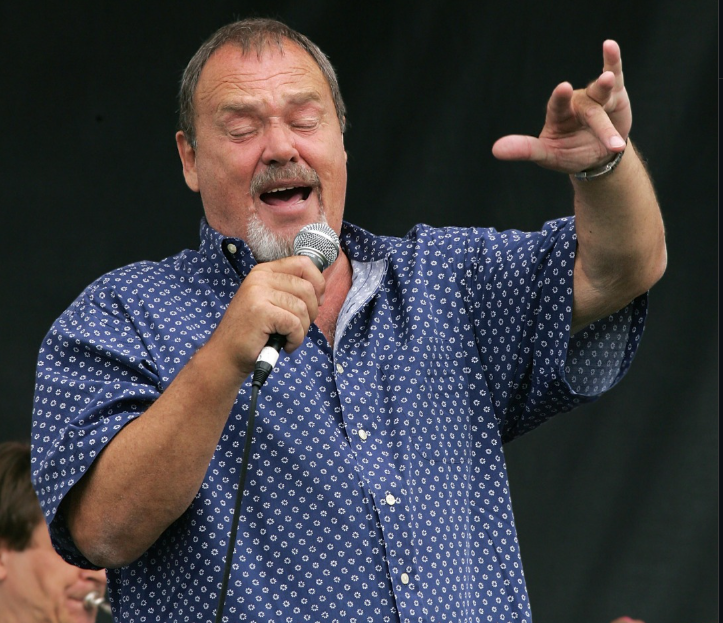
Clayton-Thomas’s rise was anything but linear. Born David Henry Thomsett in England and raised in Canada, he had an early life defined less by music than by instability. He spent parts of his youth in conflict with authority, drifting through hardship, and eventually serving time in a reformatory.
It was there, almost absurdly, that the turning point arrived: a discarded guitar and enough isolation to learn how to use it. That detail alone has the structure of myth, but in Clayton-Thomas’s case, it was simply biography. By his early twenties, he had reinvented himself completely: a new name, a new direction, a new identity built around music rather than survival.
The Band That Beat The Beatles And Paid the Price for It
When Blood, Sweat & Tears released their self-titled 1969 album, they achieved something rare: both commercial dominance and critical validation. The album famously won the Grammy for Album of the Year, beating The Beatles’ Abbey Road. For a brief moment, the band represented the future of mainstream music—complex, brassy, experimental, and still accessible enough to top charts.
But success in music rarely stays stable. The same broad appeal that elevated the band also fractured it. Artistic disagreements, lineup changes, and the sheer pressure of expectations began to erode what had looked like an unstoppable ascent.
Clayton-Thomas would leave the group in the early 1970s, returning intermittently over the years, but the original momentum never truly returned. Fame, in this case, behaved like a peak that could not be climbed twice.
The Music Scene That Raised Him and Eventually Outgrew Him
Clayton-Thomas emerged from a uniquely fluid musical environment where genres were not rigid categories but overlapping languages. Toronto’s Yonge Street scene, New York’s Greenwich Village clubs, and the broader jazz-blues circuit all shaped his sound. He moved between them with the adaptability of someone who never belonged to a single musical “home,” only to all of them at once.
That hybrid identity became the blueprint for Blood, Sweat & Tears. It also became its limitation. As rock evolved into harder, leaner forms in the 1970s, the lush orchestration of brass rock began to feel like a moment in time rather than a lasting direction. Clayton-Thomas did not fail to adapt. The audience simply moved on.
Influence That Outlived the Charts
Despite the band’s decline in mainstream dominance, their impact never disappeared. Blood, Sweat & Tears helped open the door for horn-driven rock bands like Chicago and others who built entire careers on the fusion of jazz instrumentation and rock structure.
Clayton-Thomas’s vocal approach—dramatic, emotive, and unrestrained—became part of the template for how rock singers could operate outside traditional limits.
His work also earned institutional recognition later in life, including induction into the Canadian Music Hall of Fame and honors for songwriting contributions that continue to circulate in covers, samples, and reinterpretations. He did not just sing songs. He helped define a sound that other artists would spend decades expanding.
A Career That Never Fully Ended, Even When It Slowed
After leaving Blood, Sweat & Tears, Clayton-Thomas pursued a long solo career, releasing numerous albums and touring for decades. Unlike many artists of his generation, he never fully stepped away from performance. The stage remained a constant—even when commercial peak success was long behind him.
In interviews later in life, he often reflected on the strange duality of his career: a meteoric rise followed by a long, steady continuation that lacked the same spotlight but retained the same purpose. Music, for him, was never just about the chart position. It was about motion.
The Legacy Left in the Brass
Clayton-Thomas is survived by his daughters, Ashleigh Clayton-Thomas and Christine Graham. But his broader legacy lives in the sound he helped normalize: rock music that was allowed to be complicated, orchestral, and emotionally layered without losing its mass appeal.
In an industry that often rewards simplicity, he helped prove that complexity could still sell—at least for a while. And even when that moment passed, the recordings remained. They still do.