Democratic Boycott Backfires as Massachusetts Women Refuse to Let Their State Go Missing at America’s 250th Fair
The fight over President Donald Trump’s Great American State Fair was supposed to be about politics. Instead, two Massachusetts women turned it into something much simpler: showing up.
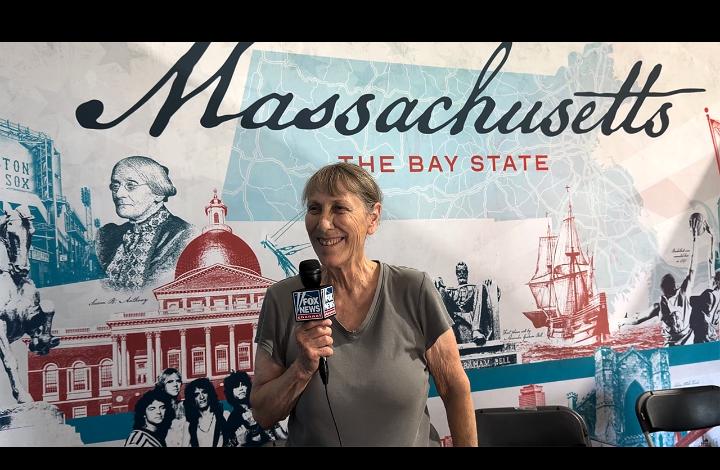
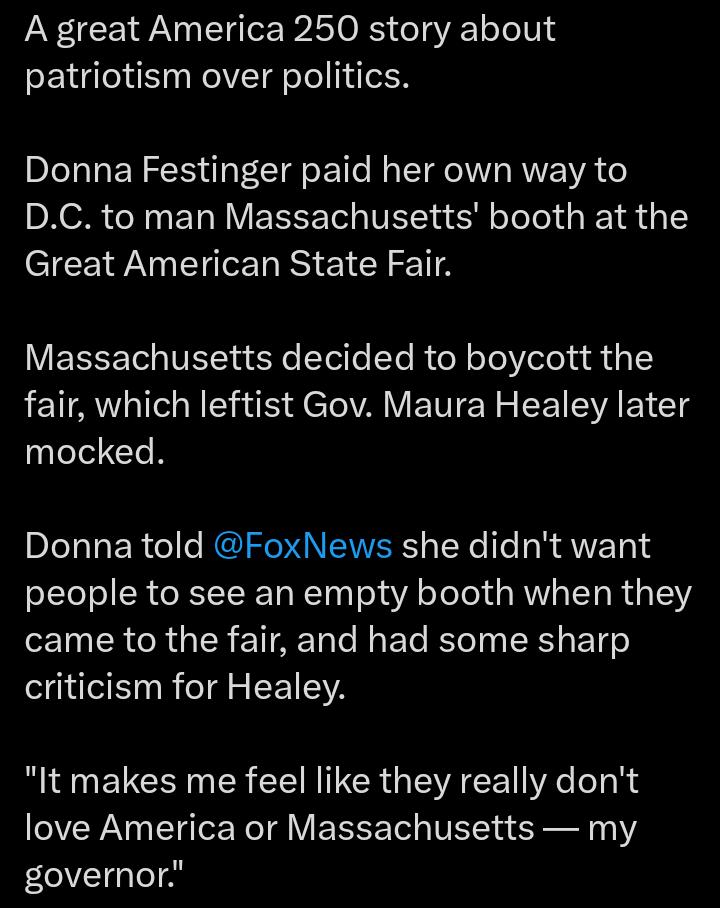
When Massachusetts officials declined to participate in the National Mall celebration, Donna Festinger decided she would not let visitors walk into an empty Massachusetts booth. She paid her own way to Washington, D.C., and stepped in to represent the Bay State herself. The fair, part of the Freedom 250 celebration, runs from June 25 through July 10 and was designed to showcase every state and territory through pavilions, exhibits, performances, food, games, and patriotic programming.
Massachusetts Skipped the Fair, but Donna Festinger Did Not

Festinger’s decision landed because it cut through the usual political noise. While state leaders stayed away, she treated the empty Massachusetts booth as a problem regular citizens could solve. Fox News reported that she traveled from Massachusetts to Washington on her own dime and began helping at the state’s booth so visitors would still see someone standing for Massachusetts.
Her message was blunt. Leaving the state unrepresented at a national birthday celebration felt wrong to her. It was not just about a booth, a banner, or a table on the National Mall. It was about whether Massachusetts, one of the most historically important states in America’s founding story, should be missing from a celebration of the country’s 250th anniversary.
Festinger did not soften her feelings about the boycott. She said she was disappointed that the the governments of Massachusetts, Maine, Connecticut, and Rhode Island chose not to support the celebration. Her strongest criticism was simple: she called it “shameful.” That comment became the emotional center of the story because it framed the boycott not as a quiet budget choice, but as a failure of civic pride.
The Political Fight Behind the Empty Booth
Massachusetts Gov. Maura Healey, a Democrat and frequent Trump critic, had already dismissed the event before the story picked up national attention. According to NOTUS, Healey said Trump was busy with his Great American State Fair that “everybody’s bailing on.” She also suggested that the event would impose costs on states that chose to participate.
Freedom 250 pushed back against that argument. A spokesperson for the organization said that states were not being charged a fee to participate in the event. Still, the cost debate is not as clean as either side may want it to sound. While organizers may not charge a formal participation fee, states can still incur real expenses if they want to create a polished exhibit.
Axios reported that Freedom 250 built pavilions for every state and territory, while participating states remained responsible for designing, furnishing, and shipping their exhibits to Washington. That means both arguments can exist simultaneously. The event may not include a direct participation fee, but showing up properly still costs money.
Even so, for Festinger and others who stepped in, the money argument did not settle the matter. Their concern was larger than the cost of shipping materials or decorating a booth. They believed Massachusetts should not be absent from a major national anniversary, especially when its own history is so deeply tied to the birth of the United States.
Other Democratic-Led States Also Stayed Away
Massachusetts was not alone in skipping the fair. Cronkite News reported that 11 Democratic-controlled states declined to participate, including Connecticut, Hawaii, Illinois, Maine, Massachusetts, North Carolina, Oregon, Pennsylvania, Rhode Island, Vermont, and Washington.
Some states pointed to cost. Others argued that the celebration had become too closely tied to Trump-era politics. Oregon officials offered one of the clearest explanations, saying the event had become more of a partisan affair than originally presented.
That complaint has followed the fair from the beginning. Supporters see it as a patriotic celebration of America’s 250th anniversary. Critics see it as a Trump-branded political showcase wrapped in bunting, fireworks, state exhibits, and patriotic language. That divide turned what could have been a standard national celebration into another flashpoint in America’s culture war.
But the empty-booth image gave supporters a powerful argument. If governors boycott the celebration, ordinary residents may decide to represent themselves. That is exactly what happened in Massachusetts.
A Citizen-Led Response With Revolutionary War Symbolism
Festinger was later joined by Judith Kalaora, a Boston resident who appeared in Revolutionary War-style clothing to honor Deborah Sampson, the Massachusetts woman who disguised herself as a man to fight in the Continental Army.
That detail gave the story a sharper historical edge. Massachusetts is not just another state in the American founding narrative. It is home to Lexington, Concord, Boston, and many of the revolutionary stories Americans still learn in school. Leaving that state visually absent from a 250th anniversary celebration was always going to spark a reaction from people who see history as bigger than today’s political fights.
Kalaora’s living-history approach helped turn the booth into something more meaningful than a protest prop. Instead of allowing Massachusetts’ Revolutionary War legacy to disappear from the National Mall, she used costume, character, and storytelling to remind visitors that the Bay State played a central role in America’s beginning.
Connecticut Saw a Similar Pushback
Massachusetts was not the only state where people stepped in after official leaders opted out. CT Insider reported that two Connecticut Republican lawmakers planned to represent their state at the fair after Gov. Ned Lamont declined to send an official delegation, citing expense.
One lawmaker said he wanted visitors to know Connecticut would still be represented, regardless of political affiliation. That mirrors the Massachusetts story closely. When state officials pull back, others may decide the absence itself sends the wrong message.
That is what makes the controversy more than a disagreement over one fair. It raises a bigger question: who gets to represent a state when elected leaders decide not to participate? A governor can choose not to spend state money. A citizen can decide her state still deserves a voice. Both choices say something.
For Healey and other Democratic leaders, staying away was a protest against what they viewed as a politicized event. For Festinger, showing up was a protest against letting politics erase Massachusetts from a national milestone.
The Booth Became Bigger Than the Fair
The Great American State Fair was designed to celebrate 250 years of American history, but it has also exposed the country’s current divisions. Some governors saw a Trump-centered event and walked away. Some citizens saw empty booths and walked in.
Donna Festinger’s decision worked because it was personal, visible, and easy to understand. She did not issue a long policy memo or hold a press conference. She simply showed up where her state government would not.
Whether people see that as patriotic, political, or both, it turned a boycott into a much bigger conversation about pride, representation, and who gets the final word when elected leaders decide to sit out.