A Ship Attack Just Turned the Strait of Hormuz Rescue Plan Into a Global Warning Sign
The Strait of Hormuz was supposed to be opening again, carefully, slowly, and under international coordination. Instead, one reported attack has forced the United Nations’ maritime agency to hit pause, reminding the world that this narrow stretch of water is still one of the most dangerous pressure points in global trade.
The International Maritime Organization, the UN agency that oversees global shipping safety, temporarily suspended its evacuation operation after a vessel was attacked in the Gulf of Oman. The plan had been designed to help stranded ships and seafarers safely exit the Persian Gulf through the Strait of Hormuz.
That may sound like a shipping story. It is much bigger than that.
Hormuz is not just another waterway. It is the front door for a major share of the world’s oil and gas exports. When it becomes unstable, energy markets watch closely, shipping companies get nervous, insurers start recalculating risk, and governments begin asking whether a fragile diplomatic deal can survive real-world pressure.
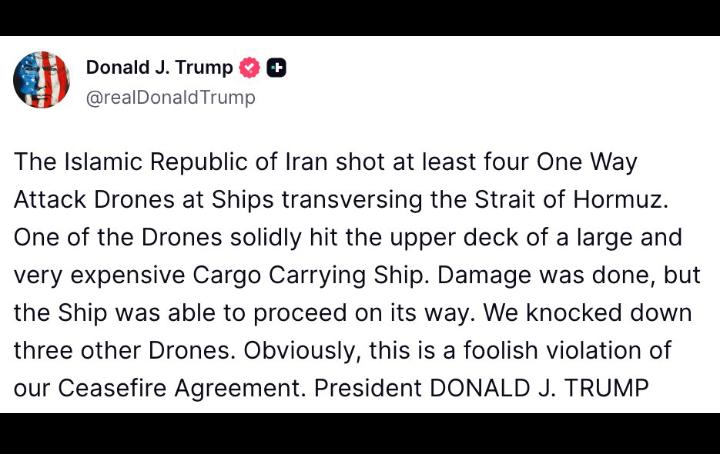
According to Reuters, U.S. officials said Iran fired on a cargo ship that had earlier reported being hit by a projectile as it tried to pass through the strait. The British maritime agency UKMTO said the vessel was struck on its starboard side near Oman’s port of Dahit. The vessel was not part of the IMO evacuation framework.
That detail matters. The IMO did not pause because one of its escorted ships was hit. It paused because the wider safety environment suddenly looked less reliable.
IMO Secretary-General Arsenio Dominguez said the agency needed to reconfirm that safety guarantees were still in place for ships on the evacuation list and for vessels in the region. In plain English, the UN could not keep pushing ships through a high-risk corridor without being sure the rules still meant something.
The evacuation plan had only just begun. Reuters reported that 57 ships carrying roughly 1,100 seafarers had already moved through the Strait of Hormuz under the plan between June 23 and the morning of June 25. The initiative was meant to help hundreds of stranded vessels and thousands of sailors leave the area via two routes: one through Iranian waters and another through Omani waters, with U.S. oversight.
Then came the reported strike.
AP reported that a U.S. official said the merchant vessel Ever Lovely was hit by a drone operated by Iran’s Revolutionary Guard. The same report said the vessel suffered damage, but no injuries or environmental impact were reported. Iran’s newly formed Persian Gulf Strait Authority later warned that ships outside its designated routes would not be covered by a guarantee of safe passage.
That is the heart of the crisis. The question is no longer only whether ships can physically pass through Hormuz. The question is who gets to decide which route is safe, who enforces that route, and whether international shipping can move without becoming a bargaining chip.

For shipowners, this is a nightmare scenario. A ship trapped in the Persian Gulf is expensive. A ship moving through a disputed route may be even more expensive. Crews face stress, companies face delays, and insurers may demand higher premiums for voyages near the strait.
For energy markets, the stakes are obvious. The U.S. Energy Information Administration said oil flows through the Strait of Hormuz averaged 20 million barrels per day in 2024, equal to about 20% of global petroleum liquids consumption. The EIA also said that about one-fifth of the global liquefied natural gas trade moved through the strait in 2024, mostly from Qatar.
That is why every incident near Hormuz travels far beyond the Middle East. A projectile near Oman can become a price concern in Europe, Asia, Africa, and the United States. Even when oil prices do not immediately explode, traders watch the risk premium. Shipping companies watch delays. Governments watch inflation. Ordinary consumers eventually feel the pressure in fuel, transport, food, and power costs.
The timing also puts pressure on diplomacy. The U.S. and Iran have been trying to hold together a fragile understanding around the reopening of the strait and a broader ceasefire framework. But maritime security is where diplomatic language meets steel, fuel, crews, and cargo.
If Iran insists that ships must follow Tehran-approved routes, while the UN, Oman, and the U.S. support other evacuation corridors, then every vessel becomes a test case. One wrong route, one warning ignored, or one strike could undo weeks of negotiation.
This is why the IMO pause is not a small bureaucratic delay. It is a signal that the current arrangement may not yet be strong enough to protect the people and ships it is supposed to protect.
The most urgent concern remains the seafarers. Thousands have been stranded by the crisis, caught between military warnings, diplomatic negotiations, and commercial pressure. These are not abstract numbers. They are crews waiting for safe passage while governments argue over authority.
The attack also shows how quickly optimism can fade in the Gulf. A route can be announced. Ships can begin moving. Markets can start breathing easier. Then one strike can remind everyone that the Strait is still fragile, contested, and deeply political.
For now, the world is watching three things.
First, whether the IMO restarts the evacuation plan soon. Second, whether Iran accepts any route it does not fully control. Third, whether the U.S. and its Gulf partners can prevent the incident from turning into a wider confrontation.
The Strait of Hormuz has always been narrow on the map. Right now, it looks even narrower in diplomacy. One ship attack has shown that reopening the waterway is not the same as restoring confidence.
And until confidence returns, every vessel moving through Hormuz will carry more than cargo. It will carry the weight of a crisis the world cannot afford to ignore.