America’s “Good Guy” Myth Has a Body Count, and the World Has Receipts
The United States has one of the most powerful public images in modern history. To many, it represents democracy, freedom, innovation, and opportunity. Hollywood, global aid programs, and decades of political messaging have reinforced the idea that America is the “good guy” on the world stage.
But history is never that simple. When you step away from slogans and look at the record of military interventions, wars, and foreign policy decisions, the picture becomes far more complicated. Supporters argue the U.S. has defended global stability. Critics argue it has repeatedly caused large-scale civilian suffering while maintaining a moral narrative that doesn’t always match reality.
The truth sits in that tension.
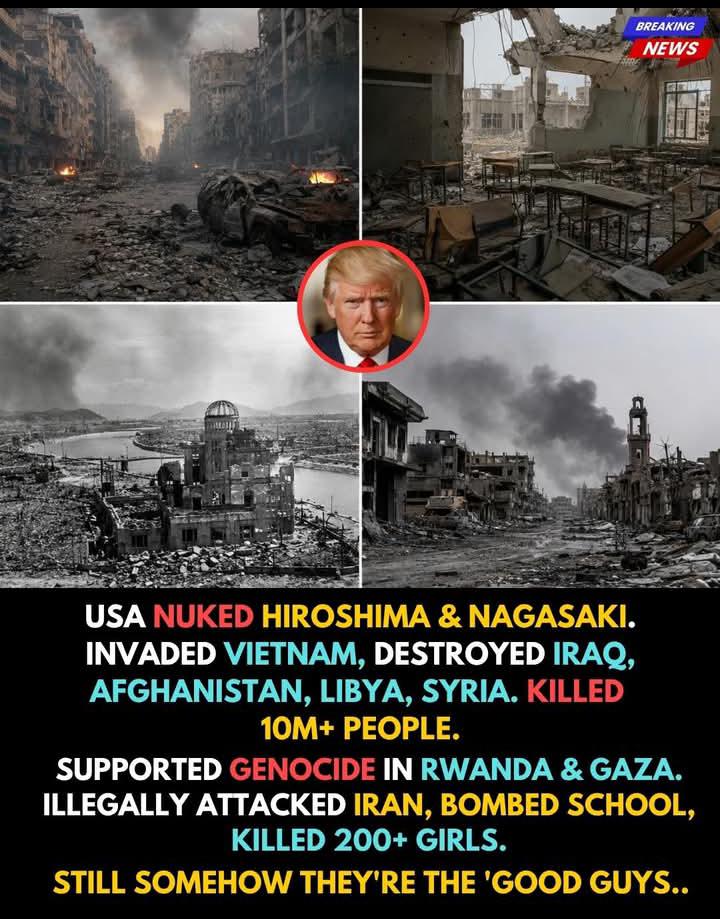
The Atomic Bombs and the Start of the Modern Debate
The debate over America’s global role often begins in 1945.
In August of that year, the United States dropped atomic bombs on Hiroshima and Nagasaki during the final stages of World War II. The bombings forced Japan’s surrender and ended the war, but they also caused catastrophic destruction. Historians estimate hundreds of thousands of people died directly or indirectly from the attacks, including long-term radiation effects.
Then, President Harry Truman defended the decision as necessary to avoid a prolonged invasion of Japan that could have cost even more lives. Critics, however, argue that the use of nuclear weapons against heavily civilian-populated cities introduced a moral line the world had never crossed before.
That moment remains one of the most controversial decisions in modern military history, not just for what it did, but for what it signaled: the United States had entered a new era of global power, where its decisions could reshape entire populations in an instant.
Vietnam, Iraq, and the Cost of Long Wars
The Vietnam War further complicated America’s global image.
The United States entered Vietnam under the logic of containing communism during the Cold War. Over time, the conflict expanded into a long and brutal war involving massive bombing campaigns, ground combat, and deep civilian suffering. By the war’s end, millions of Vietnamese had died, along with more than 58,000 American soldiers.
What made Vietnam especially significant was not just the scale of destruction, but the growing divide between government messaging and public perception. As the war continued, many Americans began to question whether the stated goals matched the reality on the ground.
That skepticism carried forward into later conflicts.
Decades later, the 2003 invasion of Iraq again raised similar questions. The U.S. government argued that Saddam Hussein possessed weapons of mass destruction and posed an urgent global threat. The invasion followed quickly.
But those weapons were never found because they had been publicly described before the war. A U.S. Senate intelligence report later concluded that many prewar claims about Iraq’s weapons capabilities were inaccurate or overstated.
The war led to the collapse of Saddam Hussein’s government, but also to years of instability, insurgency, and civilian casualties. Iraq became a central example in debates about intelligence failures, war justification, and post-invasion planning.
For critics, Iraq reinforced a pattern: strong moral framing before war, followed by complex and often devastating outcomes afterward.
Libya, Syria, and the Reality of Modern Interventions
In 2011, the United States joined NATO allies in military intervention in Libya, aimed at protecting civilians during a civil uprising against Muammar Gaddafi. The intervention helped remove Gaddafi from power.
But the aftermath did not stabilize the country. Instead, Libya fractured into competing armed factions, with ongoing violence and political instability that continues today.
Former President Barack Obama later described the lack of post-conflict planning in Libya as one of the most difficult failures of his administration, noting that while the intervention helped prevent immediate mass killings, it did not lead to long-term stability.
Syria followed a different but equally complex path. The U.S. became involved primarily through operations against ISIS, supporting local forces, and conducting airstrikes. While ISIS was largely defeated territorially, the broader Syrian conflict produced extensive civilian suffering, displacement, and destruction.
Independent monitoring groups such as Airwars documented civilian casualties from coalition airstrikes, highlighting the difficulty of modern warfare where enemy fighters often operate within populated areas.
These conflicts underline a recurring challenge: in modern war, even targeted operations can carry significant civilian consequences.
Rwanda, Gaza, and the Debate Over Responsibility
Not all controversies involving U.S. foreign policy are about direct military intervention.
In 1994, during the Rwandan genocide, approximately 800,000 people were killed in a span of about 100 days. The United States, along with much of the international community, did not intervene effectively to stop the killings.
Officials later acknowledged that the global response was insufficient and too slow, contributing to one of the most widely cited failures of international action in modern history.
More recently, the war in Gaza has renewed global debate over U.S. foreign policy and military support. Following the October 7, 2023, Hamas attack on Israel, which killed about 1,200 people and involved mass hostage-taking, Israel launched a large-scale military campaign in Gaza.
Gaza’s Health Ministry reports tens of thousands of deaths, while Israel states it is targeting Hamas and takes steps to reduce civilian harm. The United States has continued to provide military and diplomatic support to Israel, while also urging caution regarding civilian casualties.
International courts, including the International Court of Justice, have been examining aspects of the conflict in response to genocide allegations, though no final ruling has been issued.
This situation reflects one of the most difficult realities in global politics: alliances, security commitments, and humanitarian concerns often collide in ways that defy simple moral categories.
Why the “Good Guy” Label Still Survives
Despite this complex record, the United States is still widely seen as a force for good in many parts of the world. That perception is not based on a single event, but on a mix of factors: its role in defeating fascism in World War II, its economic and technological influence, its cultural exports, and its long-standing alliances.
At the same time, its military and foreign policy record continues to generate criticism, especially in countries directly affected by war or intervention.
Both perspectives can coexist without canceling each other out.
The United States is not the only country with a difficult history of conflict. But it is one of the few with the scale of global reach to shape multiple regions over decades. That level of influence naturally produces both gratitude and resentment, depending on where the impact is felt.
A Story That Still Doesn’t Have a Final Answer
The question is not whether the United States has done good or harm. It has done both, repeatedly, and often in the same historical moments.
The real issue is how nations interpret their own actions versus how those actions are experienced elsewhere.
To some, America represents protection, aid, and stability. To others, it represents intervention, war, and unintended consequences.
That tension is unlikely to disappear.
Because in global politics, the “good guy” label is rarely a fact. It is a narrative, one that is constantly being challenged, rewritten, and debated by history itself.