Andy Biggs Says Voter ID Is Common Sense. The SAVE Act Fight Is Anything but Simple
Republican Rep. Andy Biggs has reduced one of America’s fiercest election disputes to a question that fits neatly on a bumper sticker.
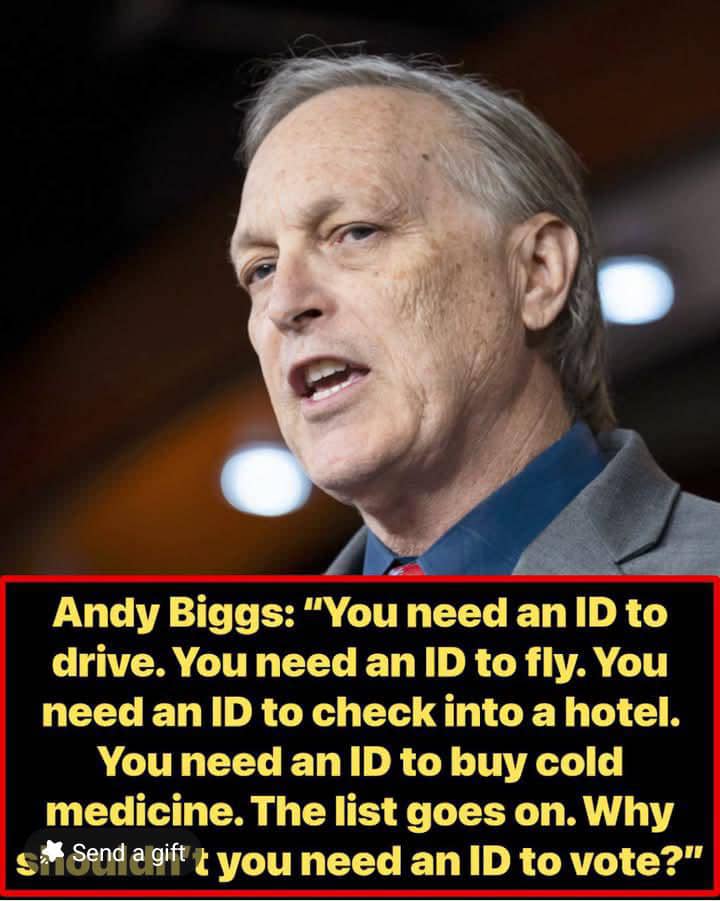
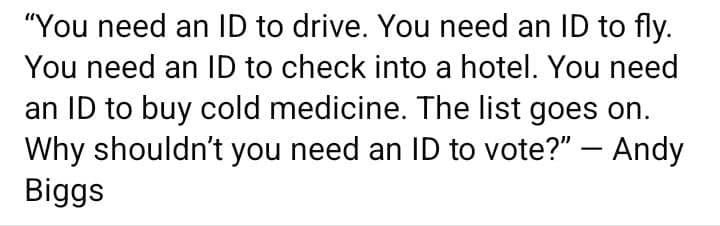
“You need an ID to drive. You need an ID to fly. You need an ID to check into a hotel,” Biggs wrote, before asking why voting should be treated differently. He ended his widely shared message by urging Congress to pass the SAVE Act.
It is an effective political argument because the examples feel familiar. Yet election law rarely stays simple once lawmakers move beyond the slogan and begin deciding which documents count, who must present them, and what happens when an eligible American cannot quickly produce one.
The debate is especially urgent in 2026. The House passed the SAVE America Act in February, but the legislation remains stalled in the Senate, where Republicans lack the 60 votes generally needed to overcome a filibuster.
Biggs’ comparison works politically, but the details matter
Biggs is hardly alone in supporting voter identification. Thirty-six states currently request or require voters to show some form of identification at the polls, according to the National Conference of State Legislatures.
The other 14 states and Washington, D.C., use different verification methods, often comparing a voter’s signature or personal information with registration records. Every state verifies voters somehow, but the documents and procedures vary widely.
Public opinion also gives Biggs a strong talking point. A 2025 Pew Research Center survey found that 83% of Americans favored requiring voters to show government-issued photo identification, including 95% of Republicans and 71% of Democrats.
Still, some of the everyday comparisons need a closer look.
Adults generally must present acceptable identification at airport security, although passengers who arrive without a physical ID may sometimes travel after completing an identity-verification process and additional screening. Hotel identification rules are usually company policies rather than one uniform federal requirement.
The cold-medicine example is narrower too. Federal rules require identification for products containing pseudoephedrine, an ingredient that can be used to manufacture methamphetamine, not for every box of cough drops or pain relievers on a pharmacy shelf.
There is another important difference. Driving, flying and renting a hotel room are activities or commercial services. Voting is a constitutionally protected political right, so restrictions receive a level of legal scrutiny that a hotel’s front-desk policy does not.
That does not automatically make voter ID unconstitutional. In 2008, the Supreme Court upheld Indiana’s photo-ID law in Crawford v. Marion County Election Board, finding that the challengers had not produced enough evidence to invalidate the law as written. The ruling, however, did not declare every possible identification requirement lawful under every circumstance.
The SAVE America Act goes beyond showing a card
The biggest complication is that the SAVE America Act is not simply a national rule asking voters to flash a driver’s license before receiving a ballot.
The House-approved legislation would require documentary proof of citizenship when someone registers or updates a federal voter registration. Acceptable evidence could include a passport, certain military records or a birth certificate paired with government-issued photo identification.
The proposal would also impose photo-ID rules for voting, require states to conduct additional citizenship checks and establish penalties for election officials who register applicants without the required documentation. The House passed it 218-213 on February 11, with one Democrat joining Republicans.
House Speaker Mike Johnson called it “common sense legislation” intended to ensure that American citizens decide American elections.
Rep. Joe Morelle of New York, the leading Democrat on the House committee overseeing elections, argued that the bill would make voting harder while giving Washington greater control over state-run election systems.
Federal law already prohibits noncitizens from voting in presidential and congressional elections. Research and reviews by election officials have generally found such voting to be rare, but rare does not mean impossible.
A recent New Jersey case gave supporters of the bill fresh ammunition. State officials said a software error mistakenly registered roughly 6,600 noncitizens in 2023 and 2024, despite those residents indicating they were not citizens. Fewer than 400 reportedly cast ballots before the problem was identified.
Those ballots represented less than 0.01% of the more than four million votes cast in New Jersey’s 2024 election, and officials said they had found no evidence that the mistake changed an outcome. The episode nevertheless demonstrated how administrative failures can create real vulnerabilities, even without evidence of a coordinated nationwide scheme.
The real battle is over who carries the burden
Supporters see the legislation as preventive maintenance. A lock on the door does not prove burglars are already inside, they argue. It is installed to make sure they cannot get in.
Opponents respond that citizenship documents are not equally easy for every eligible American to obtain. A Brennan Center survey estimated that more than 21 million citizens lack ready access to documents proving citizenship, while roughly 12 million people who voted in 2020 could struggle to re-register under the proposed rules. Those are estimates from a voting-rights advocacy organization, not a government count, but they illustrate the scale of the concern.
A birth certificate may contain a voter’s previous surname. An elderly person born at home may have incomplete records. Naturalized citizens, military families, low-income voters and people who have moved repeatedly may need extra time or money to replace documents.
That is why the most productive debate is not simply “ID or no ID.” The harder questions are whether identification will be free, whether replacements will be easy to obtain, which documents will qualify, and whether voters with legitimate problems will have a reliable way to prove eligibility.
Biggs’ argument connects because Americans understandably want confidence that every legal ballot belongs to an eligible voter. The polling shows that photo ID itself enjoys broad support across party lines.
But Congress is debating something larger than the question in Biggs’ social-media post. The SAVE America Act combines polling-place identification with citizenship documentation, database checks and new federal requirements for election offices.
The challenge is building a system secure enough to earn public trust without placing eligible citizens behind a paperwork wall. That is the part of the voter-ID debate that cannot be squeezed onto a bumper sticker.