Dave Matthews Says He Will Keep Speaking Out Against Violence in Gaza, Ukraine and Around the World
The Grammy-winning singer and songwriter has never been shy about discussing issues beyond music. In a recent statement, Matthews made it clear that he intends to continue speaking out against violence wherever he sees suffering, naming conflicts and humanitarian crises in Gaza, the West Bank, Lebanon, the Democratic Republic of Congo, Sudan, Ukraine, and violence affecting immigrants and communities in the United States.
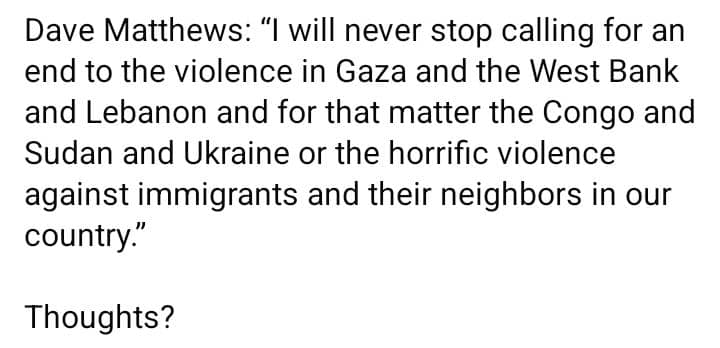
“I will never stop calling for an end to the violence in Gaza and the West Bank and Lebanon and for that matter the Congo and Sudan and Ukraine or the horrific violence against immigrants and their neighbours in our country,” Matthews said.
His message reflects a broader theme that has appeared throughout his career: a belief that artists have a responsibility to address human struggles, even when those conversations are politically sensitive or deeply divided.
Dave Matthews Turns His Platform Toward Humanitarian Concerns

Dave Matthews has built a decades-long career around music that often explores themes of compassion, social responsibility, and human connection. While he is best known as the frontman of the Dave Matthews Band, he has also frequently used public appearances and performances to highlight issues beyond entertainment.
His latest remarks focus on the devastating consequences of violence affecting civilians around the world. From the ongoing conflict in the Middle East to wars and instability in Africa and Eastern Europe, Matthews’ statement brings attention to the shared suffering experienced by ordinary people caught in conflict.
The situation in Gaza and the West Bank has remained one of the most heavily debated humanitarian issues internationally, with civilians facing the consequences of war, displacement, and political tensions. Lebanon has also experienced increased instability connected to regional tensions.
Beyond the Middle East, Matthews referenced other global crises. Sudan has faced a devastating conflict that has created a major humanitarian emergency, while the Democratic Republic of Congo has experienced decades of violence involving armed groups and political instability. Ukraine continues to face the consequences of Russia’s invasion, which began in 2022 and has resulted in widespread destruction and displacement.
Matthews’ comments do not present a political solution to these conflicts. Instead, his message centers on ending violence and reducing human suffering.
A Musician Who Has Long Mixed Art With Advocacy
Matthews’ willingness to speak about social issues is not new. Throughout his career, he has often connected music with broader conversations about humanity, equality, and peace.
Many artists choose to remain away from political discussions because of the potential backlash from audiences with different views. Matthews has taken a different approach, frequently emphasizing empathy and concern for people affected by difficult circumstances.
His supporters often see such statements as an extension of the emotional themes found in his music. His songs have regularly explored relationships, personal struggles, and the experiences that connect people across different backgrounds.
However, public statements from celebrities about international conflicts often attract strong reactions. Complex global issues can involve competing perspectives, political disagreements, and deeply held beliefs. Matthews’ latest comments place him among a group of entertainers who have chosen to speak publicly about humanitarian concerns despite the controversy that can follow.
The singer’s focus has remained centered on civilians and the impact of violence. By mentioning multiple conflicts instead of focusing on only one region, Matthews framed his message as a broader appeal for peace rather than a statement limited to a single political dispute.
The Debate Over Celebrity Voices in Global Issues
The role of celebrities in political and humanitarian conversations has long been debated. Supporters argue that public figures can bring attention to crises that may otherwise receive less attention. Critics sometimes question whether entertainers should comment on complex international matters.
Matthews’ statement highlights that debate once again. His global audience gives him a powerful platform, allowing messages about humanitarian concerns to reach millions of people who may not regularly follow international affairs.
At the same time, conflicts such as those in Gaza, Ukraine, Sudan, and the Democratic Republic of Congo involve complicated histories, political realities, and security challenges. Public discussions around them often produce disagreement over causes, responsibilities, and possible solutions.
Matthews did not claim to have answers for these conflicts. His message focused on a simple appeal: that violence against civilians should end.
He also included concerns about violence involving immigrants and their neighbors in the United States, expanding his message beyond international conflicts to issues affecting communities closer to home.
For Matthews, the central idea appears to be the protection of human life regardless of location. His statement connects different crises through a common theme: the suffering caused when violence overwhelms communities.
As conflicts continue around the world, voices from artists, activists, politicians, and ordinary citizens will continue shaping public conversations. Matthews has made clear that he intends to remain part of that conversation.
His message is not about one conflict alone. It is about a broader call for compassion, peace, and an end to violence wherever people are suffering.