Elon Musk Says Money May Become Useless-Tell That to Americans Living Paycheck to Paycheck
There are statements that sound visionary in a boardroom and insulting at a grocery checkout line.
Elon Musk may have just delivered one of them.
At the same time, his SpaceX fortune helped push him into historic trillionaire territory. Musk said money may one day become irrelevant because of artificial intelligence and robotics. In his future, machines produce so much, work changes so profoundly, and goods become so abundant that money loses the power it holds over everyday life.
That might sound exciting if you are watching the future from a launch tower or a Wall Street trading floor.
But for many Americans, it lands differently.
It lands on the worker clocking out of one job and driving to another. It lands on the parent doing food math in the aisle before putting something back. It lands on the retiree watching prices rise faster than comfort. It lands on the person staring at a rent bill and wondering why one of the richest people in the world is talking about a future where money may not matter.
Because right now, money matters every hour of the day.
The richest man said the quiet part out loud
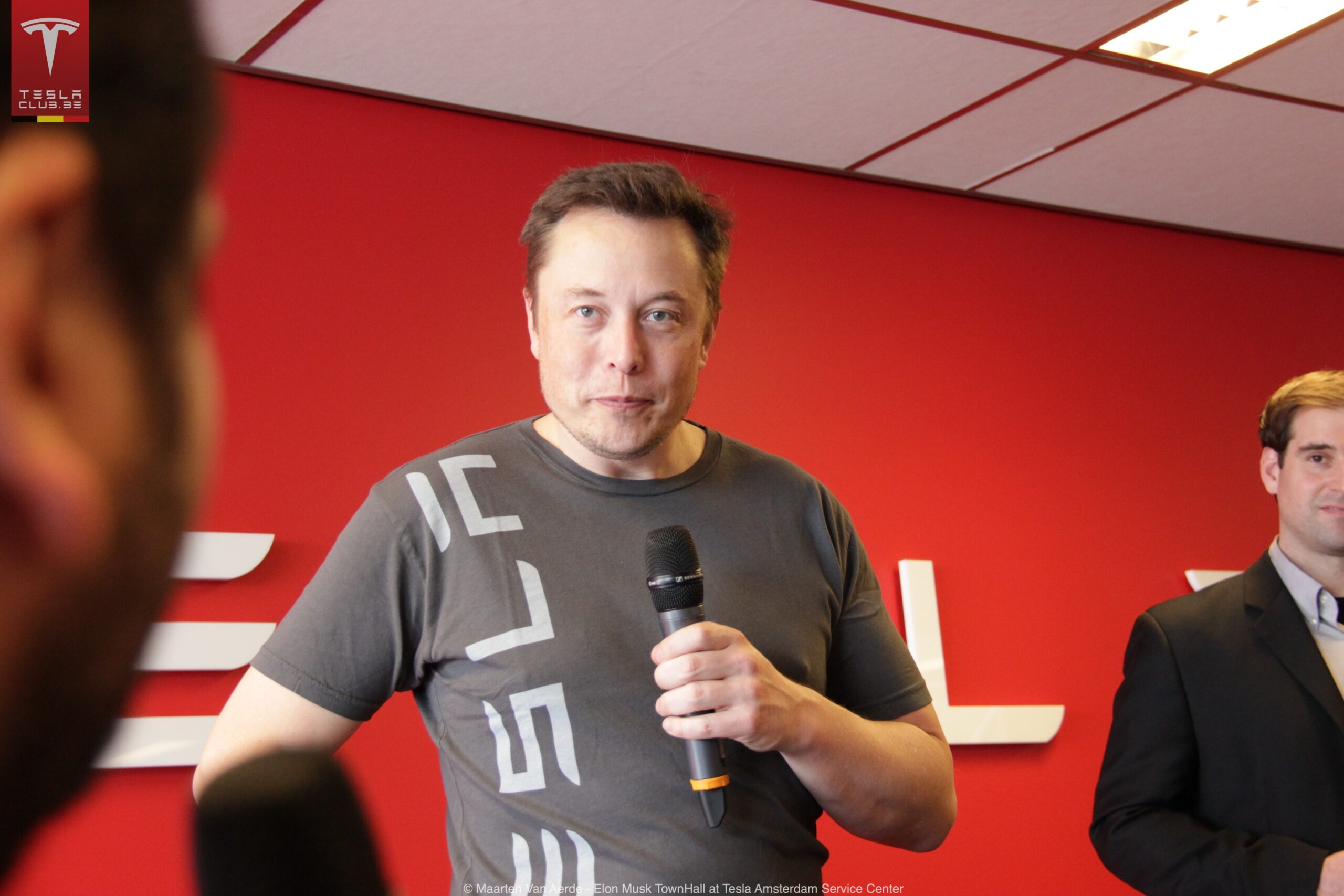
Tesla Owners Club Belgium, CC BY 2.0, via Wikimedia Commons Licensed under Elon Musk in 2014
Musk’s argument is futuristic, but the timing is what makes it explosive.
He is not a broke dreamer talking about a better society. He is not an ordinary worker hoping technology will lighten the load. He is the man sitting near the very top of modern wealth, saying the thing everyone else still needs to survive may someday become less important.
That contrast is the story.
For Musk, money may be a tool. For many families, it is oxygen. It decides whether the lights stay on, whether the car gets fixed, whether the credit card balance grows, and whether dinner is fresh food or whatever is left in the freezer.
So when a trillionaire talks about money losing relevance, people are going to hear more than a prediction. They are going to hear distance.
America is not living in Musk’s future yet
The future Musk describes may arrive one day. Robots may build more. AI may automate more. Prices may fall in ways that feel impossible now.
But America is not there today.
Today, people are stacking shifts. They are taking weekend gigs. They are driving for delivery apps after full-time work. They are skipping vacations, delaying dental visits, borrowing from relatives, and trying to stretch paychecks that already felt too small before the next bill arrived.
That is the problem with billionaire future-talk. It often skips the part where regular people are still trapped in the present.
A world where money matters less may sound amazing. But it does not help much when rent is due on the first, groceries cost more than expected, and the emergency fund disappeared three emergencies ago.
The irony is almost too perfect
Musk’s companies are built around big promises.
Tesla promised to change driving. SpaceX promised to change space. Starlink promised to change internet access. His AI and robotics ambitions promise to change work itself.
That is part of why investors keep buying into the Musk story. He sells the future better than almost anyone alive.
But this particular future has a sharper edge.
If robots and AI make human work less central, what happens to the workers? If money becomes less relevant, who gets to enjoy that world first? If abundance is coming, why does today’s economy still feel so punishing for ordinary people?
Those are the questions that make this more than another billionaire headline.
Workers hear a different message
To tech optimists, Musk is imagining freedom from scarcity.
To workers, the message can sound like this: keep grinding today, because one day the system may not need you as much.
That is not a small fear.
For decades, Americans were told that hard work was the path to stability. Work hard, pay your bills, buy a home, raise your family, save for retirement, and life would slowly become more secure.
Now, many workers feel that the promise is broken.
They are working hard, but the reward feels smaller. They are earning money, but it disappears faster. They are told technology will make life better, but they also see automation threatening jobs, wages, and entire industries.
That is why Musk’s comment hits a nerve. It touches on the exact fear lurking beneath the American economy: what if the future is rich but not for everyone?
The problem is not the prediction
To be fair, Musk may not be saying that money will become useless tomorrow. He is talking about a possible long-term future shaped by AI and robotics.
That distinction matters.
But public reaction is not only about the technical meaning. It is about timing, tone, and who is saying it.
When someone with ordinary financial stress says money should not control life, people understand the emotion. When a trillionaire says it, the same idea can sound detached from everyday reality.
That does not mean the prediction is automatically wrong. It means the messenger changes how the message feels.
A person counting billions can talk about a post-money society. A person counting dollars before payday hears it differently.
The future may be abundant, but who controls it?
The biggest issue is not whether robots can produce more goods.
The bigger issue is who owns the robots.
If AI and robotics create massive wealth, that wealth will not automatically spread itself evenly. Technology does not guarantee fairness. It can create convenience, but it can also concentrate power.
If a small group of companies controls the machines, platforms, data, distribution systems, and profits, then abundance may not feel abundant to everyone.
That is the part Americans are already arguing about.
Will AI make life easier for working families, or will it make a few already powerful companies even more powerful? Will it lower costs, or will it create new forms of dependency? Will it free people from exhausting work, or simply erase jobs before society has a real plan?
Those questions are not science fiction. They are already knocking on the door.
Why the reaction is already boiling over
The story is already hitting a nerve because it touches three American pressure points at once: money, work, and fairness.
Money is personal. Work is personal. Feeling left behind is personal.
That is why Musk’s statement is not landing as a quiet tech prediction. It is landing as a cultural argument.
Some people see his comment as a bold look at a future where AI and robotics could make life less expensive and less tied to constant work.
Others hear something very different. To them, it sounds strange for one of the richest people in the world to talk about money becoming less important while many Americans are still working long hours just to keep up.
Both reactions explain why the story is spreading.
This is not just about Musk. It is about the gap between the future being promised by powerful tech leaders and the financial pressure many Americans feel right now.
The real question is not whether money disappears
Money is not disappearing from American life anytime soon.
Bills are still coming. Prices are still real. Rent still clears on a schedule. Debt still grows when ignored. Families still need income, security, and a reason to believe the future will not leave them behind.
So maybe the real story is not Musk predicting a world where money stops mattering.
Maybe the real story is that one of the richest people in the world can imagine that future while many people are still working themselves to exhaustion just to survive this one.
That is the tension Americans will feel in this story. It is not just jealousy. It is not just anger. It is the suspicion that the people building tomorrow may not fully understand the pressure people are carrying today.
And until that changes, the idea of money becoming irrelevant will sound less like a dream and more like something only the very rich can afford to say.