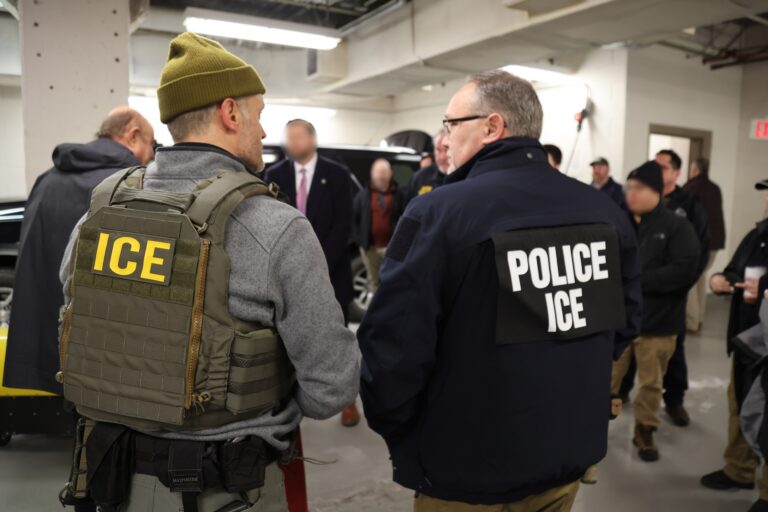
ICE Will Release Body Camera Video Only When Seen in the Agency’s ‘Best Interests,’ Policy Says
The biggest question surrounding ICE’s new body cameras may no longer be whether officers are recording. It may be who gets to decide when the public is allowed to watch.
Immigration and Customs Enforcement says its field officers nationwide will receive body-worn cameras by the end of September, accelerating a years-long rollout after fatal encounters involving immigration officers intensified demands for greater accountability.
Yet ICE’s own policy contains a catch with potentially enormous consequences. Even when a camera captures an officer shooting or seriously injuring someone, the footage does not automatically become public.
Instead, ICE leaders can first decide whether releasing it serves the agency’s “best interests.”
That distinction turns what sounds like a straightforward transparency measure into something considerably more complicated. A camera can preserve evidence. It cannot guarantee that taxpayers, lawmakers or families involved in a controversial encounter will immediately get to see it.
The camera may be mandatory, but disclosure is not

ICE’s February 2025 body-worn camera directive requires officers to activate cameras during many ordinary enforcement operations, including arrests, searches, warrant executions and emergency responses. The agency also restricts officers from deleting or altering recordings outside procedures authorized by the directive.
The more consequential rules begin after a serious encounter. When an ICE officer causes death or serious physical injury, senior officials and attorneys can review the recording and decide whether prompt public release would be appropriate. Footage could appear within 72 hours if officials approve disclosure.
The ICE director, however, can withhold or delay a recording when “specific and compelling circumstances” justify doing so. The policy does not publicly spell out a narrow list defining what those circumstances must be.
That is where critics see the central tension. Christopher Schneider, a professor at Brandon University in Canada and co-author of “Police Body-Worn Cameras: Media and the New Discourse of Police Reform,” said the language gives ICE considerable control over which incidents the public sees quickly.
“In some ways, ICE is saying the quiet part out loud,” Schneider said. “Body-worn cameras are being used as contemporary image-work tools to present the police to the public in the most favorable way possible.”
The concern is not that law enforcement agencies never delay video releases. Investigations, privacy concerns, evidence rules and the rights of people appearing in recordings can all complicate disclosure.
What makes ICE’s policy noteworthy is how explicitly the agency’s own interests enter the calculation.
Other departments use a very different clock
There is no single national rule governing when law enforcement body-camera footage must become public, and the differences can be dramatic.
Chicago offers a useful contrast. Its civilian police oversight agency generally releases video and other records involving police shootings, deaths in custody and certain serious uses of force within 60 days. Authorities may seek a one-time 30-day extension when releasing evidence would interfere with an active investigation.
Philadelphia takes a more restrictive approach and rarely exercises its discretion to publish footage from individual incidents.
ICE’s system sits somewhere else entirely. Rather than starting with a fixed public-release deadline, the federal agency leaves the ultimate decision with its leadership.
Even footage ICE does release will undergo substantial redaction. The policy calls for removing identifying details involving officers, including faces, names and badge numbers, to protect their privacy.
That creates a broader transparency issue that often gets lost in arguments about body cameras. Recording technology is only half the system. Policies governing activation, storage, review, redaction and disclosure determine how useful those recordings ultimately become to people outside the agency.
The Justice Department’s Bureau of Justice Assistance has made the same broader point in guidance for law enforcement agencies, saying effective body-camera programs need clear rules covering not only when video is recorded but also when it can be viewed, shared and discarded.
Taxpayers are buying cameras without guaranteed access to the footage
The disclosure debate arrives alongside another difficult number: the price tag.
ICE spent $30.9 million in July on body-camera equipment from Axon, the Arizona company known for cameras and Tasers, federal spending records cited in reporting on the rollout show. One publicly available ICE delivery order dated July 17 alone obligated more than $13.1 million to Axon for body-worn cameras intended for field use.
Congress had already provided $20 million for body cameras as lawmakers pressed the agency to accelerate deployment. The urgency intensified after two fatal July encounters in which ICE officers were not wearing the technology.
A 25-year-old motorist was fatally shot by an ICE officer in Maine. Days earlier, an ICE officer killed a Houston homebuilder who had been driving to work. Neither encounter was captured on ICE body cameras.
That absence became especially politically damaging because cameras were hardly a new idea inside the agency. ICE began testing the technology during President Joe Biden’s administration in 2021 and had distributed roughly 1,400 devices several years later as part of an expanding program.
President Donald Trump then revoked Biden’s 2022 policing executive order after returning to office in January 2025. That Biden order had included requirements surrounding body cameras for federal law enforcement agencies.
ICE nevertheless retained its own camera directive, and pressure to speed deployment grew as the Trump administration dramatically expanded immigration enforcement.
ICE now says more than half its field officers have received cameras, with the remainder scheduled to receive them before October. The timetable has shifted repeatedly, including previous projections placing broader deployment in August or mid-September.
Officers in the Houston area have already begun training after more than 800 cameras were sent there, U.S. Rep. Henry Cuellar of Texas said.
The agency has also said every arrest team will include at least one officer wearing a camera.
That requirement represents significant progress from operations conducted with no ICE camera at all, although one camera on a multi-officer team does not necessarily capture every movement or perspective during a chaotic encounter.
A body camera is evidence, not an automatic verdict
The Trump administration has framed body cameras partly as protection for federal officers themselves.
“I think the American people need to see what that officer sees and hears,” White House border czar Tom Homan said July 19 on CBS News’ “Face the Nation.” “And if you look at the data, body cameras actually exonerate agents more than they, you know, provide evidence of wrongdoing.”
That argument reflects one of the original selling points behind body cameras across American law enforcement. Video can challenge false allegations, strengthen criminal cases and provide investigators with evidence that otherwise depends on competing recollections.
Research, however, suggests cameras are not a magic switch for better policing. A National Institute of Justice review found mixed evidence about their overall effects. Some programs recorded reductions in complaints or use of force, while other studies found little or no statistically significant effect.
Their value as evidence can still be substantial. But cameras record from a particular angle, can miss activity outside the frame and only become accountability tools when agencies properly activate, preserve, examine and disclose the recordings.
That makes ICE’s release policy especially important. Customs and Border Protection, ICE’s sister agency, still had not released body-camera footage from the January shooting of Alex Pretti in Minneapolis when Commissioner Rodney Scott faced lawmakers in February. Scott said investigative materials would become public “when it’s appropriate.”
For Schneider, episodes like that demonstrate why the public-release rules matter nearly as much as buying the cameras themselves. He said he expects agencies to have a natural incentive to highlight recordings that support officers’ actions while taking a more cautious approach toward footage capable of damaging public confidence.
“Much of what law enforcement does is convince the public that we need them and feel safe and they do all this good stuff for us,” Schneider said. “The more bad stuff the public sees, the more angry the public gets. And this causes problems for the police brand.”
ICE’s rollout came after years of opportunities
Jason Houser, ICE’s former chief of staff during the Biden administration, said the technology could have been deployed much earlier.
“This is not hard to deploy, but they’ve slow-rolled it,” Houser said. ICE received a historic $75 billion funding infusion through Trump’s major 2025 policy legislation while simultaneously moving to hire thousands of additional officers. The agency nevertheless did not make its latest major body-camera purchases until this summer.
Houser argues that cameras should have accompanied the expansion of immigration arrests and increasingly visible street enforcement from the beginning.
Rolling them out after fatal shootings and congressional pressure, he said, “is clearly a political response.”
“This doesn’t fix the problem of putting officers in a place where they’re not trained or equipped to carry out the style of operations that the administration is asking them to do,” Houser said.
ICE’s September deadline may finally settle a debate that has followed the agency for years over whether its officers should routinely wear cameras.
It will not settle the harder debate now taking its place. Once cameras are rolling, the question becomes who controls what Americans see afterward. Under ICE’s current policy, the agency holding the footage also retains considerable power over when the public gets to watch it.