“Iran Is Not Officially a Superpower,” But Trump May Have Just Made Tehran Look Bigger Than Ever
Iran is not “officially” a superpower. No global body handed Tehran a shiny badge, no international referee blew a whistle, and no one rolled out a red carpet labeled “Welcome to the Big Boys’ Table.”
But politically? Strategically? Symbolically?
That is where things get messy and very interesting.
After months of war, oil panic, nuclear anxiety, and a new U.S.-Iran memorandum pushed by President Donald Trump, Iran suddenly looks far more central to world affairs than its economy or conventional military ranking would normally suggest. That does not make Iran the next United States, China, or Russia. It does, however, make Tehran a country everyone now has to watch before oil prices move, nuclear talks restart, Israel acts, or Washington declares another “win.”
So when critics say, “Iran is officially a superpower now, thanks Trump,” the statement is not literally true. But as political sarcasm, it lands because Trump’s deal has given Iran something powerful countries crave: leverage.
Iran Didn’t Become a Superpower. It Became Impossible to Ignore

Let’s start with the reality check.
Iran is a major regional power, not a global superpower. Its economy is nowhere near America’s or China’s. Its conventional military is serious, but not dominant worldwide. Its reach comes less from aircraft carriers and more from geography, missiles, oil routes, proxy networks, and a nuclear program that keeps diplomats awake at night.
That is the strange magic of Iran’s position. Tehran does not have to be the strongest country in the world to create global consequences. It only has to sit next to the Strait of Hormuz, the narrow waterway that carries a huge share of global oil traffic.
That is why the latest drama matters. The U.S.-Iran agreement was supposed to reopen the strait, calm markets, and begin a 60-day process toward a broader nuclear settlement. Trump called it a major success, telling reporters, “We just made a great settlement of the war with Iran.”
But Iran did not sound like a country quietly accepting orders. Before the deal was finalized, Iranian Foreign Ministry spokesperson Esmaeil Baghaei said, “We have not reached a final conclusion on this matter,” adding that the issue was still being reviewed by Iran’s decision-making bodies.
That was the first clue: Tehran was not begging for a deal. It was bargaining.
And now, with Iran again threatening or announcing restrictions around Hormuz over alleged ceasefire violations, the message is even clearer. Iran may not be a superpower, but it knows exactly where the world’s pressure points are.
Trump Wanted a Win. Iran Got a Megaphone.
Trump’s argument is simple: he says his deal stopped a wider war, reopened oil routes, and put Iran back under pressure to accept limits on its nuclear program. He has also warned Tehran not to test him. “We’re going to bomb the hell out of them if they violate the agreement,” Trump said, before adding, “I don’t want them to. I want them to honor the agreement.”
That is classic Trump: victory lap in one hand, hammer in the other.
But the awkward question is whether the deal made Iran weaker or simply made Iran more important.
Iran’s strongest cards remain unresolved. What happens to its enriched uranium stockpile? What level of inspection will international monitors get? Will sanctions relief arrive before real nuclear concessions? Can the U.S. keep Israel from blowing up the process? Can Iran control its own hardliners and regional allies?
Those are not small details. Those are the whole ballgame.
The International Atomic Energy Agency has warned that Iran’s uranium stockpile and inspection access remain critical issues. IAEA chief Rafael Grossi has said it is “essential” for inspectors to resume work so the agency can provide credible assurances that nuclear material has not been diverted.
Iran’s leadership, meanwhile, is not exactly waving a white flag. Supreme Leader Ali Khamenei endorsed future face-to-face talks but made the limits clear, saying such negotiations “will not mean accepting the enemy’s opinion.”
That one line tells the story. Iran will talk. Iran may bargain. Iran may even sign. But Iran is not presenting itself as defeated.
That is why Trump’s critics are pouncing. They see a president who once abandoned the Obama-era nuclear deal now celebrating a new interim agreement that leaves many hard questions for later. They see Tehran getting sanctions relief discussions, oil-market relevance, and a seat at the center of regional diplomacy.
In other words: Trump wanted the headline. Iran got the microphone.
The Real Story Is Leverage, Not Superpower Status
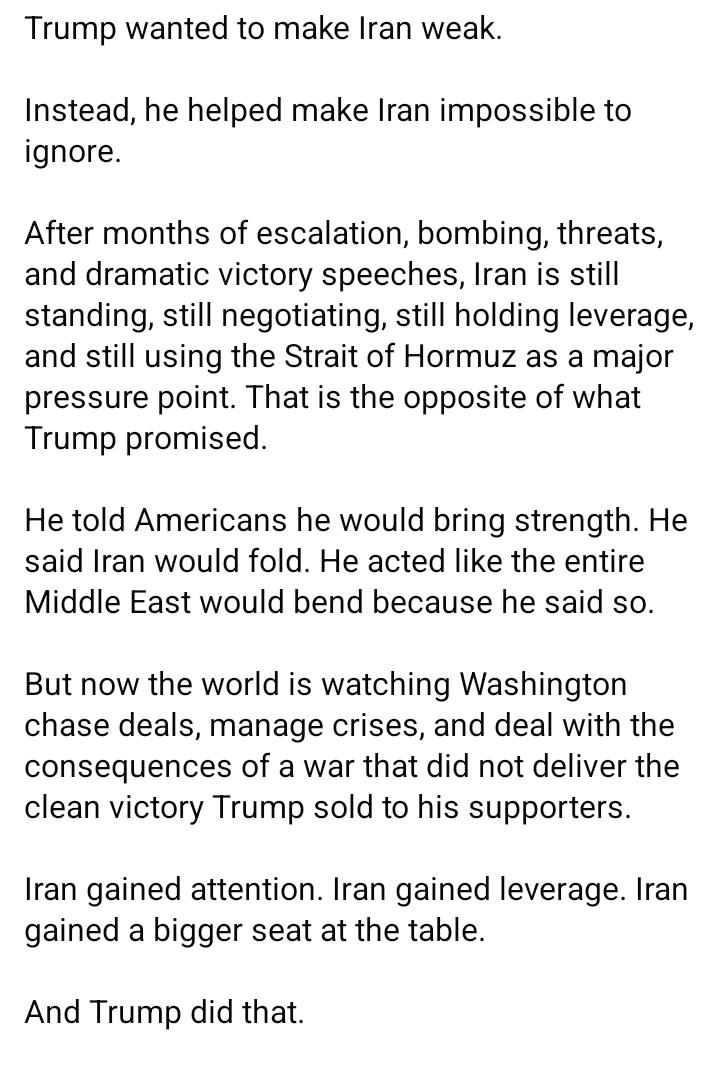
The fun version of the story is that Trump accidentally turned Iran into a superpower. The factual version is sharper: Trump’s war-and-deal cycle may have increased Iran’s leverage at the exact moment Washington wanted to reduce it.
That leverage comes from four places.
First, geography. Hormuz is not just a stretch of water. It is one of the world’s most important oil chokepoints. When Iran threatens it, energy markets listen.
Second, nuclear ambiguity. Iran insists its nuclear program is peaceful. The U.S., Israel, and international watchdogs remain deeply concerned about enrichment levels, stockpiles, and verification. That uncertainty gives Tehran bargaining power.
Third, regional networks. Iran’s links to groups such as Hezbollah mean U.S.-Iran diplomacy cannot be separated from Lebanon, Israel, Syria, Iraq, Yemen, or the Gulf. One ceasefire violation can suddenly become a nuclear-talks problem.
Fourth, American politics. Trump needs the deal to look like a win. Israel wants security guarantees. Iran wants sanctions relief and recognition. Every side is selling a different story to its own audience.
That is why the “Iran is a superpower now” line works as political satire. It exaggerates, but it points at something real: Iran has survived military pressure, forced a major U.S. negotiation, and made the world care about its next move.
Still, facts matter. Iran is not officially a superpower. It is not economically comparable to the United States. It is not militarily equal to America. It does not command a global alliance system on the scale of Washington or Beijing.
But it has become the country Trump cannot ignore, Israel cannot easily bypass, oil markets cannot shrug off, and diplomats cannot postpone forever.
That is not superpower status.
It may be something more annoying: enough power to make everyone else’s plans harder.
And in geopolitics, sometimes that is all a country needs to punch far above its weight.