Joe Biden turns Donald Trump’s Reflecting Pool makeover into a blistering symbol of vanity, power and public trust
Former President Joe Biden did not merely take a swipe at President Donald Trump when he mocked the latest fight over the Lincoln Memorial Reflecting Pool.
He turned a blue-painted pool, a proposed triumphal arch, a White House ballroom and a Kennedy Center name dispute into one of the sharpest political metaphors of Trump’s second term.
Speaking at a Democratic gala in Maryland, Biden blasted Trump as a leader consumed by “vanity projects” at a moment when many Americans are worried about prices, public services, global instability and the direction of democracy.
His most memorable line, “Whoa, what a loser,” landed because it was simple, stinging and easy to repeat. But the deeper force of the attack was not the insult. It was the image behind it.
The Reflecting Pool is supposed to mirror the Lincoln Memorial, the Washington Monument and the country’s long argument with itself over sacrifice, unity and freedom.
Now, after a controversial renovation, algae problems, contract scrutiny and political theater, it has become something else in the national conversation: a stage for a fight over whether Washington’s most sacred public spaces are being repaired, branded or remade in one man’s image.
Biden’s “what a loser” attack lands in a larger political fight
Biden’s criticism came during a politically charged moment for Democrats. His remarks arrived two years after the debate performance that helped end his 2024 reelection bid and opened the door to Kamala Harris’ failed campaign against Trump. That timing gave the speech an unmistakable edge.
Biden was not speaking as a president defending his own administration. He was speaking as a former president trying to define the current one.
His argument was direct: Trump is spending too much energy on grand construction projects and symbolic displays while presenting himself as a champion of government efficiency.
Biden pointed to several examples, including the White House ballroom, the proposed arch near the National Mall, the Kennedy Center controversy, and the Reflecting Pool work.
The line that drew the loudest attention was personal, but the message was institutional. Biden framed Trump’s projects as evidence of misplaced priorities, suggesting that the presidency was being used to reshape public landmarks to suit personal taste, political branding, and spectacle.
That is why the story has traveled beyond the usual partisan back-and-forth. This is not just another exchange between Biden and Trump.
It is a clash over what national monuments are for, who gets to alter them, and how much public trust is lost when restoration projects begin to look like political self-expression.
The Reflecting Pool becomes the unlikely center of a national argument
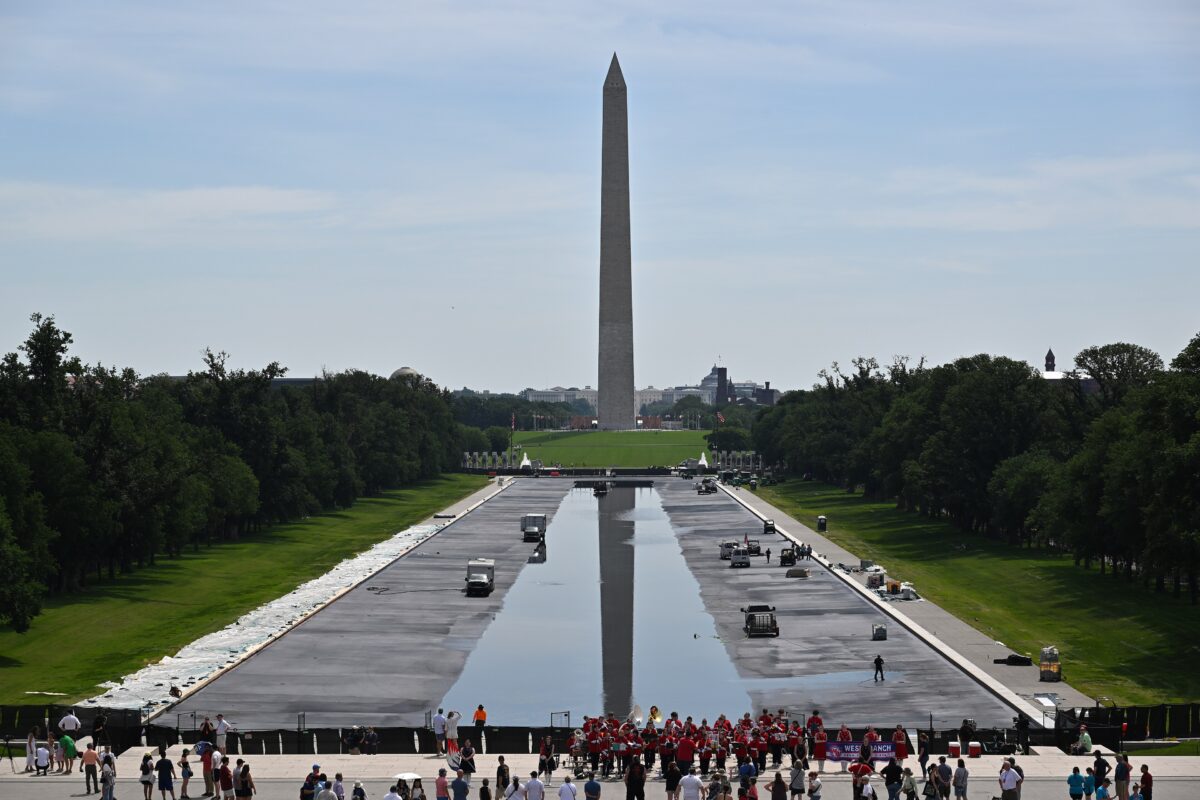
The Lincoln Memorial Reflecting Pool is not an ordinary water feature. It is one of the most recognizable landscapes in Washington, D.C., stretching across the National Mall between two of the country’s most symbolic structures.
It has appeared in historic photographs, civil rights memories, presidential ceremonies, protest images, and tourist snapshots for generations.
That symbolism is what made the renovation so politically explosive.
Trump has argued that his administration is improving Washington and restoring neglected public spaces. In April, he described the Reflecting Pool as dirty and leaking, presenting the work as part of a broader effort to beautify the capital.
The project included coating the pool bottom in a deep “American flag blue,” a choice that immediately drew attention because the pool is traditionally understood as a reflective civic space rather than a branded visual statement.
Then came the problems. Reports described algae blooms turning the water green again after the work, with workers racing to address the issue. Images of green water and peeling blue material gave critics exactly the visual they needed. A project sold as beautification suddenly looked like a political metaphor waiting to happen. Biden seized it.
His attack suggested that the Reflecting Pool now reflects something darker than monuments and sky. In his telling, it reflects ego, incompetence, and misplaced power.
Whether readers agree with Biden or not, the reason the line resonated is clear: the physical image was unforgettable. A pool meant to reflect Lincoln was now reflecting a messy fight over Trump.
Trump’s Washington makeover is bigger than one pool
The Reflecting Pool dispute is only one piece of a much larger push by Trump to remake prominent spaces in Washington.
His administration has backed or advanced several high-profile projects, including a major White House ballroom, a proposed triumphal arch tied to America’s 250th anniversary and changes involving cultural institutions.
The White House ballroom project has been promoted as a long-needed expansion that would allow the executive mansion to host larger formal events without relying on temporary structures.
Supporters view it as a practical and impressive addition to one of the world’s most important buildings. The White House has described the project as privately funded by Trump and donors, while also noting necessary security work tied to the site.
Critics see something different. To them, the ballroom represents Trump’s instinct for grand architecture, luxury scale, and personal legacy-building.
They argue that the White House is not a private club, a resort property, or a campaign backdrop. It is the people’s house, and major changes to it carry meaning far beyond design preference.
Kennedy Center controversy adds another layer to Biden’s argument
The Kennedy Center fight gave Biden another powerful example. The dispute over Trump’s name appearing in connection with the performing arts center has already moved through court scrutiny, removal efforts and public controversy.
A federal judge ordered explanations related to scaffolding and tarps after Trump’s name was removed from the building’s front.
For Biden’s argument, the Kennedy Center matters because it moves the issue from construction into cultural ownership. The center is named for President John F. Kennedy and carries decades of artistic, diplomatic, and national meaning.
Any effort that appears to rename, rebrand, or visually alter that identity is bound to provoke backlash.
The court fight also undercuts any attempt to treat the matter as ordinary renovation politics.
When judges, congressional figures, board members, and cultural leaders are all drawn into the same dispute, the story becomes much larger than signage. It becomes a question of legal authority, institutional independence, and whether a sitting president can bend national cultural spaces toward personal recognition.
The cost question makes the Reflecting Pool fight harder to dismiss
The political sting also comes from the money. Trump has repeatedly positioned his second administration as focused on reducing waste, fraud, and abuse.
That message becomes more complicated when critics point to expensive landmark projects, disputed contracts, and public works that appear to cost more than initially suggested.
The Reflecting Pool renovation has drawn scrutiny because of federal contract data and questions about the true cost of the work.
Trump described the project as a relatively modest fix, but reporting has identified larger commitments tied to the pool’s repair and coating.
That gap matters politically because voters understand cost overruns. They understand promises that sound smaller at the microphone than they look on paper.
There is also a public trust issue. When a project involves a famous national site, a president’s personal direction, unusual visual choices and later performance problems, every dollar becomes part of the story.
The question is no longer simply whether the pool needed maintenance. It becomes a question of whether the maintenance was handled transparently, competently, and with respect for the site.
For Democrats, that is potent territory. They can connect the pool to a larger argument about governing style. For Trump’s allies, the answer is equally clear: Washington was neglected, Trump is fixing it, and critics would rather mock improvements than admit the city needed work.
Why Biden’s insult may work politically
Biden’s “what a loser” line was blunt, but its political value rests on more than shock. It turned a complicated cluster of infrastructure, design, and court stories into a simple emotional frame.
That is how modern political messaging works. Voters may not follow every detail of a contract.
They may not read planning documents for a proposed arch. They may not track every procedural move involving the Kennedy Center. But they can understand the image of a president trying to paint the Reflecting Pool blue, only for algae and controversy to swallow the message.
Biden’s attack also reverses one of Trump’s long-standing strengths. Trump has often used ridicule as a political weapon, branding opponents with memorable nicknames and reducing complex arguments to cutting phrases.
Biden borrowed that style, but aimed it at Trump’s own aesthetic instincts. Instead of debating policy first, Biden mocked the spectacle.
That approach carries risk. Some voters may see the insult as petty. Others may wonder whether Democrats should focus more on economic pain, health care, housing, immigration, crime, education, and foreign policy.
The best political attacks often work because they turn a specific story into a symbol of a larger concern. Biden’s point was not only that the pool looked bad. His point was that Trump’s priorities looked bad.
The deeper issue: Who gets to shape America’s public memory?
The fight over Trump’s projects is ultimately a fight over public memory. Washington’s monuments do not merely decorate the capital. They tell visitors what the country honors. They shape how history is remembered, photographed, and taught.
The Lincoln Memorial is tied to the Civil War, emancipation, national unity, and the long struggle for civil rights. The Reflecting Pool draws the eye across that landscape.
The Kennedy Center carries the name of a president associated with youth, culture, service, and Cold War-era idealism. The White House is the central symbol of executive power.
The National Mall and its surrounding ceremonial spaces belong not to one administration, but to the public across generations.
That is why changes to these places provoke such intense reactions. A private building can be remodeled according to the owner’s taste. A national landmark cannot be treated so casually. Even when repairs are needed, process matters. Scale matters. Naming matters. Public comment matters. Transparency matters.
Biden’s sharpest attack is really about Trump’s legacy project
The reason this story matters is not that Biden called Trump a name. American politics has no shortage of insults. The reason it matters is that Biden found a visual argument that could stick.
The Reflecting Pool was supposed to project restoration. Instead, it has become a symbol that both sides are trying to claim.
Trump wants it to represent action, beauty, and patriotic renewal. Biden wants it to represent ego, waste, and failure. The same pool now reflects two competing stories about America.
One story says Trump is restoring a capital that had grown tired, inefficient, and uninspired. The other says he is using public landmarks as props in a personal legacy campaign. Between those stories lies the real question voters will keep hearing as 2026 politics intensifies: Is this beautification or branding?
Biden has clearly chosen his answer. By tying together the Reflecting Pool, the arch, the ballroom, and the Kennedy Center, he turned scattered controversies into one sharp accusation.
In his telling, the Trump administration is not merely renovating Washington. It is revealing itself through the projects it chooses, the names it elevates, the symbols it alters, and the costs it asks the public to accept.
The most damaging political attacks are the ones people can picture. Biden gave Democrats exactly that: a green Reflecting Pool, a blue coating, a giant arch, a covered Kennedy Center entrance, and a president accused of building monuments to himself while calling it national renewal. That image will be hard to drain.