Khamenei Funeral Turns Into a Tense Show of Power as Iran’s New Leader Stays Hidden
Iran wanted the funeral of Ayatollah Ali Khamenei to look like a moment of unity. Instead, it also exposed something far more uncomfortable: the country’s new supreme leader is still nowhere to be seen.
On Sunday, Iran’s political and military elite gathered at Tehran’s Imam Khomeini Grand Mosalla for funeral prayers honoring Khamenei, the longtime supreme leader killed in a February airstrike during the war involving the United States and Israel. The ceremony drew enormous crowds, black mourning clothes, red revenge banners, and the kind of anti-American anger Tehran has long used to project strength.
But the most important person in Iran’s new power structure was absent.
Ayatollah Mojtaba Khamenei, Ali Khamenei’s son and successor, did not appear at the ceremony. His brothers Masoud, Meysam, and Mostafa were seen publicly beside the coffins. Iran’s president, parliament speaker, Revolutionary Guard figures, and senior clerics were also present. Yet Mojtaba remained out of sight, deepening questions about his condition, his security, and how much control he can publicly project at one of the most important political moments in modern Iran.
A Funeral Built to Send a Message
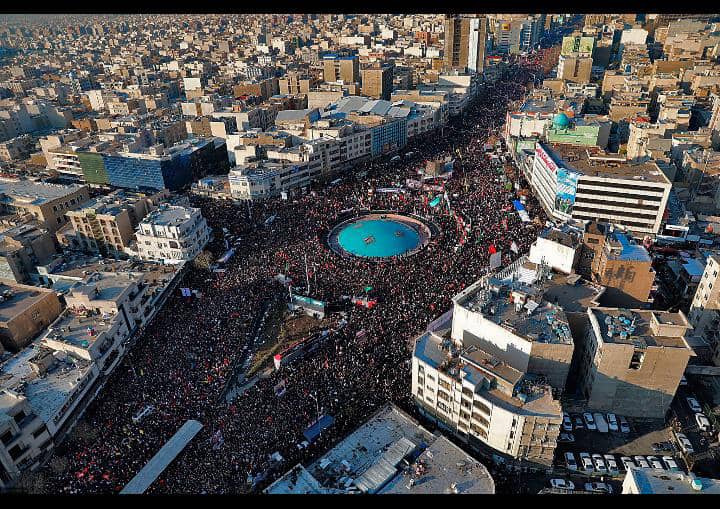
The funeral was not just about mourning. It was theater, politics, grief, and defiance rolled into one.
Crowds filled the Grand Mosalla as prayers were led for Khamenei and family members killed in the same strike. Mourners carried flags, portraits, and banners while chanting against the United States and Israel. For Iran’s leadership, the size of the turnout mattered. After months of war, military strikes, leadership losses, and economic strain, the state needed the world to see that it could still command public emotion.
That is why the appearance of so many senior officials mattered. President Masoud Pezeshkian attended. Parliament Speaker Mohammad Bagher Qalibaf attended. Revolutionary Guard commander Gen. Ahmad Vahidi was also seen, surrounded by heavy security. These were not casual appearances. During the war, public visibility for top figures was dangerous. Their presence at the funeral suggested Iranian authorities believed the ceremony was protected enough to risk putting powerful men in public view.
Still, the absence of Mojtaba Khamenei overshadowed much of the symbolism. His three brothers stood before the public. He did not. For a new supreme leader, especially one stepping into power after the killing of his father, invisibility is politically expensive.
The Missing Leader Is Now the Bigger Story
Mojtaba Khamenei has reportedly been in hiding since the February attack that killed his father. Reports have said he was wounded in that strike, although Iranian authorities have not offered a clear public explanation of his condition.
That makes his absence at the funeral hard to ignore.
A supreme leader in Iran is not simply a ceremonial figure. He sits above the elected government, shapes national security, guides the Revolutionary Guard, and carries enormous religious and political weight. At a moment when Iran is trying to project strength, the public still has not seen the man now expected to embody it.
That does not mean he is powerless. In Iran’s system, decisions can move through clerical networks, military channels, written statements, and trusted intermediaries. But politics is also performance. A leader who cannot appear in public during his own father’s funeral leaves room for speculation, even among supporters.
For ordinary mourners, the uncertainty was visible. Some came hoping to see him. Others said Iran should wait for his direction before taking revenge. That response captures the moment perfectly: the crowd was angry, but the command structure still felt hidden behind curtains.
Anger at Trump Boils Over
The funeral also carried a sharp anti-Trump edge.
Some mourners and hard-line voices targeted President Donald Trump by name, accusing him of responsibility for the war and the strike that killed Khamenei. Posters and chants reflected the crowd’s fury, while some speakers escalated the rhetoric into direct threats.
That matters because the United States and Iran are still locked in fragile negotiations over ending the war permanently. The public anger at the funeral may help Tehran domestically, but it also complicates diplomacy. Iranian leaders are trying to balance two audiences at once: angry supporters demanding revenge and foreign negotiators demanding restraint.
Trump, speaking in Washington during America’s 250th anniversary events, praised U.S. military actions and said the country had achieved major success against Iran. That only sharpened the contrast. In Washington, Trump was presenting the conflict as a victory. In Tehran, mourners were treating Khamenei as a martyr and demanding a response.
The two messages could not be further apart.
U.S.-Iran Talks Are Now Waiting on the Funeral
The funeral has also slowed the diplomatic calendar.
Talks between the United States and Iran appear to be on hold until the mourning ceremonies conclude. Those talks are not small. They involve the future of the Strait of Hormuz, Iran’s disputed nuclear program, and the wider question of whether the current ceasefire can become something more stable.
The Strait of Hormuz remains one of the biggest pressure points. It is a vital route for global energy shipments, and Iran has been demanding greater influence over how traffic moves through it. The United States has rejected Iranian demands for control, while maritime security groups continue monitoring traffic, threats, and mine-clearing efforts.
That means Khamenei’s funeral is not happening in isolation. It is unfolding while energy markets, naval routes, regional alliances, and nuclear negotiations all hang in the balance.
Iran is using the funeral to show that it has not been broken. The United States is using negotiations and military pressure to keep Tehran contained. Gulf states are watching the waterway. Israel is watching Iran’s leadership. And inside Iran, everyone is watching for Mojtaba.
A Country Mourning, and a Regime Under Pressure
The coming days will matter.
Khamenei’s body is expected to move through several cities, with major ceremonies planned before burial in Mashhad, his birthplace. Authorities have shut down parts of daily life for the mourning period, and more crowds are expected as the funeral procession continues.
For Iran’s government, the goal is clear: turn Khamenei’s death into a symbol of endurance. The state wants the funeral to tell Iranians that the system survived the strike, survived the war, and remains united under a new leader.
But the visual message is incomplete as long as the new leader remains hidden.
Mojtaba Khamenei’s absence may be based on real security concerns. It may be linked to injuries. It may be part of a deliberate effort to protect him from another strike. But whatever the reason, the result is the same: Iran is trying to project confidence while its most powerful figure stays out of sight.
That is why Sunday’s funeral was more than a farewell to an old ruler. It was a test of a new one.
And so far, Iran’s new supreme leader has chosen silence, secrecy, and survival over a public show of command.
Fact-check note: I used fresh reporting from AP, Reuters, CBS News, and The Guardian to verify the funeral attendance, Mojtaba Khamenei’s absence, the Trump-related threats, the pause in U.S.-Iran talks, and the Strait of Hormuz angle.