New York’s final Hooters Has Closed its Doors, Marking Another Setback For a Once-Booming Restaurant Chain Now Fighting to Reinvent Itself.
For years, Hooters was the kind of chain people either loved, mocked, defended, avoided, or remembered with a strange amount of nostalgia. It was never just a place for wings. It was a brand built on a wink, a sports-bar soundtrack, cold beer, late-night jokes, and a very specific idea of American casual dining that once felt impossible to miss. Now, New York no longer has a single Hooters restaurant left.
The chain’s last remaining location in the state, on Wolf Road in Colonie, has closed after roughly 15 years in business. The shutdown follows the earlier closure of New York City’s final Hooters in Fresh Meadows, Queens, and it arrives during a bruising period for the company as it tries to climb out of a financial and cultural hole.
For regular customers, it may feel like another local restaurant simply disappeared. For the brand, it looks like something bigger: a sign that a once-inescapable dining concept is being forced to answer a question it avoided for years. What does Hooters become when the old formula no longer fills the room?
The Last New York Holdout Finally Went Quiet
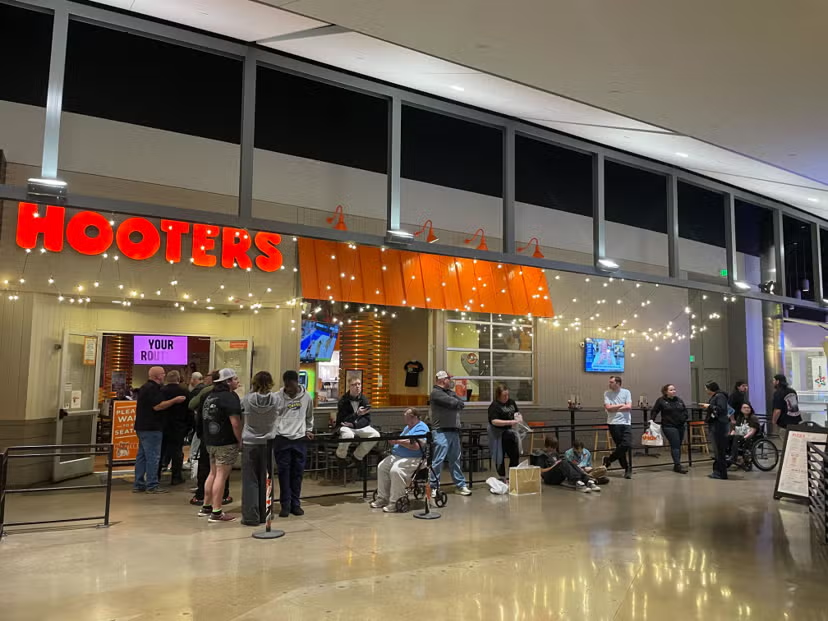
The Colonie restaurant was not just another chain location along a busy road. It had become the last orange-and-white outpost in the Empire State, the final place where New Yorkers could walk into a Hooters without crossing state lines. It’s closing turns a regional retreat into a clean break.
That matters because chain restaurants usually fade slowly. First, the hours change. Then the dining room looks thinner. Then the online ordering stops making sense. Then one day, a note appears on the door thanking customers for the memories. That appears to be the rhythm Hooters customers have seen in several markets as closures spread across the country.
The Colonie shutdown also comes after Massachusetts lost its remaining Hooters restaurants in Dedham, Saugus, and West Springfield. Together, those closures show that this is not merely a New York story. It is part of a wider thinning-out of a brand that once felt planted in the American roadside landscape.
Hooters grew famous by being simple and unmistakable. It offered wings, beer, televised sports, and a service style that became its identity. But what worked in the 1980s, 1990s, and early 2000s now faces a different marketplace. Diners have more options. Sports bars have multiplied. Delivery apps have changed habits. Younger customers are less sentimental about old chain-restaurant rituals. Families watching their budgets are thinking harder before paying sit-down prices for casual food.
That leaves Hooters stuck between memory and reinvention.
Bankruptcy Bought Time, Not Magic
Hooters of America filed for Chapter 11 bankruptcy protection in 2025, outlining a plan to sell its company-owned restaurants and move toward a pure franchise model. The company said at the time that restaurants would continue operating during the process, but it also acknowledged that it was reviewing its footprint.
That phrase sounds corporate and tidy. In real life, it often means locked doors, reassigned workers, disappointed regulars, and empty buildings waiting for a new tenant.
The company’s problem is not only debt. Debt can be reorganized. Restaurants can be sold. Menus can be refreshed. But a brand identity is harder to fix, especially when that identity is both the reason people remember you and the reason some people stopped taking you seriously.
Hooters has been trying to lean back into its original beach-bar roots while softening the image that made it famous. Executives have described a more family-friendly direction, with less emphasis on the old “breastaurant” stereotype and more focus on wings, neighborhood hospitality, and nostalgia. That is a tricky turn. Move too far from the old image, and loyalists may say the brand lost its personality. Stay too close to it, and the company risks looking frozen in another era.
The restaurant industry is not forgiving right now. Labor costs are higher. Food costs are stubborn. Rent is punishing in many markets. Casual dining chains have spent years fighting for customers who are eating out less often or choosing faster, cheaper options. Hooters is hardly alone in that squeeze. But it carries a brand burden most competitors do not.
People do not casually notice a Hooters closure. They react to it. They joke. They reminisce. They argue over whether the chain mattered. That reaction proves the brand still has cultural weight, even as its physical footprint shrinks.
The Bigger Story Is About Changing American Taste
The end of Hooters in New York is not just about wings. It is about how quickly the American casual dining map is being redrawn.
For decades, chains like Hooters thrived by creating a predictable experience. A traveler could walk in and know exactly what the place was selling before seeing the menu. That predictability was the point. Today, predictability is not always enough. Customers want value, convenience, better food, local flavor, or a reason to make the trip.
Hooters still has name recognition that most restaurants would envy. The problem is that recognition alone does not pay the bills. A familiar logo cannot save a weak location. A joke from the past cannot keep a dining room full on a Tuesday night.
Still, it would be premature to write the brand’s obituary. Hooters is not disappearing from America. It is shrinking and reshaping, trying to survive by becoming leaner and more franchise-driven. That may help the strongest locations. It may also make the chain feel less national and more regional, with pockets of loyal customers keeping the lights on where the concept still works.