South Korea Says Trump Is Considering a New Way to Stop North Korea’s Nuclear and Missile Push
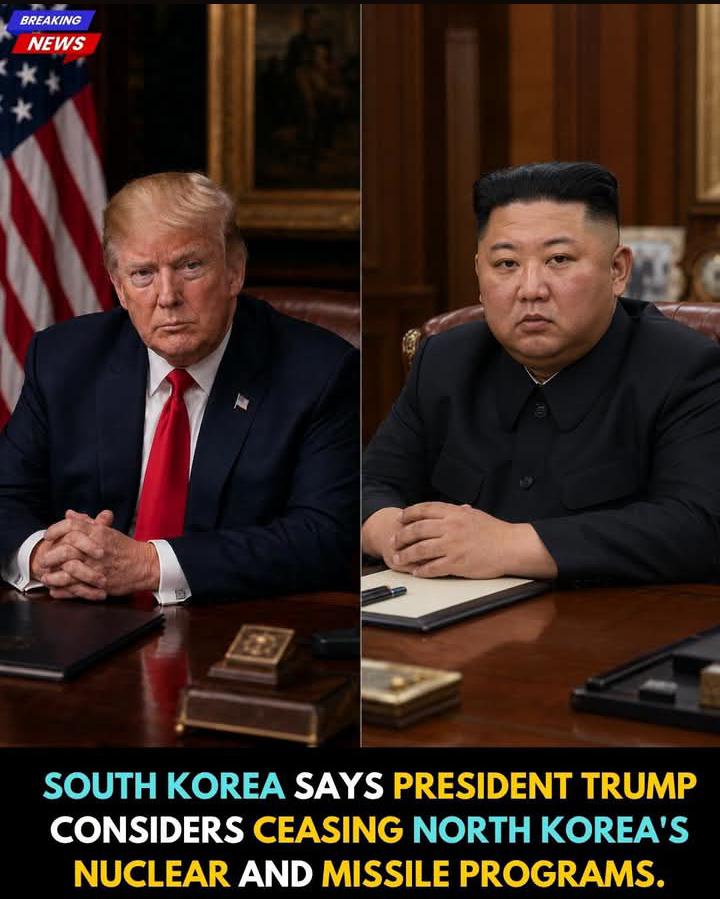
South Korea has sparked fresh diplomatic buzz after signaling that former U.S. President Donald Trump is open to considering a new, phased approach to North Korea’s nuclear and missile programs, one that begins with slowing or halting expansion rather than demanding immediate, full denuclearization.
According to South Korean President Lee Jae Myung’s account of recent discussions with Trump on the sidelines of the G7 summit, the idea on the table is not a dramatic overnight disarmament deal. Instead, it is a step-by-step strategy: freeze North Korea’s weapons development first, then gradually work toward reducing and ultimately dismantling its nuclear capabilities.
That distinction matters. For decades, diplomacy with Pyongyang has swung between maximum-pressure campaigns and ambitious “complete denuclearization” goals. But North Korea’s arsenal has only grown more sophisticated. Now, Seoul appears to be testing whether a more incremental approach could break the cycle of stalemate.
Lee has framed the discussion as pragmatic rather than idealistic, arguing that the immediate priority should be preventing further expansion of nuclear materials and ballistic missile technology. In other words, stopping the clock from moving forward before trying to rewind it.
South Korea’s Push for a “Step-by-Step” Nuclear Freeze
At the center of Seoul’s proposal is a simple but controversial idea: accept that North Korea is already a nuclear-armed state in practice, and focus first on capping its growth.
President Lee Jae Myung has described this approach as a phased framework. The first stage would aim to halt North Korea’s production of additional nuclear material and slow further development of long-range missile systems. The second stage would involve reducing stockpiles and limiting delivery capabilities. The final stage — still framed as the long-term objective — would be complete denuclearization.
It is a structure designed to reflect political reality rather than diplomatic aspiration.
North Korea has repeatedly declared itself a nuclear power and has continued testing and expanding its missile systems despite years of sanctions from the United Nations, the United States, and its allies. Intelligence assessments across multiple countries suggest Pyongyang is now capable of producing more advanced weapons systems than it was even a few years ago, including intercontinental ballistic missiles with extended range potential.
Against that backdrop, Lee’s argument is that insisting on immediate total dismantlement may no longer be realistic, at least not as a starting point.
Instead, he reportedly told Trump that focusing on a freeze would be a more achievable entry point for negotiations. That would mean limiting escalation first, then, if possible, building trust before attempting deeper reductions.
Importantly, Seoul is not abandoning the goal of denuclearization. Rather, it is trying to restructure the path toward it.
Diplomats familiar with the approach describe it as a recognition that North Korea is unlikely to trade away its nuclear program in one sweeping agreement, especially given how central it has become to regime survival strategy in Pyongyang.
Still, the proposal is politically sensitive. Critics of phased deals often argue that freezes can unintentionally legitimize a country’s nuclear status while giving it breathing room to strengthen its position behind closed doors.
Supporters, however, counter that the alternative, continued isolation and stalled negotiations, has already failed to slow North Korea’s progress.
Trump’s Reported Openness and the Return of Old Diplomacy Questions
What has made this latest discussion particularly attention-grabbing is Trump’s reported reaction.
According to Seoul’s account, Trump did not reject the phased idea outright. Instead, he indicated openness to considering different approaches to North Korea, signaling that renewed engagement is worth exploring.
This fits with Trump’s earlier record on the issue. During his first term, he became the first sitting U.S. president to meet a North Korean leader face-to-face. His summits with Kim Jong Un in Singapore in 2018 and Hanoi in 2019 produced historic imagery and global attention, but ultimately failed to deliver a lasting nuclear agreement.
Those meetings, however, did shift the diplomatic landscape. For the first time in decades, Washington and Pyongyang engaged directly at the highest level, bypassing many traditional channels.
Now, Seoul appears to be floating the idea that Trump could once again play a central role if he returns to the issue — this time with a more incremental framework.
The key difference in this proposed direction is pace and scope. Instead of a single grand bargain, the focus would be on smaller, verifiable steps: limiting production, reducing escalation risks, and preventing further proliferation of missile technology.
South Korean officials argue that even a partial freeze could reduce immediate security risks on the Korean Peninsula, especially given concerns about North Korea’s growing missile range and testing frequency.
However, there are major unanswered questions. Any freeze would require verification mechanisms, monitoring access, and enforcement rules, all of which North Korea has historically resisted. There is also the issue of sanctions: whether relief would be offered in exchange for partial steps, and how quickly.
Without those details, the idea remains a framework rather than a negotiated plan.
North Korea’s Response and the Bigger Geopolitical Stakes
Pyongyang, meanwhile, has shown no sign of accepting any external push toward denuclearization, phased or otherwise.
Kim Jong Un’s influential sister, Kim Yo Jong, has repeatedly dismissed calls for denuclearization as unacceptable and a violation of North Korea’s sovereignty. The country’s official stance has hardened in recent years, declaring its nuclear status irreversible and central to national defense.
That position sharply limits the space for diplomacy. Even a freeze agreement, which does not require immediate disarmament, could be difficult if North Korea believes it sets a precedent for future pressure.
Adding another layer of complexity is the changing global environment. North Korea has deepened its ties with Russia amid the war in Ukraine, raising concerns in Washington and Seoul that Pyongyang could gain access to military technology or economic support in exchange for cooperation.
That potential alignment has shifted calculations in Northeast Asia. What was once a relatively isolated nuclear issue is now entangled with broader geopolitical rivalries involving the United States, Russia, China, and their regional partners.
For South Korea, the urgency is clear. Missile tests have continued, regional tensions remain high, and diplomatic channels with Pyongyang are largely frozen.
Lee’s outreach to Trump reflects a belief that breaking that deadlock may require unconventional political chemistry, the same dynamic that once produced headline-grabbing summits, even if they fell short of lasting results.
Still, even proponents of engagement acknowledge the risks. A phased deal could reduce immediate tensions, but it could also entrench North Korea’s nuclear status if not carefully structured. A failed negotiation, on the other hand, could further erode trust and make future talks even harder.
For now, what exists is not a deal, but a direction being tested.
South Korea is signaling that the next phase of North Korea diplomacy may need to focus less on perfect outcomes and more on manageable steps. Trump, according to Seoul’s account, is at least willing to consider that shift.
Whether that evolves into policy or fades into another cycle of stalled diplomacy will depend on how the world’s most complex nuclear standoff responds to a very old question with no easy answer: Is slowing the threat enough if stopping it completely is out of reach?