Supreme Court Clears Way for Alabama GOP‑Favored Map …What That Means For the 2026 Midterms
The U.S. Supreme Court dropped a blockbuster decision late Tuesday that will reverberate far beyond Alabama. In an unsigned 6–3 order, the conservative majority cleared the way for the state to use a new congressional map that cuts the number of districts where Black voters could elect their preferred candidate. That map was previously blocked by a federal court for violating civil rights laws.
The ruling is part of a broader wave of decisions reshaping America’s electoral landscape and shifting power toward Republican candidates ahead of the critical 2026 midterm elections. It drew sharp praise from GOP lawmakers and fierce criticism from civil rights advocates who say it weakens long‑standing federal protections against racial discrimination in voting.
What the Supreme Court Actually Did
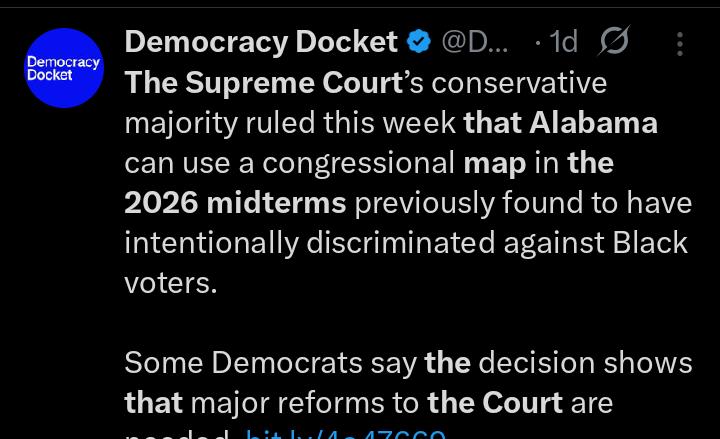
Late Tuesday night, the Supreme Court eliminated a federal court block on Alabama’s congressional map, a decision with immediate political consequences. Under the new map, Alabama’s delegation is likely to include six Republican‑leaning districts and just one where a Democrat has a fair shot.
That stands in stark contrast to the map the three‑judge panel had ordered. Federal judges, including two appointed by President Donald Trump and one by President Bill Clinton, had determined the state’s earlier plan diluted Black voting strength and violated the Voting Rights Act of 1965.
In fact, the lower court had already imposed a remedial map that allowed Alabama to elect two Black Democrats to Congress in the 2024 cycle. Under the Supreme Court’s latest order, that progress will be undone, and Democratic Rep. Shomari Figures of Alabama’s 2nd District, one of those Black members of Congress, will likely lose his seat under the new lines.
The high court did this through what’s known as an unsigned order, meaning no full opinion was published explaining the legal rationale. But the effect is clear: Alabama will use the Republican‑favored map for its 2026 elections.
Why It Matters: Voting Rights, Gerrymandering, and the 2026 Midterms

For decades, Section 2 of the Voting Rights Act protected minority voters from electoral maps that diluted their voice. Under Section 2, plaintiffs could challenge maps that had discriminatory effects even without proof of discriminatory intent.
But this Supreme Court is rewriting the rules.
Just last month in Louisiana v. Callais, the Court tightened the standards for challenging maps under the Voting Rights Act, making it much harder for challengers to prevail. After that decision, plaintiffs must now show “strong inference” of intentional discrimination, a higher bar that legal experts say will often be out of reach.
Now, Allen v. Milligan, the Alabama case, is applying that stricter framework. In this ruling, the Court essentially told the lower court it erred by assuming lawmakers didn’t act in good faith when drawing the map, and said courts should defer to state legislatures unless there’s extremely clear evidence of discriminatory intent.
What makes this especially consequential is timing. The decision came just as some Alabama primaries were underway, triggering logistical confusion and last-minute election changes, an outcome even the Supreme Court once warned against in similar contexts.
Civil Rights Advocates: “An Affront to Democracy”
For voting rights groups, the ruling is a gut punch.
Marina Jenkins, executive director of the National Redistricting Foundation, called the decision “an absolute affront to the founding principles of our democracy.” She said it “wipes out whatever was left of the Court’s credibility” and called for federal action to guard against future abuses.
The three Supreme Court liberals, Justices Sonia Sotomayor, Elena Kagan, and Ketanji Brown Jackson, also dissented sharply. Sotomayor blasted the majority for “doubling down on chaos” and “debasing the democratic process.” She warned the ruling will upend elections and burnish discrimination under the guise of legal deference.
Civil rights advocates fear that this decision doesn’t just affect Alabama; it sets a national precedent that will make it harder to challenge racially discriminatory maps in other states.
Republicans and State Officials: “Affirming State Sovereignty”
Alabama Attorney General Steve Marshall, who fought to uphold the map, said the decision vindicated the state’s authority to set its own electoral districts. While acknowledging disappointment from critics, Marshall said the ruling “affirms the principle that states should decide for themselves how to draw their maps.”
National Republican strategists have been quick to frame the ruling as a strategic advantage. Redistricting battles in states like Florida, Texas, and Tennessee may now tip more seats toward GOP candidates, with analysts projecting Republicans could net up to ten additional House seats based on court- and legislature‑approved maps nationwide.
Court Trends and What’s Next

This decision is not an isolated incident; it fits a pattern in recent terms.
In Louisiana v. Callais in April, the Court undercut the Voting Rights Act’s Section 2 protections, particularly where race and partisan politics overlap. And in Allen v. Milligan, it carried that logic into a direct confrontation with a lower court’s finding of racial discrimination.
Critics argue this hands a structural advantage to Republican mapmakers, enabling them to erect electoral barriers that are difficult to challenge in court. Supporters counter that federal courts were overstepping by micromanaging state political decisions and that the new standard reinforces legislative prerogatives.
You may also see ripple effects in other states. Courts and legislatures have been revisiting maps in places like Virginia and Louisiana. As these battles unfold, the Supreme Court’s latest move will almost certainly be cited as justification for similar redistricting strategies.
What Voters Should Know

- Alabama’s congressional map changes are now cleared for 2026, with six Republican‑leaning seats and one Democrat‑leaning seat.
- The Supreme Court’s 6–3 conservative majority overruled a lower court finding of intentional discrimination.
- Voting rights standards have been tightened, making it substantially harder to challenge maps under the Voting Rights Act.
- Civil rights groups warn this hurts minority voters; Republican leaders say it restores local control.
- The decision’s effects are likely to influence races nationwide, not just in Alabama.
This is one of the most consequential Supreme Court orders in the 2026 midterm cycle, not because it is long or filled with legalese, but because of its real‑world impact on who represents Americans in Congress.
Whether you see this as a correction of judicial overreach or a setback for civil rights protections, the decision marks a turning point. As campaign season accelerates and more maps come under scrutiny, this ruling will be cited again and again as either a defensive shield for state lawmakers or a weapon that reshapes American democracy in ways many hadn’t imagined.