Texas Protest Outside ICE Facility Leads to Decades in Prison as Families Challenge Antifa Claims
For families gathered around a federal courthouse in Texas, the case did not end like a normal sentencing. It ended with numbers that sounded almost impossible to process: 100 years, 70 years, 50 years, 30 years.
A protest that began outside the Prairieland Detention Center near Dallas has now become one of the most closely watched legal fights in the country, raising questions about violence, immigration enforcement, political labeling, and how far the justice system should go when a demonstration turns into a criminal case.
On Tuesday, Benjamin Song, a former U.S. Marine reservist, was sentenced to 100 years in prison after prosecutors said he opened fire during a July 4 demonstration outside the immigration detention center in Alvarado, Texas. A police officer was wounded in the shooting.
Seven other defendants were also sentenced to lengthy prison terms, ranging from 30 to 70 years. Prosecutors described the case as terrorism-related and alleged the group had ties to antifa, a loosely organized anti-fascist movement. Defense lawyers denied those ties and argued that several defendants did not plan violence, did not carry firearms, and did not expect the protest to become dangerous.
What Prosecutors Say Happened Outside the Detention Center
According to prosecutors, the July 4 gathering outside Prairieland was not simply a protest. They alleged that people arrived with firearms, body armor, first aid supplies, fireworks, and other gear, creating what the government described as a coordinated attack on a federal immigration facility.
The Justice Department said Song shouted, “Get to the rifles,” before opening fire. Prosecutors said a police officer who had arrived at the scene was struck.
U.S. District Judge Reed O’Connor described the incident as more than a demonstration, calling it an “assault on democracy.” He said the sentences were meant to deter similar conduct in the future.
Acting Attorney General Todd Blanche also praised the sentencing, saying the case showed that people accused of attacking law enforcement and federal facilities would face severe punishment. But the defense painted a very different picture.
Lawyers for the defendants said the gathering was meant to be a late-night demonstration in support of immigrants detained at Prairieland. They said some people brought firearms because they feared for their own safety, not because they planned an attack. Others, attorneys argued, had no weapons at all and were not involved in planning what happened.
Families Say the Sentences Feel Like Life Behind Bars
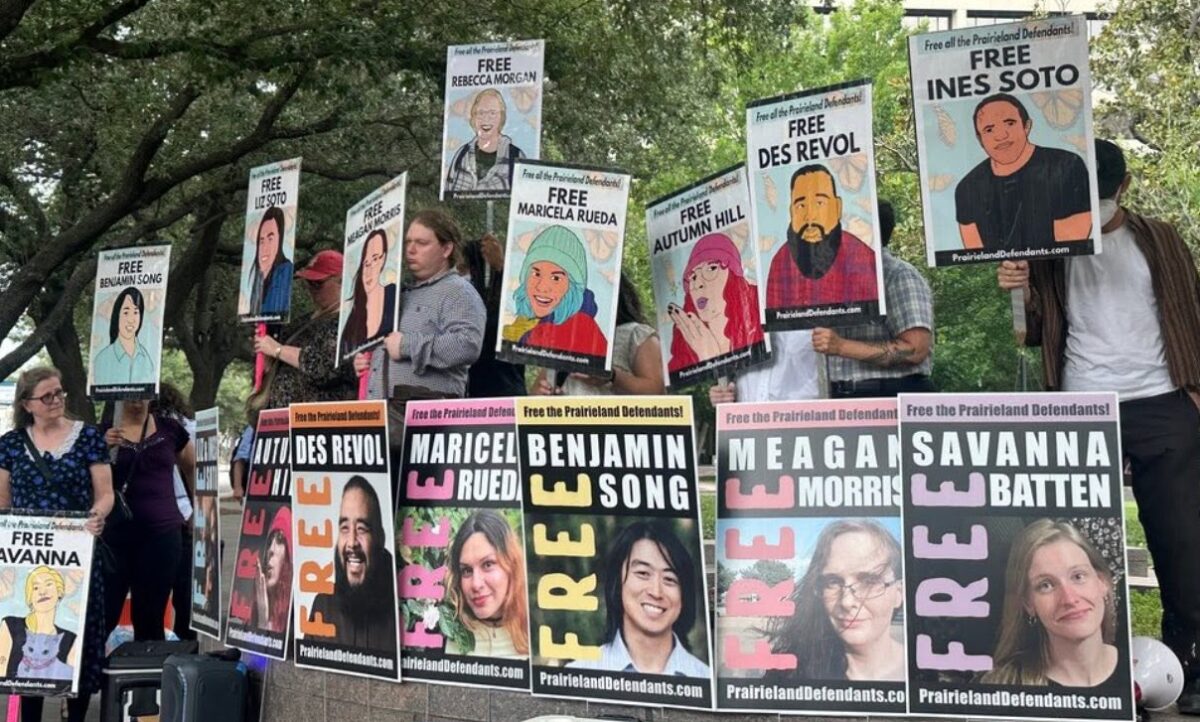
The most emotional response came from the families of those sentenced. Lydia Koza, whose wife, Autumn Hill, received a 50-year sentence, said she was furious after hearing the punishment. She said the government was trying to take away her wife’s life over a protest where “nobody died.”
Hill told the court that the event felt “more like a party” than a planned attack. Her attorney said there was no evidence she had a gun or believed in using violence to create political change. He also said that after fireworks were used, she picked up trash before leaving the area.
Savanna Batten, another defendant sentenced to 50 years, was also described by her attorney as someone who did not bring a firearm, spray paint, or fireworks, and did not participate in planning the demonstration.
Another defendant, Daniel Sanchez Estrada, received a 30-year sentence. His attorney said Sanchez Estrada was not even at Prairieland the night of the shooting and was convicted only on charges tied to concealing documents. The defense said the items involved were personal belongings, including artwork, poetry, journals, and zines.
For supporters of the defendants, those details have become central to the concern: they argue that the sentences sweep too broadly and punish people far beyond their individual actions.
Why This Case Is Drawing National Attention
The case matters beyond one Texas detention center because it sits at the intersection of three major national debates: immigration, protest rights, and political extremism.
Prairieland Detention Center is part of the immigration enforcement system that has drawn protests from immigrant-rights activists across the country. Demonstrations outside detention facilities are not new, but this case has become a flashpoint because prosecutors framed the incident as terrorism-related.
The government alleged links to antifa. Defense lawyers disputed that claim.
That distinction is important. Antifa is not a traditional organization with a single leader, membership card, or national headquarters. It is generally used as an umbrella term for anti-fascist activists, some of whom confront far-right groups at demonstrations. Critics of the prosecution worry that using the label too broadly could affect future protest cases, especially if political beliefs, clothing, literature, or online activity are treated as evidence of criminal intent.
Law enforcement supporters, however, see the case differently. For them, the central fact is that an officer was shot and a federal facility was targeted. They argue that protests cross a clear line when weapons, property damage, or attacks on officers are involved.
What Happens Next
The legal fight is not over.
Civil liberties advocates have warned that the case could have a chilling effect on First Amendment activity. Their concern is not that violence should be excused. It is that courts and prosecutors must separate proven criminal conduct from association, ideology, or presence at a protest.
Song’s attorney has said he plans to appeal the 100-year sentence. Other defense attorneys are also expected to challenge the convictions or sentences, especially in cases where they argue their clients had no direct role in the shooting.
Another defendant who was connected to the broader case is expected to be sentenced later, keeping the Prairieland case in the courts and in public debate.
Appeals could focus on several questions: whether the evidence supported terrorism-related convictions, whether the sentences were excessive, how the court treated alleged political affiliation, and whether individual defendants were punished based on their own actions or the group’s alleged intent.
Why It Matters
For people in Alvarado and across North Texas, the case is a reminder of how quickly a national political conflict can land in a local community. A detention center, a holiday-night protest, a wounded officer, and a courtroom full of families have now become part of a larger American argument.
The case does not fit neatly into one simple story. It is about public safety. It is about immigration enforcement. It is about the limits of protest. It is about whether political labels can influence criminal punishment. And for the families involved, it is about decades of life now measured in prison terms.
As appeals move forward, the central question will remain: did the court deliver justice for a violent attack, or did it set a new and troubling standard for how protest-related cases can be punished in America?