Trump Reimposes Iran Blockade as Hormuz Crisis Turns Deadly Again
The fragile pause between the United States and Iran is collapsing fast, and the Strait of Hormuz has once again become the center of a dangerous military showdown.
U.S. forces launched a third consecutive night of attacks on Iranian targets, as Iran fired ballistic missiles toward an American air base in Jordan. The latest exchange followed deadly missile strikes on oil tankers in the strait, where one Indian sailor was killed and eight crew members were wounded.
President Donald Trump has now ordered the return of a blockade against Iranian shipping. He also says vessels using the strategic waterway should pay the United States a fee worth 20% of their cargo for American protection.
That is not a small policy adjustment. It is a dramatic escalation in a waterway that normally carries roughly one-fifth of the world’s traded oil and natural gas.
Five hours of attacks put the ceasefire on life support
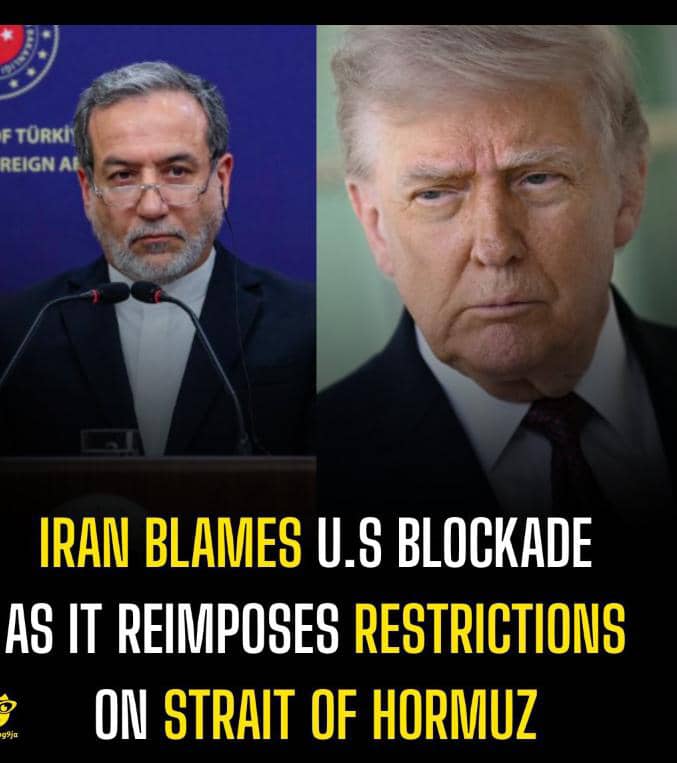
The latest U.S. operation lasted about five hours and targeted sites connected to Iran’s coastal defenses, missiles, drones and maritime forces. American officials said the goal was to weaken Iran’s ability to threaten commercial ships moving through the Strait of Hormuz.
U.S. Central Command described the targets as “coastal defense systems, missile and drone sites and maritime capabilities.”
Iran answered by launching ballistic missiles toward an American air base in Jordan. Jordan’s armed forces said they intercepted four missiles that entered the country’s airspace. Iran’s Revolutionary Guard urged Jordanians to push for the removal of U.S. military facilities, presenting the attack as a strike against Washington rather than Jordan itself.
The exchange was smaller than some of the enormous missile barrages seen earlier in the conflict, but that does not make it harmless. Every new strike increases the possibility of an interception failure, a civilian casualty, or a retaliatory attack that neither side can easily walk back.
Trump insists the pressure will continue. “The Hormuz Strait is OPEN, and will remain OPEN, with or without Iran,” he wrote while announcing that the blockade would be restored. He has also described the United States as a possible “guardian angel of the strait.”
The U.S. Navy-led Joint Maritime Information Center said the blockade would take effect at 8 p.m. GMT on Tuesday. It had previously been suspended under an interim agreement signed last month.
Tanker attacks make Hormuz the world’s most dangerous shipping lane
The argument over who controls the strait is no longer being conducted through statements and negotiations alone. Commercial sailors are now paying the price.
The United Arab Emirates said Iranian cruise missiles struck the Mombasa B and Al Bahyah, two Emirati oil tankers traveling through Omani territorial waters. One Indian crew member aboard the Mombasa B was killed. Eight others were wounded, including six Indian nationals and two Ukrainians. Four suffered serious injuries.
Fires broke out on both vessels, causing significant damage, although crew members eventually brought the flames under control. A separate chemical tanker, the Stolt Magnesium, was also struck near Oman. Its operator said the crew survived.
The UAE condemned what it called a “blatant attack” and said it retained its “full right to respond to this escalation.” That warning matters. A direct Emirati military response could pull another powerful Gulf state deeper into a war that has already spread across several borders.
Iran’s Revolutionary Guard claimed it had targeted two tankers after they allegedly ignored repeated warnings, switched off navigation systems and entered a route Tehran described as mined. The statement did not clearly establish whether the vessels were the same ships identified by the UAE.
Iranian Foreign Minister Abbas Araqchi, meanwhile, pushed back against Trump’s claim that America would manage the strait. He said Iran would remain its guardian “forever,” then mocked Trump’s proposed fee: “20% is of course too much. We will be fair.”
The joking tone cannot hide the serious legal fight underneath. The United Nations shipping agency said there is “no legal basis” for mandatory tolls on international straits, regardless of whether Washington or Tehran attempts to collect them.
A 60-day peace window is being shredded
Only weeks ago, the United States and Iran signed an interim memorandum meant to halt the fighting, reopen the Strait of Hormuz, and create a 60-day window for broader negotiations. Those talks were expected to cover maritime security, sanctions and Iran’s nuclear program.
The agreement was already under strain before Tuesday’s attacks. Iran accused Washington of violating its commitments, while the Trump administration blamed Tehran for attacking vessels and interfering with navigation. Now the blockade is returning, missiles are flying again, and negotiators appear to be losing control of the timetable.
Oil markets noticed immediately. Brent crude climbed as high as $87.49 per barrel Tuesday, its highest level in about four weeks. Tanker traffic through Hormuz also fell to its lowest point in two months, while stock markets in Dubai, Abu Dhabi and Saudi Arabia declined.
Air travel is also feeling the pressure. European aviation regulators warned airlines about operating over Bahrain, Kuwait, Qatar, the UAE and the Gulf of Oman as missile alerts sounded across the region.
Some regional analysts believe both governments are still trying to gain bargaining power rather than restart unrestricted warfare. Andreas Krieg of King’s College London described the situation as a “low-intensity conflict that will not produce any clear victory.”
That may be true, but low-intensity conflicts can become high-intensity disasters with one bad decision. For now, the United States and Iran are still leaving the door to diplomacy slightly open. The problem is that each new missile is making that doorway harder to reach.