Trump’s Signature Will Appear on Future U.S. Paper Currency, Treasury Confirms
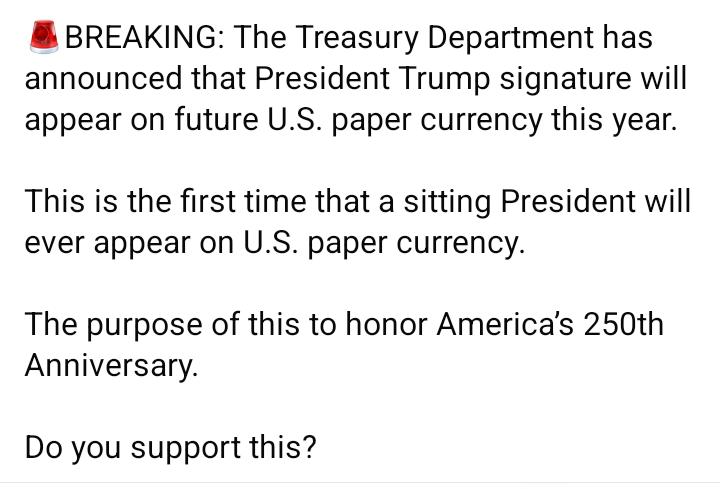
The U.S. dollar is getting a symbolic update that’s already sparking political debate and public curiosity. The Treasury Department has confirmed that President Donald Trump’s signature will appear on future U.S. paper currency, marking a rare break from long-standing tradition in how American money is designed.
The announcement ties into preparations for the nation’s 250th anniversary, with officials framing the move as part of a broader celebration of American history and economic identity. According to Treasury officials, the redesign will roll out gradually, starting with new production runs of the $100 bill before expanding to other denominations.
While currency redesigns are not unusual, this one stands out because of what is being added and who it represents.
What Treasury Says Is Changing About U.S. Money

At the center of the announcement is a simple yet highly symbolic change: Trump’s signature will appear on newly printed paper currency alongside that of the sitting Treasury Secretary.
The Treasury Department says the updated bills will be introduced through normal production cycles handled by the Bureau of Engraving and Printing, the federal agency responsible for printing U.S. paper money. That means the change will not happen overnight. Instead, it will gradually enter circulation as older notes are replaced through regular banking activity.
Officials have indicated that the first notes to feature the updated signature design are expected to begin with the $100 bill, one of the most widely circulated and globally recognized U.S. denominations. Other bills would follow in later stages of production.
Importantly, nothing about existing cash changes. Older bills will remain fully valid, and Americans will not need to exchange or replace any money they currently hold. The U.S. dollar system regularly has multiple designs and signature combinations in circulation simultaneously.
The Treasury has framed the decision as part of the country’s upcoming 250th anniversary, presenting it as a commemorative moment tied to national history rather than a functional change in how money works.
Still, even in technical terms, it is a notable shift. For decades, U.S. currency has carried the signatures of senior Treasury officials, not presidents. That pattern is what makes this announcement stand out in both political and historical terms.
Why This Breaks With a 165-Year Currency Tradition
To understand why this decision is drawing attention, it helps to understand how U.S. paper money normally works.
American currency has long followed a consistent design structure: portraits of historical figures on the front, and official signatures from the Treasury Secretary and the Treasurer of the United States. These signatures act as formal authentication marks, confirming the bill’s legitimacy as government-issued currency.
What has not traditionally appeared on circulating U.S. paper money is the signature of a sitting president.
That distinction is important because it touches on both symbolism and tradition. While presidents have influenced currency design indirectly, their personal marks have not appeared on the physical notes in modern circulation. The Treasury Department’s move changes that pattern by introducing a presidential signature into the official design system.
There is also a legal backdrop worth noting. U.S. law restricts the use of living persons’ portraits on currency, which is why bills do not feature current political leaders. However, a signature is treated differently from a portrait under existing design rules, allowing this change to proceed without the same legal barriers.
Even so, the shift is significant because currency is one of the most widely seen federal artifacts in everyday life. Unlike government buildings or official documents, money passes through nearly every American hand—often daily. That makes any design change inherently visible, even if most people only notice it briefly.
Economically, nothing about the dollar’s value or function changes. A $20 bill will still be a $20 bill, regardless of which Treasury signatures appear on it. But symbolically, the change introduces a new layer of identity to something that has long appeared politically neutral.
Political Reactions, Rollout Plans, and What It Means for Consumers
As expected, the announcement has triggered a mix of support, criticism, and confusion in political circles.
Supporters of the move describe it as a fitting tribute for the nation’s 250th anniversary. They argue that the redesign reflects a moment of national pride and recognizes Trump’s role in shaping the country’s recent political and economic landscape.
Critics, however, see it differently. Some lawmakers have already raised concerns that the decision blurs the line between national currency and personal branding. One member of Congress has introduced legislation to block the use of a sitting president’s signature on U.S. currency altogether, arguing that money should represent the nation as a whole rather than any individual political figure.
Others in government have taken a more procedural stance, noting that currency design authority ultimately rests with the Treasury Department and follows established production rules. From that perspective, the rollout is less about politics and more about administrative discretion within existing systems.
On the ground, the practical impact for Americans will be minimal. New bills will gradually enter circulation through banks, ATMs, and federal cash distribution systems. Most people will not notice an immediate change, and for a long period, old and new versions of the same denominations will circulate side by side.
Collectors, however, are likely to pay close attention. New currency designs often attract interest from numismatists, especially in early print runs or limited-production batches. That could make the first wave of Trump-signed bills more sought after in collector circles, even though their face value remains unchanged.
For everyday consumers, the biggest takeaway is simple: this does not affect spending power, savings, or banking systems. It is a design change, not an economic one.
You will still be able to use any valid U.S. bill in circulation, whether it was printed five years ago or five months from now.
What is changing is the look and the political meaning attached to it.
Because in the end, currency is more than paper. It is one of the few objects that blends government authority, national identity, and daily life into something you can hold in your hand. And now, for the first time in modern history, it may also carry the signature of a sitting U.S. president.