Trump’s “Trump 2028” Joke Is Getting Bigger: 22nd Amendment Fight, Legal Questions and the Numbers Behind the Debate
Donald Trump has turned a simple red campaign hat into one of the biggest constitutional conversations in American politics. During the 2026 White House Correspondents’ Association Dinner, Trump put on a “Trump 2028” hat, joked about running again, and reignited a debate that has followed him since he returned to the White House: Could a president who has already won two elections ever seek a third term?
The answer under the current Constitution is straightforward, but the political impact of the conversation is far more complicated. Trump has mentioned the possibility of a third term more than a dozen times in recent years, sometimes presenting it as humor and other times suggesting there could be “methods” to make it happen.
For millions of Americans, the issue is not only about whether Trump can legally return to the ballot in 2028. It is also about how far a president can push political boundaries, how constitutional limits are defended, and why a joke repeated enough times can become a national debate.
Trump’s 2028 Talk Has Produced Months of Headlines, Merchandise and Political Debate
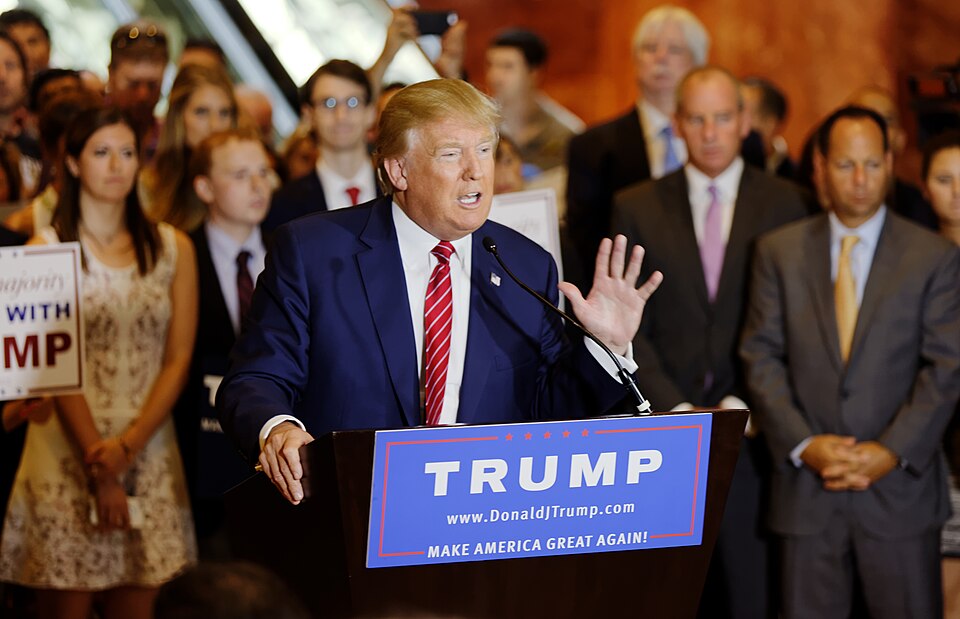
Michael Vadon, CC BY-SA 4.0, via Wikimedia Commons
The latest “Trump 2028” moment did not appear out of nowhere. Since returning to the presidency in 2025, Trump has repeatedly teased the idea of staying politically involved beyond his second elected term, creating a discussion that has stretched across campaign rallies, interviews and political events.
At the correspondents’ dinner, Trump reportedly combined humor with a familiar political message. After joking about his popularity and relationship with the media, he displayed the “Trump 2028” hat, turning a constitutional question into a viral political symbol.
The numbers behind the moment are part of what makes the issue so powerful. Trump is the first president since Franklin D. Roosevelt to win nonconsecutive terms, the first former president to defeat a sitting president in a later election since Grover Cleveland, and now the only living person whose possible third term would immediately collide with the 22nd Amendment.
The merchandise strategy has also expanded the conversation. A $55 “Trump 2028” hat and other related products have allowed supporters to treat the idea as political humor, while critics see the repeated branding as an attempt to normalize the possibility of extending presidential power.
The result is a political message with multiple meanings. To some supporters, it represents loyalty and enthusiasm. To critics, it represents a challenge to a constitutional rule that has existed for more than 70 years.
Why the 22nd Amendment Makes a Third Trump Election Extremely Unlikely
The constitutional barrier is found in one sentence adopted after World War II. The 22nd Amendment states that “no person shall be elected to the office of the President more than twice.”
The amendment was created after President Franklin Roosevelt won four elections between 1932 and 1944. Before Roosevelt, presidents generally followed George Washington’s two-term tradition, but there was no constitutional requirement preventing a president from seeking additional terms.
Roosevelt’s unprecedented four victories changed that debate permanently. In 1947, Congress approved the 22nd Amendment, and by 1951 enough states had ratified it for the limit to become part of the Constitution.
The timeline matters. The United States has operated under presidential term limits for 75 years, and only 1 president in American history has ever been elected more than twice.
Legal experts generally agree that Trump cannot simply appear on the 2028 presidential ballot and win a third election under the current rules. Any attempt to do so would almost certainly trigger immediate legal challenges across multiple states.
The question becomes more complicated only when people move away from a direct presidential campaign and begin discussing possible alternative paths.
The “Vice President Loophole” Theory Has Become the Biggest Legal Debate
One of the most discussed scenarios involves Trump running for vice president instead of president. Under this theory, another Republican candidate could lead the ticket, win the election, and later leave office, allowing Trump to assume the presidency.
Trump himself mentioned a version of this possibility during a 2025 interview, suggesting a scenario in which Vice President JD Vance runs for president with Trump as his running mate.
The problem is the 12th Amendment, which says that anyone constitutionally ineligible to become president cannot be eligible to become vice president.
That creates a major constitutional conflict.
Supporters of the theory argue that the 22nd Amendment only says a person cannot be “elected” president more than twice. They argue that it does not specifically say that a person cannot later assume the office through another constitutional process.
Opponents argue that interpretation ignores the purpose of presidential term limits. If someone could become vice president and immediately take over the presidency, they argue, the 22nd Amendment would lose much of its meaning.
The numbers show why the issue would become a historic legal battle. The United States has 50 states, 538 electoral votes, and thousands of election officials who would have to deal with challenges before any transfer of power could happen.
No president has ever attempted this strategy, and no court has approved it.
Changing the Constitution Would Be the Only Clear Legal Path
There is one unquestionably legal way Trump could serve another elected term: change the Constitution.
The process, however, is intentionally difficult.
Under Article V, a constitutional amendment requires approval from two-thirds of the House of Representatives and two-thirds of the Senate, followed by ratification from three-fourths of the states.
That means 290 representatives, 67 senators, and 38 states would need to support the change if Congress used the traditional amendment route.
America has only added 27 constitutional amendments in more than 230 years, showing how rare and difficult the process is.
A proposal connected to Trump’s third term has already been introduced in Congress. Representative Andy Ogles introduced a resolution seeking to modify presidential term limits, but introducing an amendment is only the first step. Thousands of proposed constitutional changes have been introduced throughout U.S. history, but only 27 have become part of the Constitution.
A constitutional amendment supporting a third Trump term would require a level of bipartisan and nationwide support that has never existed around presidential term limits.
Why Trump Keeps Bringing Up 2028 Even Without a Clear Legal Path
Political analysts have offered several explanations for why Trump continues returning to the subject.
One reason is attention.
Trump has built much of his political identity around controlling the news cycle. A single comment about 2028 can dominate headlines, spark debate on television networks, and force political opponents to respond.
The strategy also keeps Trump positioned as the central figure in Republican politics. Historically, presidents entering their second term often lose influence as potential successors begin building their own campaigns.
By suggesting that he could remain politically relevant beyond 2028, Trump signals to Republican lawmakers and voters that he remains the dominant force inside the party.
The timing is also significant.
The 2026 midterm elections will determine control of Congress, and political parties traditionally begin focusing on the next presidential race well before election day. By keeping attention on 2028, Trump maintains a national conversation centered on himself rather than on potential Republican challengers.
Why Legal Experts Say Americans Should Not Ignore the Conversation
Even experts who believe a third Trump term is unlikely say the discussion itself matters because constitutional systems depend on more than written words.
They depend on elected officials respecting limits, courts enforcing rules, and citizens understanding how government authority works.
The concern raised by constitutional scholars is not simply that Trump will successfully serve another term. The concern is whether repeatedly testing boundaries can change what voters consider acceptable.
American history contains several examples of political conflicts that began as debates over interpretation before becoming larger constitutional struggles.
At the same time, experts caution against assuming that every statement represents a concrete plan. There is currently no approved amendment, no court ruling allowing a third term, and no official Trump 2028 presidential campaign.
The reality is more complicated: Trump’s comments exist somewhere between political performance and constitutional controversy.
The Trump 2028 Debate Is Really About More Than One Election

The controversy surrounding Trump’s third-term jokes is not only about a possible 2028 campaign. It is about how Americans understand presidential power in a country where constitutional limits have shaped elections for generations.
The numbers tell the story clearly: 22 constitutional amendments came before the 27th, 75 years have passed since presidential term limits became law. Only one president has ever tested the old tradition by winning more than two elections.
Trump’s “Trump 2028” message may be a joke, a strategy, a fundraising tool or a serious political signal. The meaning depends largely on who is listening.
But one fact remains unchanged: under the Constitution as it exists today, winning a third presidential election would require changing one of the nation’s most important rules.
The debate is no longer just about a hat with a year printed on it. It is about whether America’s oldest political traditions are strong enough to withstand the pressure of modern politics.