World Cup Meets Real-World Conflict as U.S. Hosts Iran on Day of Airstrikes
Soccer is supposed to give the world ninety minutes to breathe. On Friday, June 26, 2026, it delivered something far stranger: a World Cup host nation carrying out military strikes against the country of a team playing on its soil that same day.
That is the uncomfortable, almost unbelievable backdrop to Iran’s final Group G match against Egypt in Seattle. While fans were watching the drama of the world’s biggest football tournament, U.S. Central Command confirmed that American forces had struck targets in Iran in response to what it called an Iranian drone attack on a commercial ship in the Strait of Hormuz. CENTCOM said U.S. aircraft hit Iranian missile and drone storage locations and coastal radar sites on June 26.
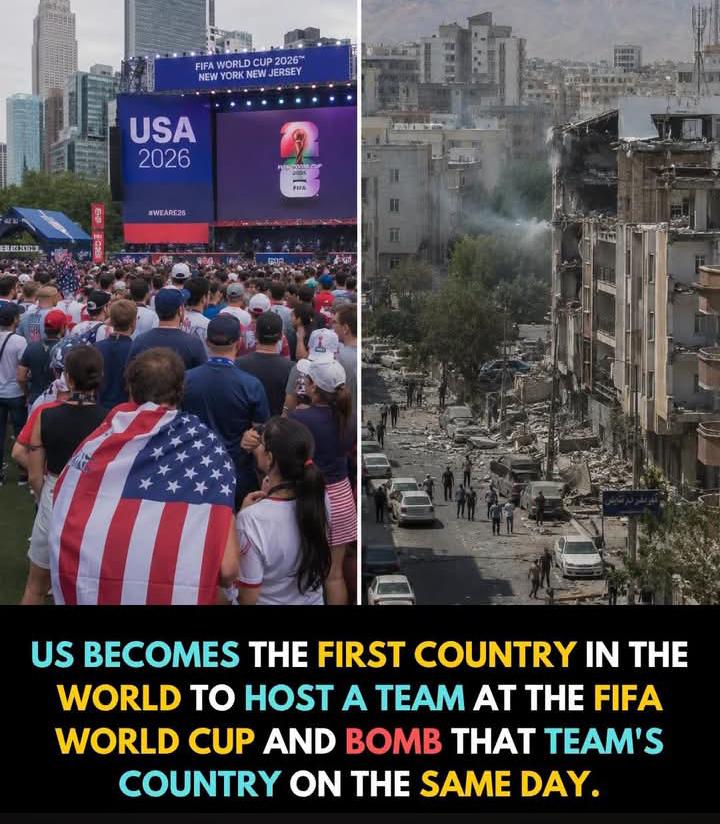
The viral line practically wrote itself: the U.S. became a World Cup host while bombing a country whose team was competing in the tournament. Several reports have described the broader U.S. hosting of Iran during wartime as unprecedented in World Cup history, though FIFA itself has not issued a formal “first ever” statistic for the same-day bombing claim. Anadolu reported earlier in June that, never before, had a World Cup host been in active war or just emerging from one with another participating country.
A World Cup night with a war headline attached
The football part was simple enough on paper. Iran was drawn into Group G with Belgium, Egypt, and New Zealand. Its schedule sent the team to Los Angeles for matches against New Zealand and Belgium, then to Seattle for the game against Egypt. Sky Sports listed Iran’s results as a 2–2 draw with New Zealand, a 0–0 draw with Belgium, and a 1–1 draw with Egypt.
But nothing around Iran’s World Cup was simple.
The Egypt match was scheduled for June 26 in Seattle local time, while FIFA’s match listing showed kickoff as June 27 in UTC time. That time-zone wrinkle matters because the same-day claim rests on the U.S. calendar date: June 26. Lumen Field also listed Egypt vs. Iran for June 26, 2026.
Then came the other half of the split-screen. CENTCOM said the June 26 strikes were a “powerful response” to the previous day’s attack on the M/V Ever Lovely, a Singapore-flagged cargo ship exiting the Strait of Hormuz. The command said Iran’s conduct “clearly violated the ceasefire” and undermined freedom of navigation.
Vice President JD Vance put the administration’s message even more bluntly, writing that Iran had signed a ceasefire and that the U.S. had honored it. “Violence will be met with violence,” he said.
So yes, the sentence sounds like internet exaggeration. But the timeline is real: U.S. strikes on Iran were confirmed on June 26, and Iran played a World Cup match in Seattle that same date in local time.
Iran’s tournament was never just about football
Long before kickoff in Seattle, Iran’s presence at the World Cup had already become one of the tournament’s most politically charged stories.
FIFA president Gianni Infantino insisted in March that Iran would compete, saying Iran “will be at the World Cup” and that its matches would be played according to the draw. He also said FIFA wanted teams to compete in “a spirit of fair play and mutual respect.”
That sounded nice. The reality was messier.
Iran had sought to move its matches away from the United States, with Mexico floated as an alternative. FIFA rejected that route, keeping the matches in U.S. cities. Anadolu reported that Iran had argued security must be guaranteed under FIFA rules and had pushed for assurances before agreeing to participate.
The team’s logistics became part of the story. Reports said Iran’s training base was switched from Arizona to Tijuana, Mexico, and that the team traveled into the U.S. for matches before returning to Mexico. The Guardian reported that the team would travel to Los Angeles on matchday and return to Mexico immediately afterward to avoid staying overnight in the U.S.
After Iran’s draw with Egypt, head coach Amir Ghalenoei did not hide his frustration. He said the host country had treated Iran “very unfairly” and urged FIFA not to allow future hosts to treat teams that way. He also praised his players, saying he was proud of what they had done despite the obstacles.
Captain Mehdi Taremi was just as direct. He called the situation a “disaster World Cup” from Iran’s perspective and questioned how FIFA could allow key logistical problems to continue through the group stage.
By the time Iran left the tournament, the mood had soured further. Iran’s football federation accused U.S. officials of “mistreatment and lies” after Homeland Security Secretary Markwayne Mullin said he was glad Iran was done and not coming back.
Why this moment is bigger than one match

The World Cup loves its slogans. Unity. Joy. Global friendship. One ball, one planet, one very expensive ticketing system.
But June 26 exposed the awkward truth that football does not float above politics. Sometimes it lands right in the middle of it.
This was not simply a strange sports footnote. It was a reminder that the 2026 World Cup is being played across three countries, including one deeply involved in a live and fragile conflict with a participating nation. Research described Iran as the first country in World Cup history to compete on the soil of a host nation with which it was at war. Political scientist Jules Boykoff called it “the most politically combustible World Cup ever.”
That does not erase the football. Iran still played. Egypt still fought for qualification. Fans still filled seats, shouted, groaned, checked VAR, argued about offside, and lived through the regular chaos of tournament football.
But the surrounding context made every normal football image feel surreal. A national anthem. A corner kick. A stoppage-time chance. A team bus leaving for the airport. And somewhere in the same news cycle, military statements about strikes, drones, radar sites, and ceasefire violations.
The safest way to write the history is this: on June 26, 2026, the United States hosted Iran’s World Cup match in Seattle on the same day U.S. forces confirmed strikes inside Iran. That is verified. The claim that no country has ever done exactly this before is widely reported as unprecedented, but it should be framed carefully unless FIFA or a formal historical body confirms it.
Still, even with that caution, the moment stands out. The World Cup is meant to pause the world’s arguments. This time, the arguments followed the teams all the way to the stadium.