America’s Most Expensive Neighborhood Is Facing a Financial Collapse as $500 Million Malibu Project Hits Trouble
Imagine spending millions of dollars building what you believe will become one of America’s most exclusive neighborhoods, only to find yourself fighting over debt, struggling to sell the homes, and dealing with bankruptcy proceedings. That is the situation surrounding The Case, a luxury development overlooking the Pacific Ocean in Malibu, California.
The five-home development was designed to attract some of the country’s wealthiest buyers. Its modern architecture, ocean views, and private setting were meant to set it apart in Malibu’s already expensive real estate market. But the ambitious project is now facing serious financial and legal problems.
What was supposed to be a luxury showcase has become a complicated dispute involving its developer, financial partners, unsold properties, and millions of dollars in contested debt.
A $500 Million Dream Built on 24 Acres
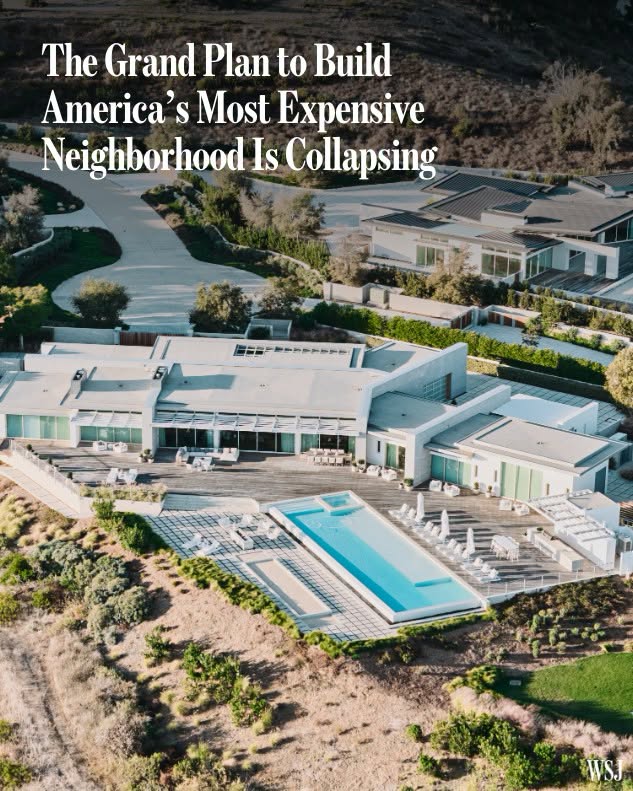
Luxury home designer and developer Scott Gillen created the development, known as The Case. Located on approximately 24 acres of Malibu’s coastline, the gated community contains five large contemporary homes overlooking the Pacific Ocean.
Gillen purchased the land in 2017 for a reported $50 million. At the time, the purchase was considered a record price for undeveloped land in Malibu.
His vision was to create something different from the typical luxury neighborhood. Rather than building five identical mansions, he gave each property its own architectural identity. The homes include The Cantilever House, The Butterfly House, The Edge, The Flat House, and The Glass Tunnel.
The properties were designed with expansive windows, modern finishes, and layouts intended to make the most of their coastal surroundings.
In 2023, Architectural Digest reported that the homes were being marketed for between $70 million and $115 million each. The development was promoted as a potential contender for America’s most expensive neighborhood.
However, an important detail is behind the $500 million headline. The figure refers to the ambitious combined sales target for the five properties, not the price of an individual house.
Only One Home Has Completed a Sale
Luxury properties can take time to sell, especially when their asking prices reach tens of millions of dollars. But The Case has faced a particularly difficult sales journey.
One of its homes, The Edge, eventually sold for $61 million in July 2024. That was still an enormous transaction, but the property had originally been offered for $75 million.
The remaining homes have had a much harder time finding buyers.
By late October 2026, The Wall Street Journal reported that four of the five properties remained unsold. The Flat House reportedly entered a contract in 2022, but a contract alone does not mean a sale was completed.
The Butterfly House has also attracted attention because of its changing price history. It was previously marketed for approximately $95 million in 2023. In September 2026, a bankruptcy notice proposed selling the property for $55 million.
That proposed figure is not proof that the transaction was completed. Still, it illustrates the challenges facing a development built around exceptionally high asking prices.
Bankruptcy and a Dispute Over Millions
The financial problems worsened in 2026 when entities connected to the development entered Chapter 11 bankruptcy proceedings.
One of the companies involved, 600 Spring, LLC, became the subject of a bankruptcy case in California. A September 1 court notice proposed selling the property at 24168 Case Court for $55 million.
The proposed transaction was intended to take place through bankruptcy proceedings. Interestingly, the notice also stated that Scott Gillen and his company, Unvarnished, would remain responsible for developing, designing, and completing the property.
However, the financial situation is complicated by a disagreement between Gillen and his financial partner, Barry Shy.
Shy’s side reportedly claims that a company provided a $260 million promissory note in 2021. The outstanding principal and total amount allegedly owed have become points of disagreement.
Reports describe Shy’s side as claiming more than $240 million, including interest, while Gillen has reportedly asserted that about $89 million in principal remains outstanding.
These figures represent competing claims, not a final court determination. Neither should be treated as an established amount that Gillen or the development legally owes.
The disagreement has also raised questions about who should control the project’s future and who is responsible for its financial difficulties.
Did Ego Get in the Way?
One of the most memorable comments about the development came from real estate agent Tracy Tutor, who worked with Gillen on sales in 2019.
Speaking to The Wall Street Journal, Tutor acknowledged that the original concept had potential but suggested that the developer’s personality became part of the problem.
“The idea was right,” she said. “It was a beautiful piece of land in a great location. Ego just got in the way.”
Her comments came amid criticism of Gillen’s approach to selling the homes, including ambitious pricing and his involvement in the sales process.
For a development targeting extremely wealthy buyers, presentation and pricing matter. Even a spectacular property can struggle if potential purchasers do not believe the asking price reflects its value.
The criticism does not establish that Gillen’s personality caused the bankruptcy. However, it raises an interesting question about what happens when a developer’s personal vision becomes closely tied to a major financial investment.
Sometimes, the same confidence that helps someone create an ambitious project can make it difficult to adjust when the market responds differently than expected.
Are the Mansions Actually Falling Apart?
The word “collapse” in the headlines may suggest that the expensive homes are physically falling apart. But the available evidence points mainly to financial and legal trouble, not a confirmed structural disaster.
Local reporting by KBUU/Malibu.FM in October 2026 described construction as having ground to a halt. It also reported that some of the unfinished properties appeared neglected, with construction materials exposed to dirt.
However, no independent engineering assessment has established that the buildings are structurally failing.
Genuine environmental considerations surround the development. Official City of Malibu environmental documents identify potential concerns involving slope stability, soil erosion, drainage, wastewater systems, and wildfire protection.
The project was subject to requirements involving foundations, grading, drainage, and slope maintenance.
These are important issues for any coastal development. But environmental risks and required safety measures do not prove the bluff is currently collapsing or that the homes are unsafe.
There is also no verified evidence that the properties have been condemned or ordered demolished.
A Public Skatepark Added Another Layer of Controversy

The development has also been connected to a separate disagreement involving a neighboring public skatepark.
According to The Malibu Times, Gillen donated land and $1 million toward the skatepark project. However, he later challenged aspects of its design, raising concerns about noise and the possible impact on the luxury homes.
The dispute created tension between private property interests and the community’s desire for a public recreational space.
The permanent skatepark eventually opened in June 2026.
Although the disagreement attracted attention, no evidence shows it caused the development’s bankruptcy.
What Happens to The Case Now?
The future of The Case remains uncertain. The proposed $55 million bankruptcy sale could provide a route toward resolving at least part of the financial situation, but its approval and completion have not been verified in the available records.
Other possible outcomes include further property sales, refinancing, restructuring, or continued legal disputes between the parties involved.
For now, the development stands as an example of how even a multimillion-dollar real estate vision can run into trouble when ambitious pricing, financing disagreements, and slow sales collide.
The homes may still have spectacular views and impressive architecture. But selling luxury properties is about more than building something beautiful.
And as Tracy Tutor’s comment suggests, sometimes the biggest challenge is not the land, the design, or even the price tag. It is knowing when to adjust the original vision.