British Islamic Scholar Abu Ibraheem Sparks Debate After Saying Even Women’s Eyes Can Draw Male Attention
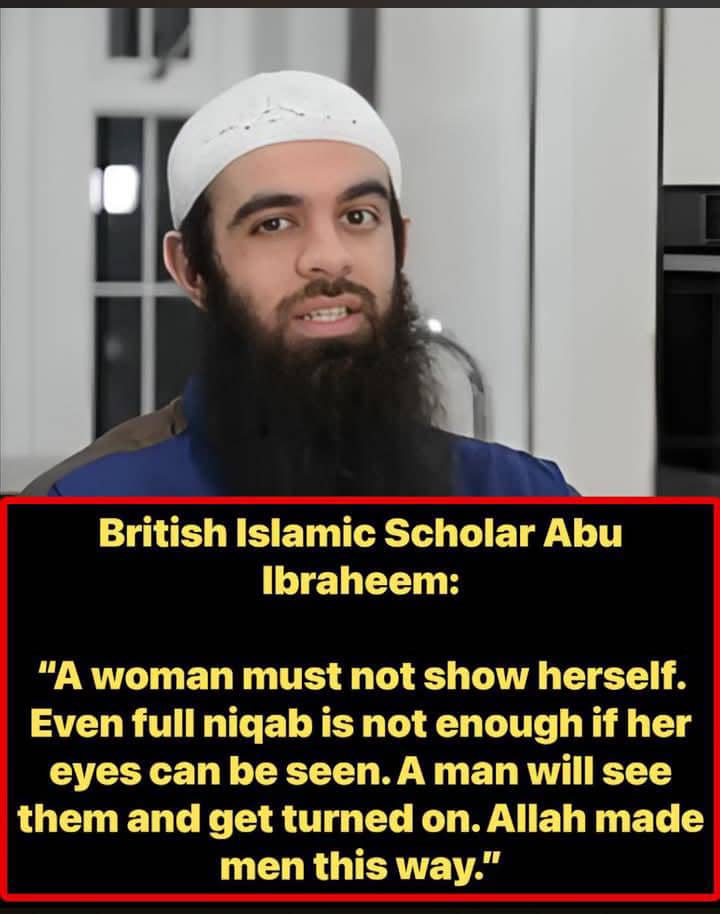
A woman covers her hair, body and face, yet somehow the discussion still lands on the tiny opening that allows her to see. That is the striking argument circulating online in a clip attributed to British Islamic speaker Abu Ibraheem Hussnayn.
Posts sharing the footage quote Hussnayn as saying, “A woman must not show herself,” before arguing that “even full niqab is not enough” when a woman’s eyes remain visible. He reportedly adds that men could become sexually attracted by seeing her eyes because “Allah made men this way.”
Hussnayn is an established online preacher whose official YouTube channel describes itself as his only official account and contains hundreds of lectures on marriage, modesty, faith and family life. The statement should therefore be described as attributed to him through a circulating clip, rather than presented as a fully authenticated transcript with confirmed context.
The Argument Takes Modesty to Its Narrowest Opening
The niqab is already one of the most covering forms of Islamic clothing. Unlike the hijab, which commonly leaves the face visible, the niqab covers the face while usually leaving a narrow opening around the eyes.
The circulating statement appears to go further. Its message is that covering the hair, body shape, and face may still be insufficient because a woman’s eyes could attract male attention. The responsibility for preventing that attraction is consequently placed almost entirely on the woman.
That is where the argument becomes much larger than a clothing discussion. It suggests that male desire is so automatic that women must continuously reduce their visibility to manage it. Taken to its logical end, modesty stops being about appropriate dress and begins looking like disappearance.
The quotation about men being created this way also raises a difficult question. Attraction may be natural, but religious rules frequently exist precisely because human beings are expected to control natural impulses. Hunger does not remove rules about food, anger does not excuse violence, and attraction does not automatically remove personal responsibility.
Islamic Scholarship Does Not Speak With One Voice
Anyone treating this argument as the settled Islamic position would be skipping centuries of disagreement. Muslim jurists have long debated whether women must cover their faces, but even scholars who support compulsory face covering generally allow the eyes to remain visible.
One conservative ruling published by Islam Question and Answer states plainly that “it is permissible for a woman to show her eyes” so that she can see. The same ruling quotes Saudi scholar Salih Al Fawzan saying that when a face veil leaves only the eyes uncovered, “that is acceptable.”
Another detailed ruling from the same platform permits a narrow eye opening provided it does not expose the cheeks or a large area around the eyes. It concludes that a woman may wear such a niqab whether she is walking, sitting in a vehicle or otherwise going about ordinary life.
Other scholars take a less restrictive position. Islamic jurisprudence includes a widely held view among Hanafi, Maliki and Shafi’i scholars that a woman’s face and hands are not parts of the body that must always be concealed from unrelated men. The Hanbali tradition is more likely to require face covering, although opinions and conditions still vary within the schools.
This difference matters because “Islam says” is often used as though one microphone speaks for nearly two billion Muslims. It does not. A preacher may sincerely present the interpretation he follows, but honesty requires acknowledging that respected Muslim scholars have reached different conclusions.
The Quran Also Gives Men an Instruction

The most obvious missing piece in the circulating statement is the responsibility assigned to men. Before the Quran addresses women’s dress and adornment in Surah An Nur, it tells believing men to “lower their gaze and guard their chastity,” adding that this conduct is purer for them.
The following verse tells believing women to lower their gaze, guard their chastity, and avoid displaying adornment beyond what ordinarily appears. It also instructs them to draw their veils over their chests. The passage therefore addresses modesty as a shared discipline, not a job assigned exclusively to women.
Another frequently cited verse, Surah Al Ahzab 33:59, tells believing women to draw their outer garments over their bodies so they may be recognized and not harassed. Classical commentators disagree over whether this requires covering the face, with some interpretations allowing one eye to remain visible and others allowing the face and hands.
That makes the eye covering claim one interpretation at the far stricter end of an already complicated debate. It is not the only Islamic position, and it may be stricter than the rulings of scholars who already consider the niqab obligatory.
The deeper issue is not whether Muslim women should be allowed to wear hijab, niqab or an additional eye veil. Religious freedom includes the right of women to adopt conservative dress when that decision is genuinely theirs. The problem begins when one preacher’s strictest reading is presented as a universal requirement and male self-control quietly disappears from the conversation.
A woman’s eyes may communicate warmth, caution, joy, or fear. Declaring them inherently provocative says more about how the observer has been taught to view women than it does about the woman simply trying to see where she is going.