Court Orders Trump’s Name Removed From Kennedy Center as Officials Warn of ‘Hundreds of Millions’ in Permanent Losses
We are now witnessing a legal and institutional confrontation centered on one of America’s most prominent cultural landmarks, the John F. Kennedy Center for the Performing Arts. What began as a dispute over branding and naming rights has escalated into a broader conflict involving federal courts, congressional authority, donor expectations, and claims of potentially irreversible financial damage.
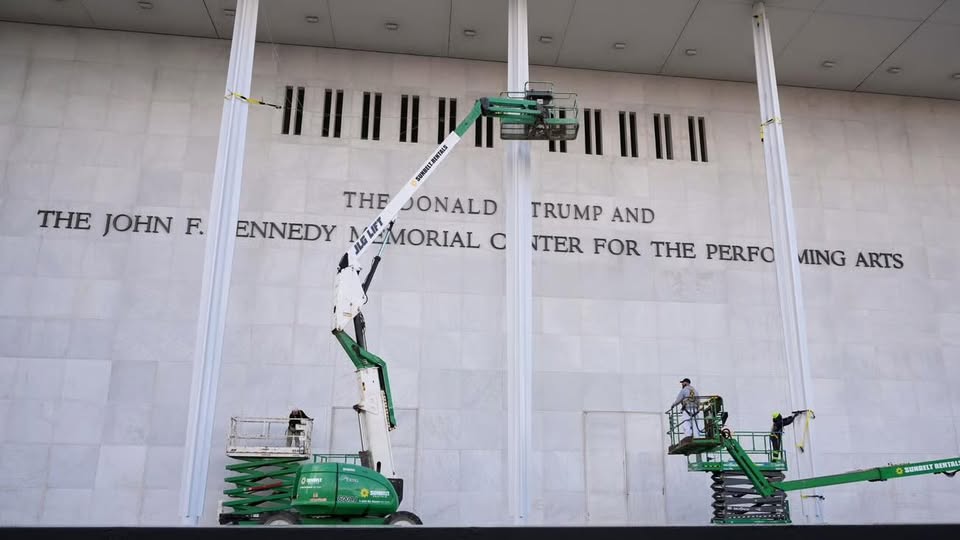
At the center of the controversy is a court-ordered directive requiring the removal of Donald Trump’s name from Kennedy Center branding materials, signage, digital platforms, and internal communications. The decision has already been implemented across physical and digital assets, but the financial and legal consequences are only beginning to unfold. The Kennedy Center has now warned in filings that the fallout could amount to “hundreds of millions of dollars in losses” that may never be recovered, raising urgent questions about governance, donor intent, and the limits of institutional rebranding tied to political figures.
Why the Kennedy Center Naming Dispute Became a Constitutional Flashpoint
The legal foundation of the dispute rests on a surprisingly rigid statutory reality: the Kennedy Center is not a privately named venue. It is a congressionally designated national cultural institution established as a living memorial to President John F. Kennedy. Federal law requires the institution to be referred to as the John F. Kennedy Center for the Performing Arts, and that statutory language became the key reason a federal court rejected efforts to rebrand it under a Trump-aligned board decision.
The court ruled that naming authority does not belong to the board of trustees, but to Congress itself. That distinction transformed what could have been a symbolic branding initiative into a constitutional question about separation of powers and institutional governance. When the Trump-aligned board moved to incorporate the former president’s name into the institution’s identity, it triggered immediate legal opposition. Critics argued that no board, regardless of appointment structure, has the authority to override a congressional designation embedded in federal law. The court ultimately agreed.
“Hundreds of Millions That May Never Be Recovered”
The most alarming dimension of the dispute is not legal—it is financial. The Kennedy Center has warned that removing Trump’s name could destabilize donor relationships and jeopardize funding pipelines tied to naming visibility and branding expectations. According to court filings, some donors allegedly contributed under the assumption that Trump’s name would remain prominently associated with the institution. The organization has argued that reversing that expectation could trigger: Loss of pledged donations, Withdrawal of committed capital for renovation projects, Potential refund obligations for prior contributions, and long-term damage to fundraising credibility. In internal assessments, the center has suggested that the financial impact could reach hundreds of millions of dollars, particularly if construction and modernization projects lose donor backing or require restructuring.
The most severe claim is that some of these losses would be permanent and unrecoverable, especially if donor confidence collapses or if funding commitments were explicitly tied to naming rights. This transforms the dispute from a branding correction into a potential fiscal crisis for one of the nation’s most important cultural institutions.
No Immediate Evidence of Irreparable Harm
Despite the Kennedy Center’s warnings, the federal court rejected arguments that immediate financial harm justified delaying enforcement of the naming order. The judge ruled that the institution failed to demonstrate concrete, irreversible damage that would occur before compliance. The court also noted that portions of Trump-related branding had already been removed from digital platforms, weakening claims that full implementation would create sudden financial disruption.
The ruling suggests a key judicial interpretation: reputational or fundraising uncertainty does not automatically qualify as irreparable harm when weighed against statutory naming authority. In effect, the court prioritized legal compliance over speculative financial risk.
How Trump’s Influence Reshaped the Kennedy Center Governance Structure
The origins of the dispute trace back to a broader restructuring of the Kennedy Center’s leadership and governance model following Trump’s return to political power. The administration made sweeping changes to the board of trustees, removing former members and appointing new members aligned with its policy direction. This shift allowed the board to pursue a series of institutional reforms, including programming changes and branding revisions.
The most controversial step came when the board voted to incorporate Trump’s name into the institution’s identity, effectively attempting to rebrand the center as the “Trump Kennedy Center.” That decision immediately raised legal questions about whether a federally established memorial could be renamed without congressional approval. The court ultimately answered that question decisively: it cannot.
The Signage Removal and Institutional Reset
Following the court ruling, Kennedy Center leadership confirmed that Trump’s name has been removed from:
- Exterior signage
- Website branding
- Email signatures
- Official letterhead
- Printed brochures
- Internal administrative documents
The rapid rollout reflects court-imposed deadlines requiring full compliance across both physical and digital systems. This widespread removal has effectively reset the institution’s public identity, restoring its federally mandated name while simultaneously leaving behind a complex legal and financial aftermath.
Renovation Plans Add Another Layer of Political and Financial Risk
Beyond naming rights, the Kennedy Center dispute is deeply intertwined with large-scale renovation and modernization plans. Federal funding allocations exceeding $250 million have been tied to infrastructure upgrades, safety improvements, and performance venue restoration. These funds were part of broader legislative packages that supported capital improvements at the institution. However, renovation plans became politically controversial when they were linked to leadership changes and proposed temporary closures.
A court ruling later blocked a planned two-year shutdown, citing concerns about governance authority and operational justification. That decision ensured that programming would continue, but it also complicated long-term construction scheduling and financial planning. The result is a fragmented renovation strategy shaped by legal constraints rather than purely operational needs.
Donor Confidence, Artistic Programming, and Institutional Stability at Risk
The Kennedy Center is not just a building. It is a national cultural ecosystem dependent on three fragile pillars: Donor funding, Artistic programming partnerships. Each of these pillars is now under pressure. Donors face uncertainty over naming rights and branding stability. Artists are evaluating whether the institution’s political environment will affect programming independence.
Audiences are responding to perceived instability in leadership direction. Even minor disruptions in perception can have outsized consequences in cultural institutions where long-term planning is essential. Touring productions, orchestras, festivals, and international partnerships often require commitments made years in advance. Legal uncertainty introduces hesitation—and hesitation is costly.
What Happens Next in the Legal and Financial Battle
The case is now moving through the appeals process, where both sides are preparing for a deeper constitutional and financial argument.
The Kennedy Center and its supporters are expected to emphasize:
- Financial harm from donor withdrawal
- Operational disruption from enforced branding changes
- Administrative burden of compliance
Opponents are expected to focus on:
- Congressional authority over naming rights
- Legal limits of board decision-making
- Preservation of federal institutional identity. While an immediate stay was denied, the appellate review will ultimately determine whether the lower court’s interpretation stands or whether the naming dispute reopens.
A Cultural Institution Caught Between Law, Politics, and Money
The Kennedy Center now finds itself in an unusually precarious position. Every possible outcome carries consequences: If the ruling is upheld, the institution stabilizes legally but risks donor backlash; if overturned, branding conflicts may reignite public and political criticism; if delayed further, financial uncertainty may deepen; if renovations stall, infrastructure needs remain unresolved. What was once a symbolic naming dispute has evolved into a structural challenge affecting governance, funding, and public trust.
At its core, the battle over Trump’s name at the Kennedy Center is no longer about signage. It is about who controls national cultural identity, how far political influence can extend into public institutions, and what happens when legal authority collides with financial expectation. And as the case moves forward, one reality is becoming increasingly clear: the cost of this dispute may extend far beyond any name on a building.